Quantum computers produce probabilistic outcomes, so useful answers require repeated trials and statistical estimates.
Quantum computers produce probabilistic outcomes, so useful answers require repeated trials and statistical estimates.
More from this video
See all →Nobody knows when quantum computers will break cryptography. Estimates range from roughly five…
Quantum superposition does not require parallel realities or alternate universes to explain it.
A trapped-ion quantum computer holds a charged atom in ultra-high vacuum and low temperatures,…
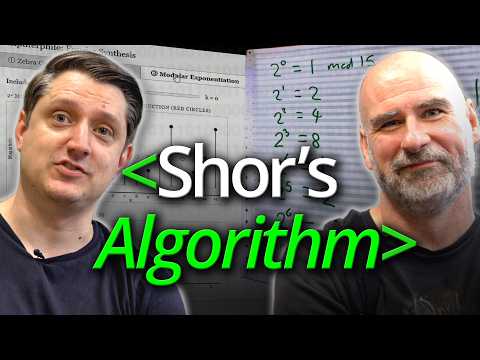
Shor’s algorithm attacks RSA by finding a modular function’s period instead of factoring directly.
Shor’s algorithm reframes integer factorization as period finding, a problem quantum computers…
A quantum state can be pictured as a rotating phasor whose rotation rate sets its frequency and…
A precisely timed microwave pulse controls the odds of finding a quantum system in one state or…
Quantum energy follows E = hF, so higher-energy states oscillate faster than lower-energy states.
Don't lose this one
A free account saves insights like this to your Boards, and Korva resurfaces them so you actually remember.