Korva is a scroll of the internet’s best ideas.
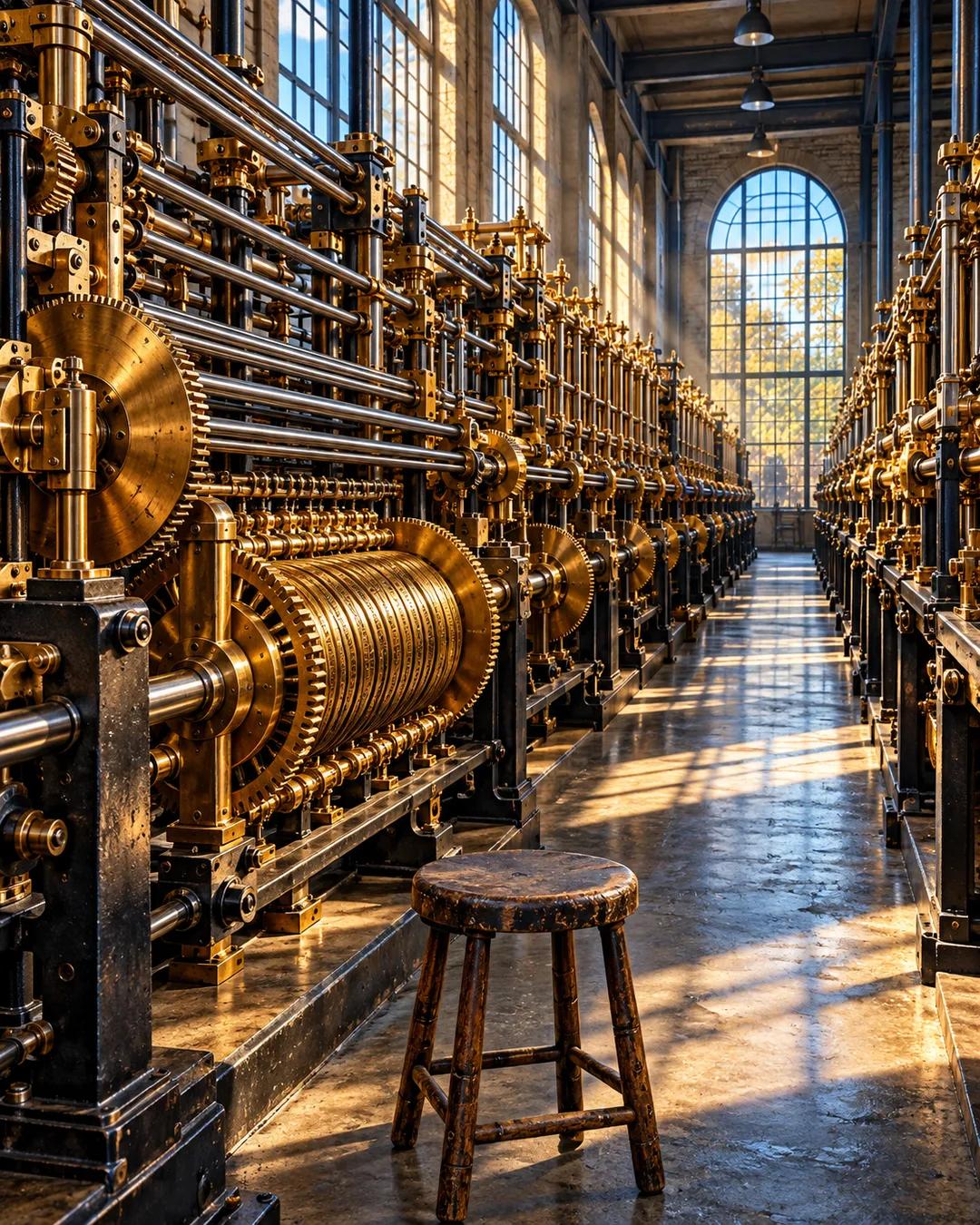
30 weeks of spinning gears

Shannon spotted the job in the spring of 1936, typed on a postcard posted to an engineering bulletin board: come to MIT and run the largest analog computer in the world. The post was master's student and assistant on the differential analyzer, and it suited a young man who found equal joy in equations and construction. He pushed hard for it and got it. Vannevar Bush, who ran the lab, had a keen eye for him.
The differential analyzer could work away at a problem for days and nights on end before it ground to a halt. One problem, measuring the effects of the Earth's magnetic field on cosmic rays, took 30 weeks. By brute force it solved equations so complex that attacking them with human brain power would have been pointless.
Less than a decade after Shannon's paper, the great analog machine was effectively obsolete. Digital computers driven by thousands of logic gates did the same work a thousand times faster, answering questions in real time. Their design descended directly from Shannon's discovery.
How did gears solve differential equations?
Vannevar Bush's differential analyzer, finished at MIT in 1931, used rotating shafts to stand for the quantities in an equation. Its key part was the wheel-and-disc integrator, in which a small wheel rests on a spinning disc and turns at a speed set by its distance from the disc's center. That performs integration mechanically. Operators set up a problem by linking shafts and integrators with long rods, and a pen plotted the answer as a curve on paper.
Why did switching circuits replace analog machines?
Analog machines represent numbers as physical quantities, so every gear and wheel adds small errors that pile up. Shannon's 1937 master's thesis showed that on-off switches could carry out Boolean logic, which let a machine work in exact digits. ENIAC, completed in 1945, was built from thousands of vacuum tubes switching on and off. Transistors and then integrated circuits later shrank those switches to microscopic size.
How do cosmic rays meet Earth's magnetic field?
Cosmic rays are mostly charged particles, such as protons, arriving from space. A magnetic field bends the path of a charged particle, so Earth's field steers many of them toward the poles and turns others away near the equator. Working out those paths means integrating equations for each particle's trajectory, and the MIT physicist Manuel Vallarta used Bush's analyzer for such calculations in the 1930s. The results helped explain why cosmic ray intensity varies with latitude.
More from Founders