Korva is a scroll of the internet’s best ideas.
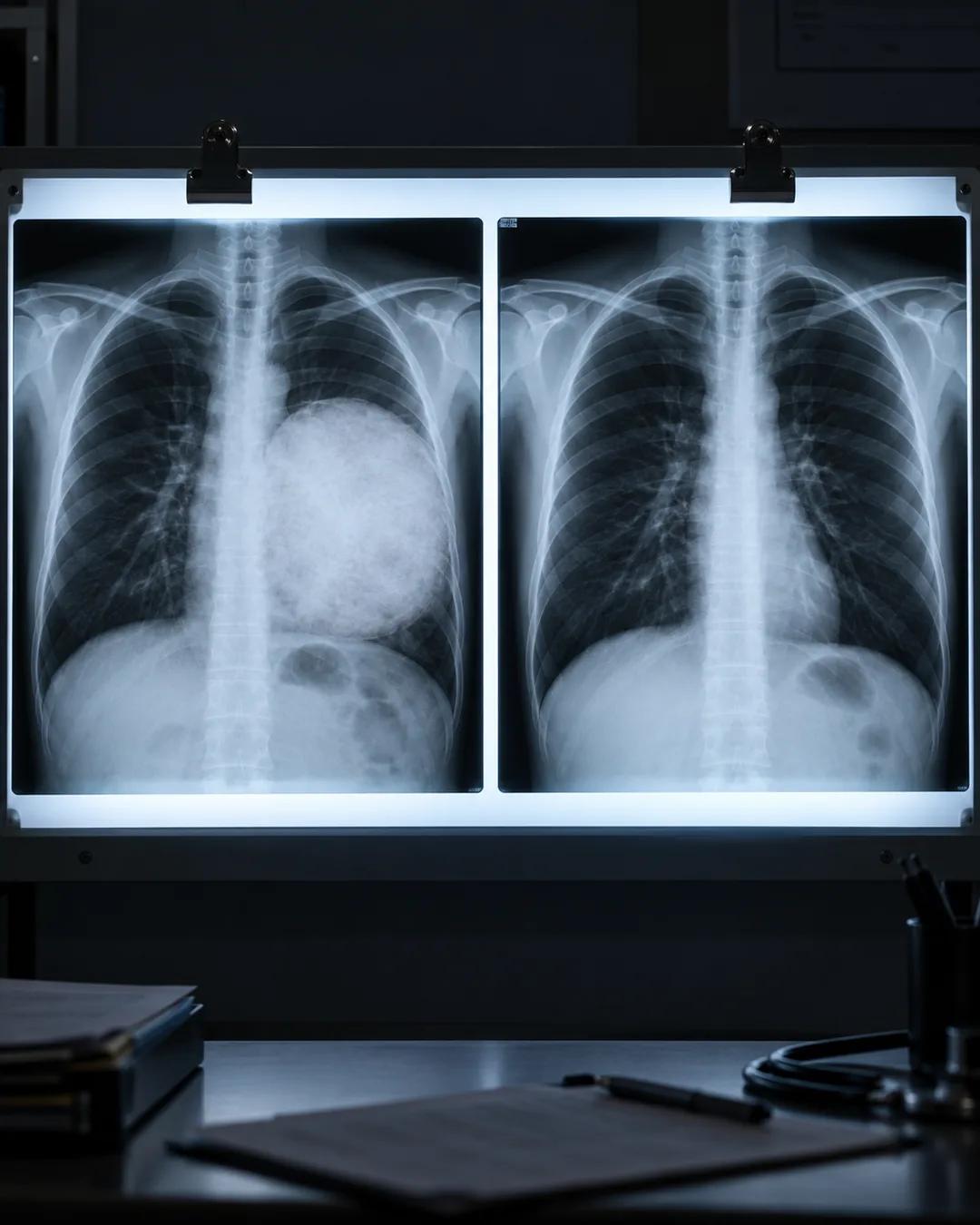
A 13 centimeter lung mass vanished

The shadow
The shadow turned up on a routine chest X-ray in 2005, while Brian was a patient at Clifton Perkins State Hospital. Doctors suspected lung cancer and wanted to treat it. Brian saw a chance to get out of the hospital through death and refused. The hospital fought him, and his psychiatrist ruled him not mentally competent for a decision this serious. He had no family or friends willing to act as a surrogate decision-maker, and his sister Kathy lived in Ohio.
Brian's case to the jury
Brian took the question to a jury and defended himself. He argued that a physical illness is a physical illness: anyone may decline a biopsy, and nothing can be done to a person without consent. Hospital staff testified to behavior they treated as proof of mental illness. One psychiatrist offered the time Brian stuffed his ears with toilet paper. Brian's explanation was that the nurses were talking in the hall, he couldn't get to sleep, he asked them again and again to stop, and he put toilet paper in his ears.
The mass vanishes
The judge declared a mistrial on a technicality, and the court gave Perkins temporary authority over his medical decisions. In the months after, a chest X-ray showed an even darker mark, a mass 13 centimeters wide. A biopsy couldn't establish whether it was definitely cancer. Then one day the mass vanished, and doctors called it spontaneous regression.
How can a tumor disappear on its own?
Doctors have documented spontaneous regression, the disappearance of a tumor without effective treatment, for well over a century. In the 1890s, the surgeon William Coley noticed that some sarcoma patients improved after severe bacterial infections, and he began injecting bacterial extracts, an early ancestor of immunotherapy. Proposed explanations today include an immune response that suddenly recognizes the tumor, infection, and hormonal changes. A 1966 book by Tilden Everson and Warren Cole gathered more than a hundred reported cases.
Why can a court override a patient's refusal?
The starting point in American law is that an adult may refuse treatment, a principle stated by Judge Benjamin Cardozo in a 1914 New York case, Schloendorff v. Society of New York Hospital. The exception turns on capacity, meaning whether a person can understand a choice and its consequences. Capacity is judged for each decision rather than for a person as a whole, so a psychiatric diagnosis alone does not settle it. When a court finds capacity lacking, it can appoint a decision-maker or authorize treatment itself.
Why are lung shadows on X-rays hard to read?
A chest X-ray flattens the whole chest into one image, so ribs, blood vessels, and the heart can overlap and hide or mimic a mass. A shadow can come from cancer, but also from infections such as tuberculosis, scar tissue, or benign growths. That is why a shadow usually leads to a CT scan or a biopsy. In the National Lung Screening Trial, reported in 2011, low-dose CT scans caught lung cancers that chest X-rays missed and lowered lung cancer deaths by about 20 percent.
More from Criminal