Korva is a scroll of the internet’s best ideas.
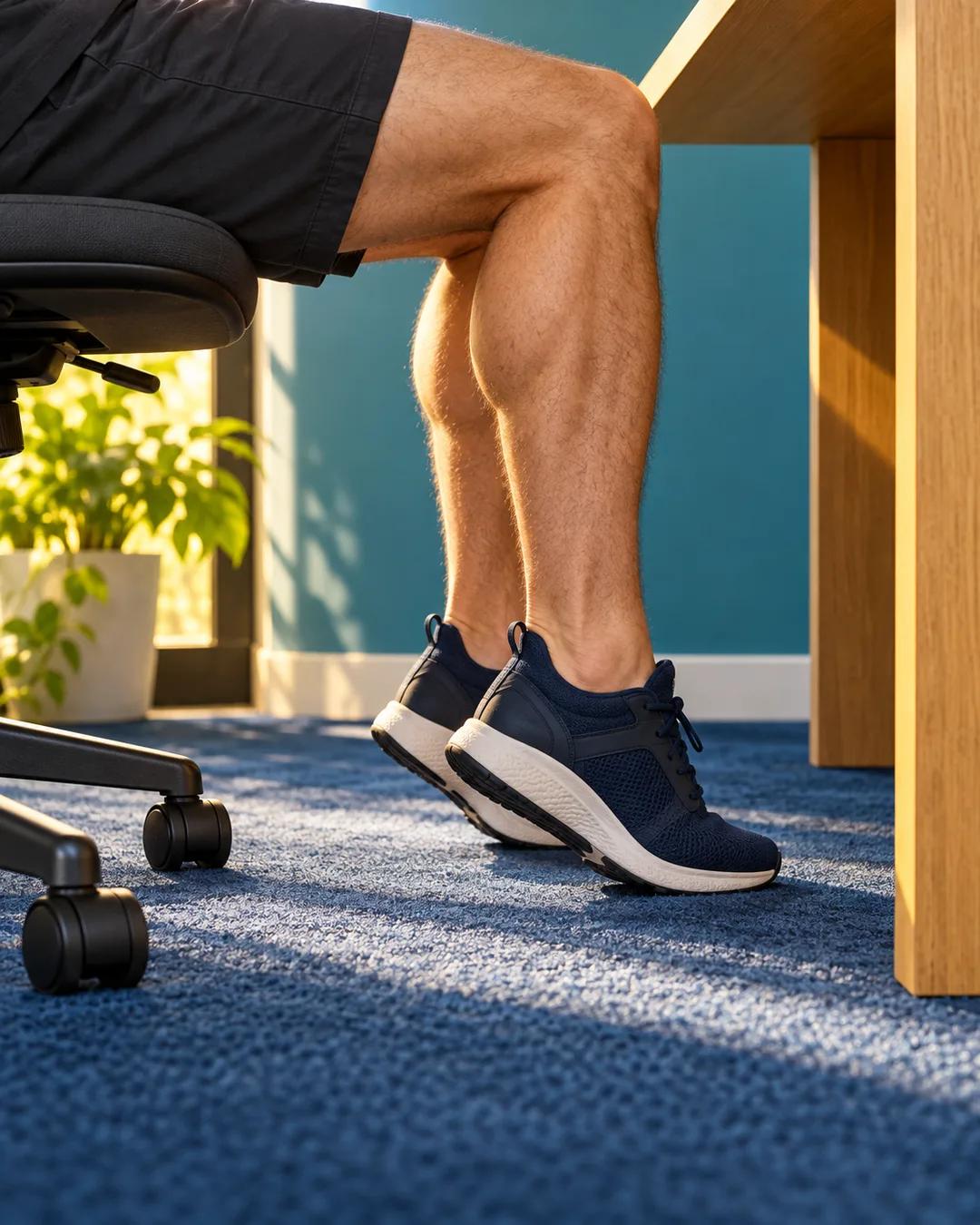

In one study, people did what researchers called soleus push-ups: unweighted seated calf raises, repeated while sitting. Blood glucose regulation improved powerfully, and the peaks after eating were buffered.
The soleus is a slow twitch muscle, and the low-level repeated contractions of walking seem to make it an unsuspected furnace for glucose. Smaller peaks mean less insulin secreted and fewer energy crashes, and over time metabolic health can be better or at least cannot get worse.
A comparison study had people either walk after meals or do ten air squats every forty-five minutes, and the two looked comparable, with the squats perhaps ahead. Knee bouncing counts as a mild version of the same contractions.
Why is the soleus so hard to tire?
The soleus is made up of roughly 80 percent slow-twitch fibers, according to muscle biopsy studies. Those fibers are packed with mitochondria and the oxygen-carrying protein myoglobin. They resist fatigue and burn fat and glucose at a steady pace. The soleus keeps people upright on their feet for hours.
How can muscle take up glucose without insulin?
Contracting muscle moves glucose transporters called GLUT4 to the cell surface through a pathway that does not depend on insulin. Insulin triggers the same transporters by a separate route. Because the two routes are independent, the contraction pathway keeps working in people whose cells respond poorly to insulin. Research on exercise and glucose uptake has documented this for decades.
What else does the calf muscle do?
The calf works as a second pump for the circulatory system. Each contraction squeezes the deep veins of the leg, and one-way valves push blood back toward the heart against gravity. The soleus holds large venous sinuses that empty during contraction. Physiologists often call the calf the peripheral heart.
More from The Diary Of A CEO with Steven Bartlett