Korva is a scroll of the internet’s best ideas.
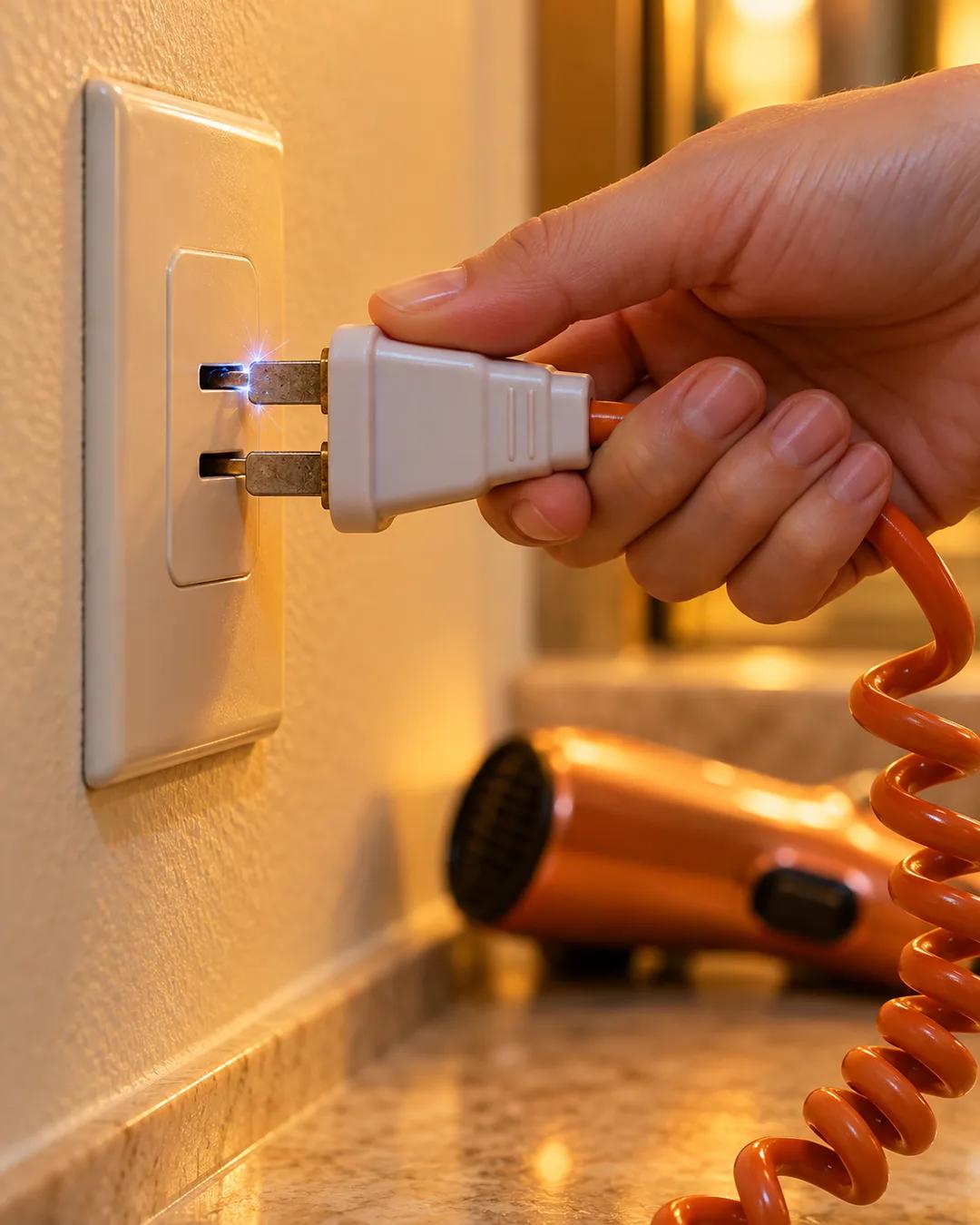
A collapsing magnetic field makes the spark

A 1 cm spark in air takes about 10,000 volts, and mains electricity is only around 120 to 240 volts. The extra voltage has to come from somewhere inside the appliance itself.
While the hair dryer runs, current flows through coils of wire, and that current creates a magnetic field. Pulling the plug cuts the current off suddenly, so the magnetic field rapidly drops to zero.
A coil responds to a sudden change in its magnetic field by compensating for it. As the field falls, it induces a voltage in the coil that tries to keep the current flowing. That voltage can climb high enough to ionize the air between the plug and the socket, and the glowing, ionized air is the spark you see.
Why does a faster cutoff make a bigger voltage?
The voltage across a coil equals its inductance multiplied by how quickly the current through it changes. Cutting the current to zero in a few microseconds is a far steeper change than letting it fade over a second. A coil with an inductance of just a few millihenries can therefore produce thousands of volts when a circuit is broken abruptly. This relationship is the standard inductor equation taught in introductory electronics courses.
How do car engines use this same effect?
A gasoline engine's ignition coil is built to exploit exactly this collapse. A 12 volt battery drives current through a primary winding, and the current is then interrupted at the right instant for each cylinder. The collapsing field induces a large voltage in a second winding with many more turns. That voltage reaches the tens of thousands of volts needed to jump the gap in a spark plug.
Why does air glow when a spark jumps?
A strong enough electric field pulls electrons off the nitrogen and oxygen molecules in air, which turns a thin channel of the gas into plasma. Once that channel forms, current can flow through it easily, which is why a spark is a sudden flash and not a slow leak. The light comes from the freed electrons recombining with molecules and from excited atoms releasing energy as they settle back down. The bluish-white color of small sparks reflects the emission of excited nitrogen.
Why do some plugged-in devices spark far less?
The size of the spark depends on how much energy is stored in the device's magnetic field. A motor or a heating element wound in coils stores a good amount, while a simple incandescent lamp has very little inductance and stores almost none. Many modern power supplies also include filtering components that absorb the surge when the circuit opens. Relay and switch makers add parts called snubbers for the same reason, to protect contacts from arcing.