Korva is a scroll of the internet’s best ideas.
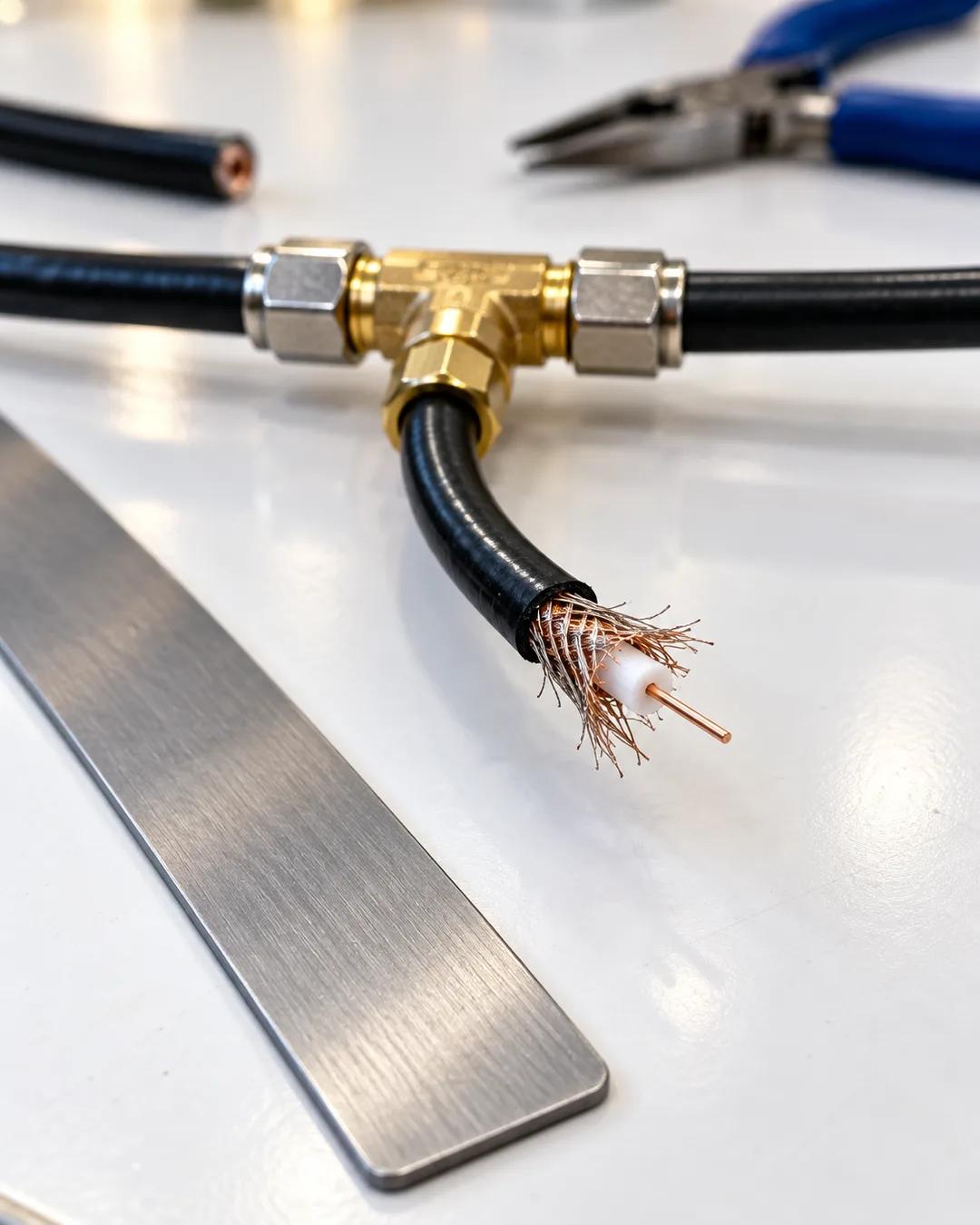
A dangling cable stops reflections

The rim of the chart
A line that ends in an open circuit or a short circuit sends the whole wave back, so both sit on the outer rim of the Smith chart, where the reflection is as big as it gets. Add a bit of line to that end and the point walks around the rim, one lap for every half wavelength, passing through every reactance there is. That means a length of transmission line can stand in for an inductor or a capacitor.
Building a stub
In the lab, a reactance of positive 1.8 in normalized terms had to be canceled, and the fix was a stub: a side branch of the same coaxial cable, with the inner wire and outer shield left unconnected at the far end. The rest of the circuit sees the impedance at the stub's input, and that depends on how long the stub is. Picture a little cove branching off a river: water runs in, bounces off the back wall, and flows out again, and the length of the cove sets the timing of that returning water.
Trimming to a match
Walking around the chart from the open-circuit point to 1.8 covers about 302 degrees, which works out to a stub of 77 millimeters. The chart repeats every half wavelength, so a longer stub reaches the same reactance. Starting with a longer stub and trimming it shorter, bit by bit, brought the line to a good match, and every reflection stopped with a break in the circuit and a dangling piece of cable.
Why does an open cable end reflect everything?
At an open end there is nowhere for current to go, so the current there must be zero. The incoming wave cannot deliver any energy to the end, so all of it turns around. The reflected current wave is flipped to cancel the incoming current at that point, while the voltage wave comes back with the same sign, which makes the voltage at the end twice the incoming value. A short circuit does the reverse, forcing the voltage to zero, and still sends the whole wave back.
Why does stub length change its impedance?
A wave entering the stub travels to the open end and reflects, then returns to the input after a round trip of twice the stub's length. The returning wave arrives with a phase shift set by that length, so it combines with the incoming wave in a different way for each length. An open stub shorter than a quarter wavelength behaves like a capacitor. One between a quarter and half a wavelength behaves like an inductor.
Why does the chart repeat every half wavelength?
The reflected wave travels to the load and back, so moving a distance along the line adds a phase shift for twice that distance. A half wavelength of movement therefore adds a full wavelength of travel, which is one complete 360 degree cycle of the wave. After a complete cycle the relationship between voltage and current is the same as before, so the impedance returns to its starting value. A line exactly a half wavelength long shows at its input the same impedance that sits at its far end.
More from Veritasium