Korva is a scroll of the internet’s best ideas.
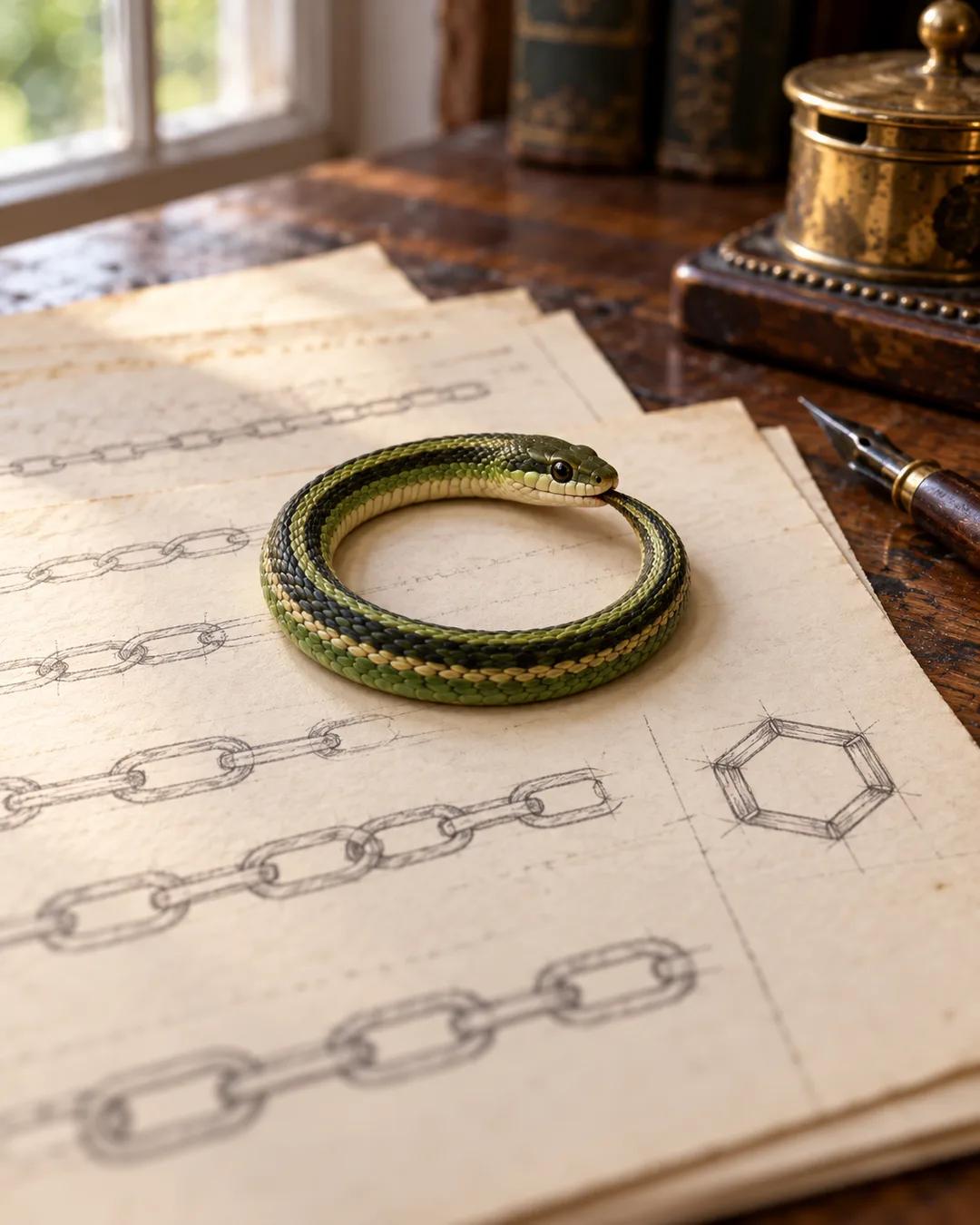
A dream snake solved benzene

Kekulé was a chemist in Germany in the mid-19th century, when every molecule was assumed to be arranged in a line. Benzene would not behave. The math did not add up for a linear shape, and the answer required thinking completely differently from everything he had been trained to do.
One night he slept and dreamed of the Ouroboros, the snake eating its own tail. When he woke, it was clear as day that the benzene molecule was a ring, a circular arrangement instead of a linear one, and he was right.
It is the example that turns up on nearly every list of solutions to waking-life problems that arrived in dreams.
Why was benzene's formula such a puzzle?
Michael Faraday isolated benzene in 1825, and chemists later found it has six carbon atoms and six hydrogen atoms. Carbon forms four bonds, so a straight chain of six carbons can hold fourteen hydrogens, far more than benzene has. Compounds with so few hydrogens for their carbons were usually highly reactive, yet benzene was unusually stable. Kekulé published his ring proposal in 1865.
Why is benzene's ring so stable?
Kekulé drew the ring with alternating single and double bonds. Later work showed the electrons are not fixed in those positions but spread evenly around the whole ring, an effect called delocalization. As a result all six carbon-carbon bonds in benzene have the same length, between that of a single bond and a double bond. Linus Pauling's resonance theory in the 1930s gave this picture its standard explanation.
How was the ring later confirmed?
In 1929, Kathleen Lonsdale used X-ray diffraction on crystals of hexamethylbenzene, a benzene relative with six methyl groups attached. Her analysis showed that the six-carbon ring is a flat hexagon with equal bond lengths. It was one of the earliest crystal structures worked out for an organic compound. The result matched the ring Kekulé had proposed more than sixty years earlier.
More from Stuff You Should Know