Korva is a scroll of the internet’s best ideas.

A muon's wobble counts every particle
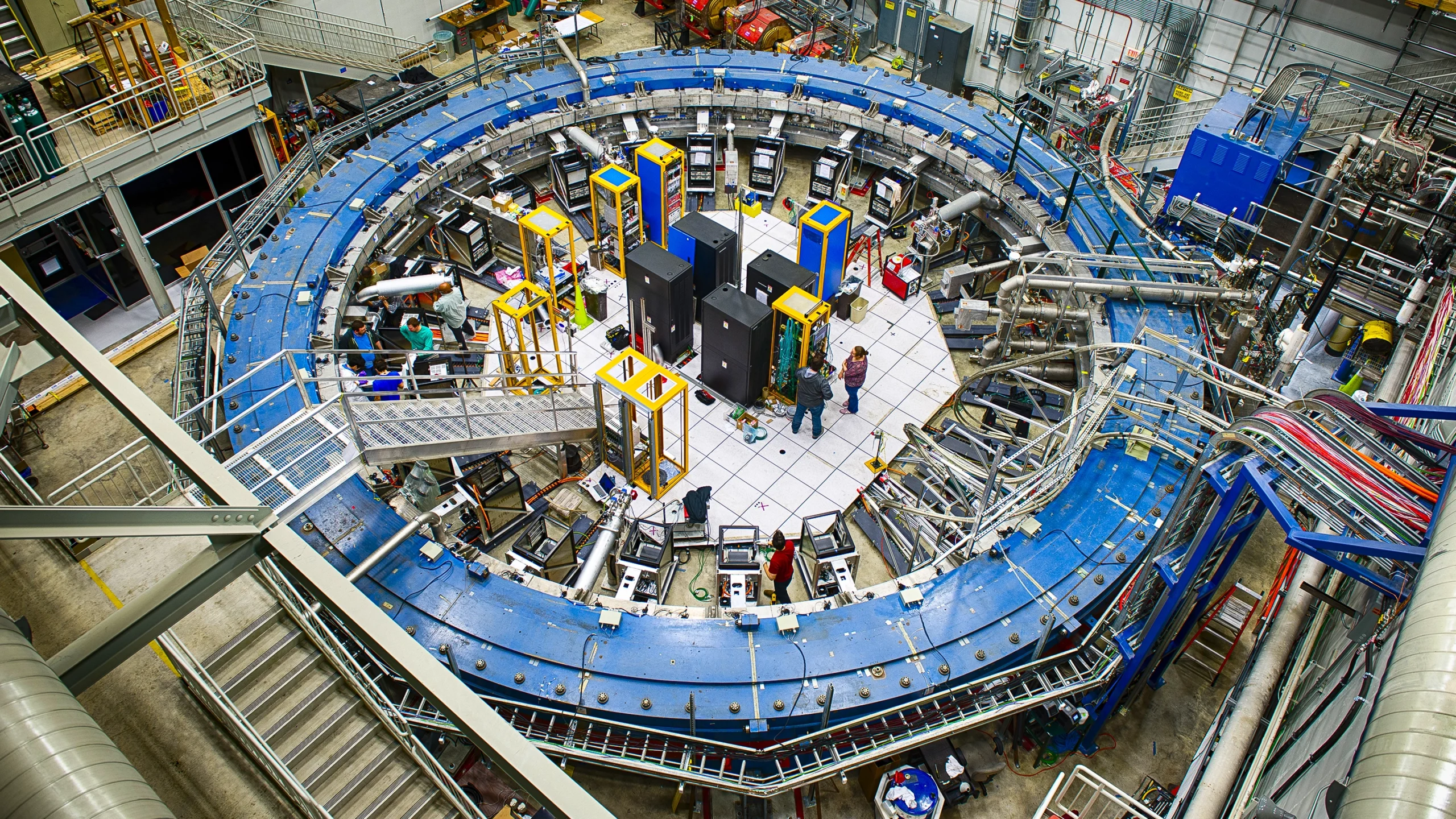
The wobble
The muon is a heavier cousin of the electron, and it behaves a bit like a tiny bar magnet. Spin one in a circle inside a magnetic field and the magnetism makes it wobble, tracing out smaller circles whose sizes are set by a number called the g-factor. A muon sitting isolated from other particles would have a g-factor of exactly 2.
The crowd of particles
Quantum theory requires that all other particles influence it. As the muon wobbles, it releases particles such as photons, which are too short-lived to show up in detectors. These release other particles, which release still more, and the muon quickly reabsorbs the whole fleeting crowd. The only trace left behind is that the muon wobbles a little bit more.
Through these chains of emission and reabsorption, every particle in existence has some small effect on the muon's movement. The size of the excess wobble, called g-2, is a proxy for how many particles exist in the universe.
Why is the muon's g-factor exactly 2 alone?
In 1928, Paul Dirac's equation for a spinning charged particle predicted a g-factor of exactly 2. In 1947, Polykarp Kusch and Henry Foley measured the electron's g-factor and found it slightly larger. Julian Schwinger explained the difference in 1948, calculating that a particle's interaction with its own photons adds a small correction of about 0.1 percent. That calculation was an early triumph of quantum field theory.
How can unseen particles change a measurement?
Quantum mechanics allows a particle to borrow energy for a very short time, so particles can briefly appear and disappear without ever being detected. Physicists call these virtual particles. Each possible chain of emission and reabsorption adds a tiny amount to the wobble, and theorists sum them all. Measurements of the electron's g-factor agree with this summed prediction to roughly a part in a trillion.
Why would heavy hidden particles show up at all?
Even particles too heavy for any collider to produce can appear as virtual particles and nudge the muon's wobble. The heavier the particle, the smaller its effect, so only a very precise measurement can sense it. Precision measurements of this kind have succeeded before: the mass of the top quark was inferred from precision tests of the electroweak force before the quark was observed directly in 1995.