Korva is a scroll of the internet’s best ideas.
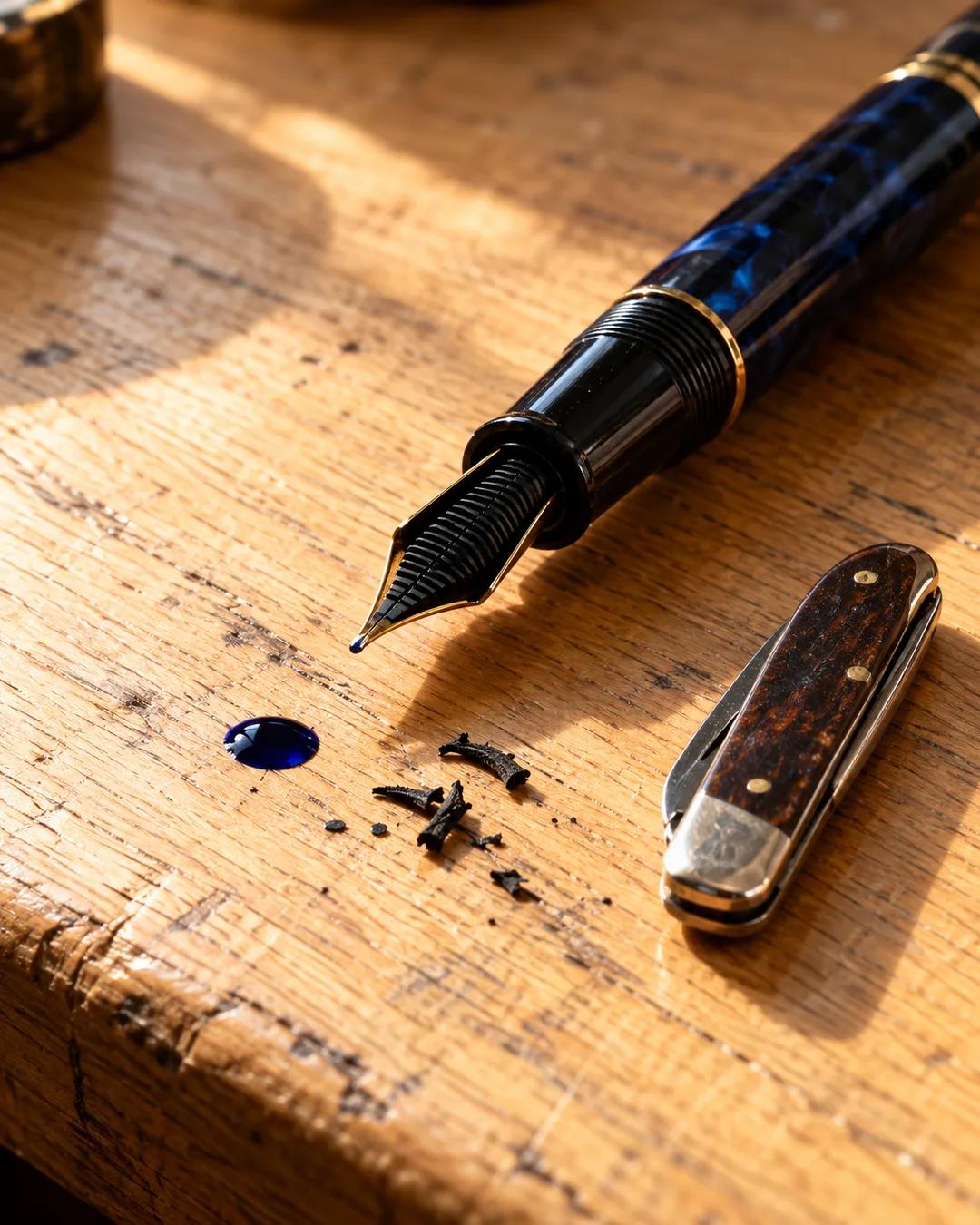
A penknife and a ruined contract

How early nibs flooded
In the 1880s or so, pens had a plain metal nib split down the middle, like the metal front on a quill, with a small hole drilled at the top of the split. Ink flowed down the split from the chamber, and nothing controlled how fast. As Waterman signed, ink went everywhere.
Pressing too hard made it worse. The split opened and dumped ink onto the page, and touching the nib down again and again worked like a bellows, opening and closing the channel and drawing loads of ink down.
What the feed does
Supposedly, he got out a penknife and started cutting the black shape that sits under the nib of a fountain pen today. That part is the feed. Its channels, or fins on some pens, fill with excess ink and hold it behind the metal front of the nib, so it can't flood onto the page. The ink still makes its way through to the paper in time.
Why does a pen need a feed at all?
A bare split nib moves ink by capillary action, the pull that draws liquid into narrow gaps, and that pull has no brake. A feed gives the ink a controlled route, with narrow channels that meter the flow and wider ones that store the extra. Lewis Waterman patented his feed design in 1884, and his company grew into one of the major pen makers of the early twentieth century. Nearly every modern fountain pen still carries a feed built on the same principle.
How does capillary action move ink?
Capillary action happens because liquid molecules stick to the walls of a narrow channel more strongly than they hold to each other. The liquid creeps along the wall and drags the rest behind it. The narrower the channel, the stronger the pull compared with the weight of the liquid. A paper towel soaks up a spill by the same effect.
Why did earlier fountain pens leak so often?
Fountain pens with built-in ink reservoirs were patented decades before Waterman, including a design by the Romanian inventor Petrache Poenaru in 1827. Many relied on gravity or a pinch of air to move the ink, so they either starved the nib or dumped ink without warning. Steady flow only became reliable once designers added dedicated air and ink channels to the feed.
More from The Rest Is Science