Korva is a scroll of the internet’s best ideas.
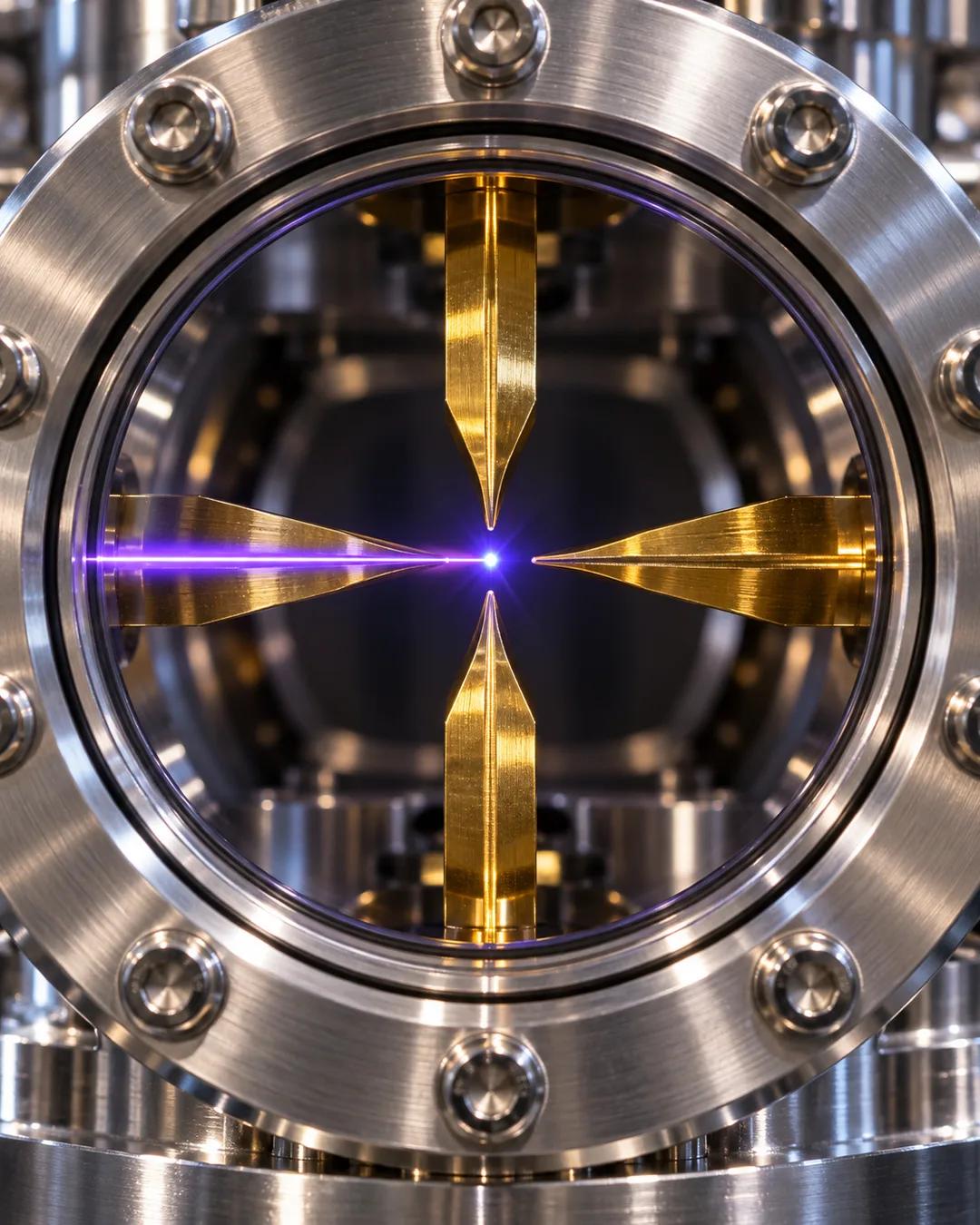
A qubit is one trapped atom

An atom as a bit
The picture of electron orbitals stacked by energy is a model, a helpful fiction, and it works for seeing the setup: a low-energy state is the zero and a high-energy state is the one. The atom can sit in either state or in a superposition of both.
Precisely timed microwave pulses, a few gigahertz and the same sort of frequency range as the microwaves that heat food, set how much of the atom is in each state. It can be entirely zero, entirely one, or any mix, such as 10 percent in one state and 90 percent in the other.
Reading and averaging
Reading it out takes a laser. The atom sends back far fewer photons in one state than in the other, so counting photons gives the measurement. Measuring collapses the superposition, and the system has to be set up from scratch again. A calculation is therefore run over and over and the results averaged, because the answer is a probability.
Arrows and interference
Each state's wave can be drawn as a spinning arrow. Energy equals h times frequency, so the higher-energy state spins faster, and squaring the length of an arrow gives the probability of finding the atom in that state. Waiting lets the arrows fall out of step, and when they are completely out of phase they cancel, which is the destructive interference the calculation uses.
Why are trapped ions good qubits?
Every atom of a given isotope is identical to every other, so there is no manufacturing variation between qubits. Ions held in vacuum are well isolated from their surroundings, which lets their quantum states last a long time. A 2017 experiment from Tsinghua University reported a coherence time beyond ten minutes in a single trapped ytterbium ion. Most solid-state qubits hold their states for far shorter periods.
How is a charged atom held in place?
A static electric field cannot trap a charged particle in all three directions, a result known as Earnshaw's theorem. An ion trap gets around this with electric fields that oscillate, usually in the radio-frequency range, so the ion is pushed toward the center from every side on average. The design is called a Paul trap. Wolfgang Paul shared the 1989 Nobel Prize in Physics for developing ion-trapping techniques.
Why does one state send back more photons?
The readout laser is tuned to a transition that only one of the two states can absorb. An atom in that state absorbs and re-emits light again and again, so it appears bright. An atom in the other state is off resonance with the laser and stays dark. The technique is called state-dependent fluorescence.
More from Computerphile