Korva is a scroll of the internet’s best ideas.
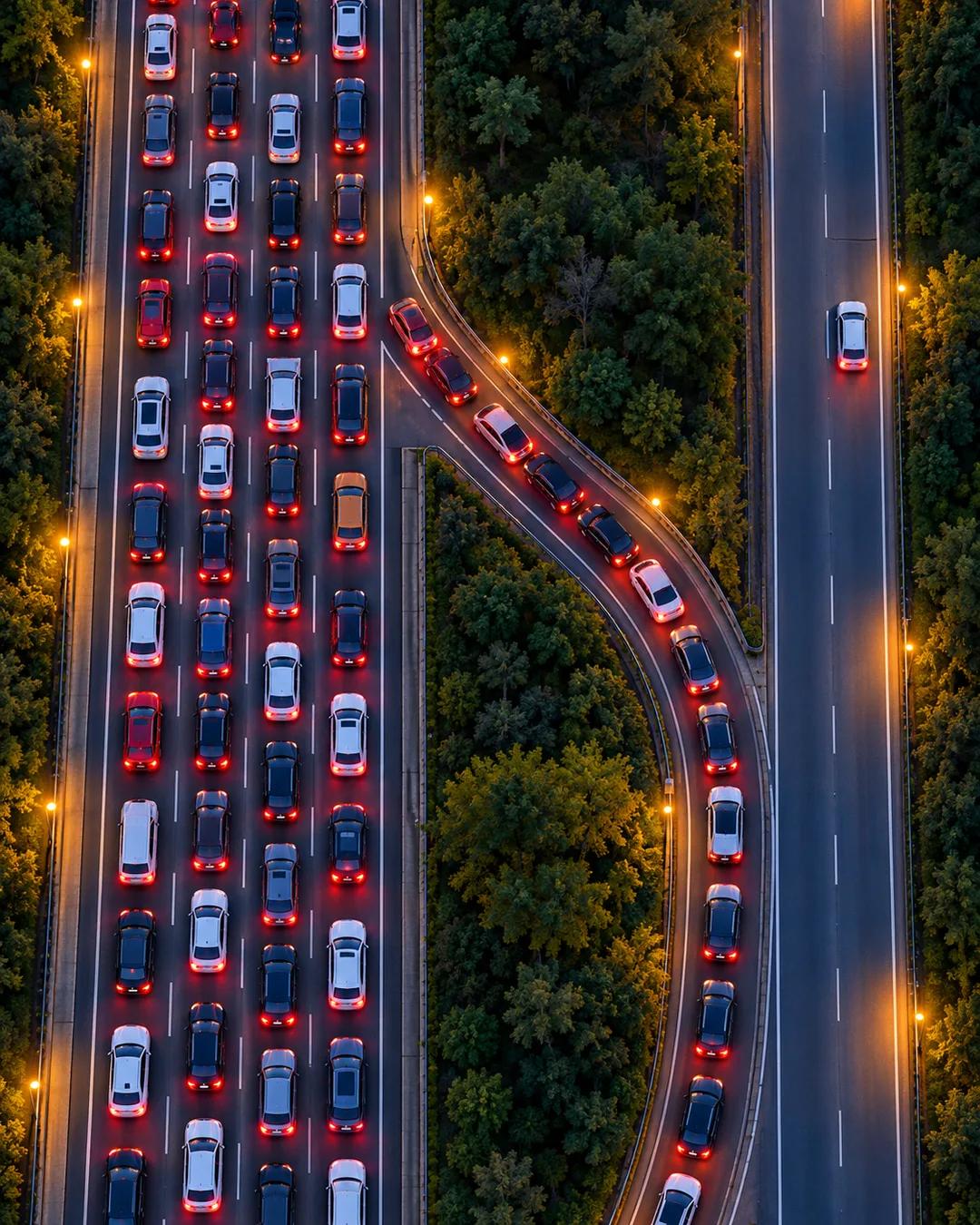
A shortcut slows everyone down

The paradox
In 1968, a German mathematician named Dietrich Braess used numerical analysis to build a traffic model and noticed something strange. When each driver makes the best choice for themselves, a new shortcut can leave everyone slower than they were before it existed. The fast lane becomes the slow lane.
The effect has turned up in real cities. In Seoul, South Korea, traffic around the city improved after an expressway was removed as part of a restoration project.
Careers and AI
The same thing is happening to careers and networking. AI has built an everything shortcut for finding jobs, applying to jobs, cold outreach, and building relationships, and it is effectively free. So everyone floods into it, and the whole system slows down. Applications and outreach become less effective for every person using them, and a tool meant to make the road smoother makes it bumpier.
When a traffic jam forms in the fast lane, staying in your own lane gets you there sooner.
Why does a free shortcut make every trip slower?
In the textbook version, two routes link the same start and end, and each combines one road that slows as it fills with one road of fixed travel time. Drivers split evenly between the routes. Add a free link joining the two congestion-sensitive roads, and every driver does better by using both of them, so everyone switches. Once all of them have switched, every trip takes longer than before, and no single driver gains by going back. Economists call this kind of stable but worse outcome a Nash equilibrium, after the mathematician John Nash.
How did Seoul end up removing an expressway?
The expressway ran above the Cheonggyecheon, a stream that had been covered in concrete between the late 1950s and the 1970s. Seoul's city government began tearing the road down in 2003. The restored stream opened to the public in 2005 as a park running through the downtown core.
Has closing a road helped traffic anywhere else?
In 1990, New York City closed 42nd Street to cars for Earth Day, and traffic engineers expected gridlock across Midtown. The New York Times reported that traffic flowed more smoothly than on a typical day. Drivers had apparently shifted to other routes and times. The episode is still cited by transportation planners alongside Braess's model.
More from Curiosity Chronicle