Korva is a scroll of the internet’s best ideas.
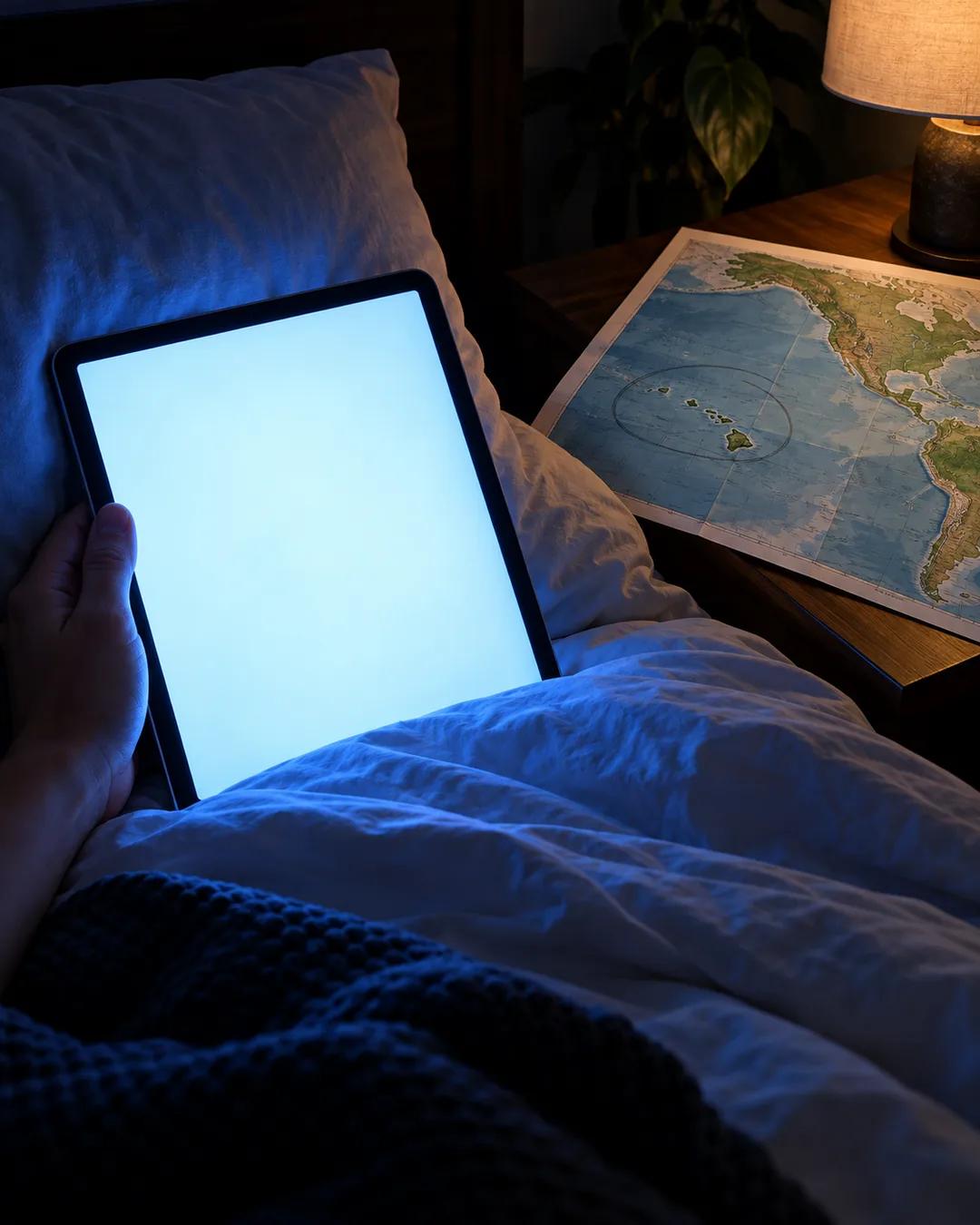
An iPad pushed sleep toward Hawaii

The melatonin delay
For a reader in Seattle, that shift put the biological melatonin rhythm almost all the way to Hawaii.
Worse sleep
Sleep was worse too. REM sleep was disrupted, and people felt worse and less refreshed the next morning. It took a few days for the effect to wash away after they stopped.
Cutting blue light
Software that desaturates the most harmful wavelength of light, which is blue light, seems to help, and so do blue-light blocking glasses. The current recommendation is to limit screen time in the last hour before bed and to decrease stimulation overall. Blackout curtains also help at night.
Why does blue light delay melatonin?
The retina has specialized cells, called intrinsically photosensitive retinal ganglion cells, that contain a pigment named melanopsin. Melanopsin responds most strongly to short-wavelength blue light, around 480 nanometers. These cells send signals to the brain's master clock, which tells the pineal gland to hold back melatonin. Harvard researchers including George Brainard helped establish this peak sensitivity in the early 2000s.
How does the brain keep time without a clock?
A cluster of about 20,000 neurons in the hypothalamus, the suprachiasmatic nucleus, serves as the master clock. Cells in the nucleus keep a rhythm even when removed from the body and grown in a dish. In 1999, Charles Czeisler and colleagues at Harvard measured the human internal day at about 24 hours and 11 minutes. Light each day resets the clock to match the sun.
Why would light at night feel natural?
For most of human history, light after sunset came from fire, with a warm, low-blue spectrum. Modern LED screens and bulbs emit far more short-wavelength light. Melatonin is sensitive enough that ordinary room light before bed can lower its level, according to a 2011 study by Joshua Gooley and colleagues at Brigham and Women's Hospital. Dim light has a much smaller effect.
More from Talks at Google