Korva is a scroll of the internet’s best ideas.
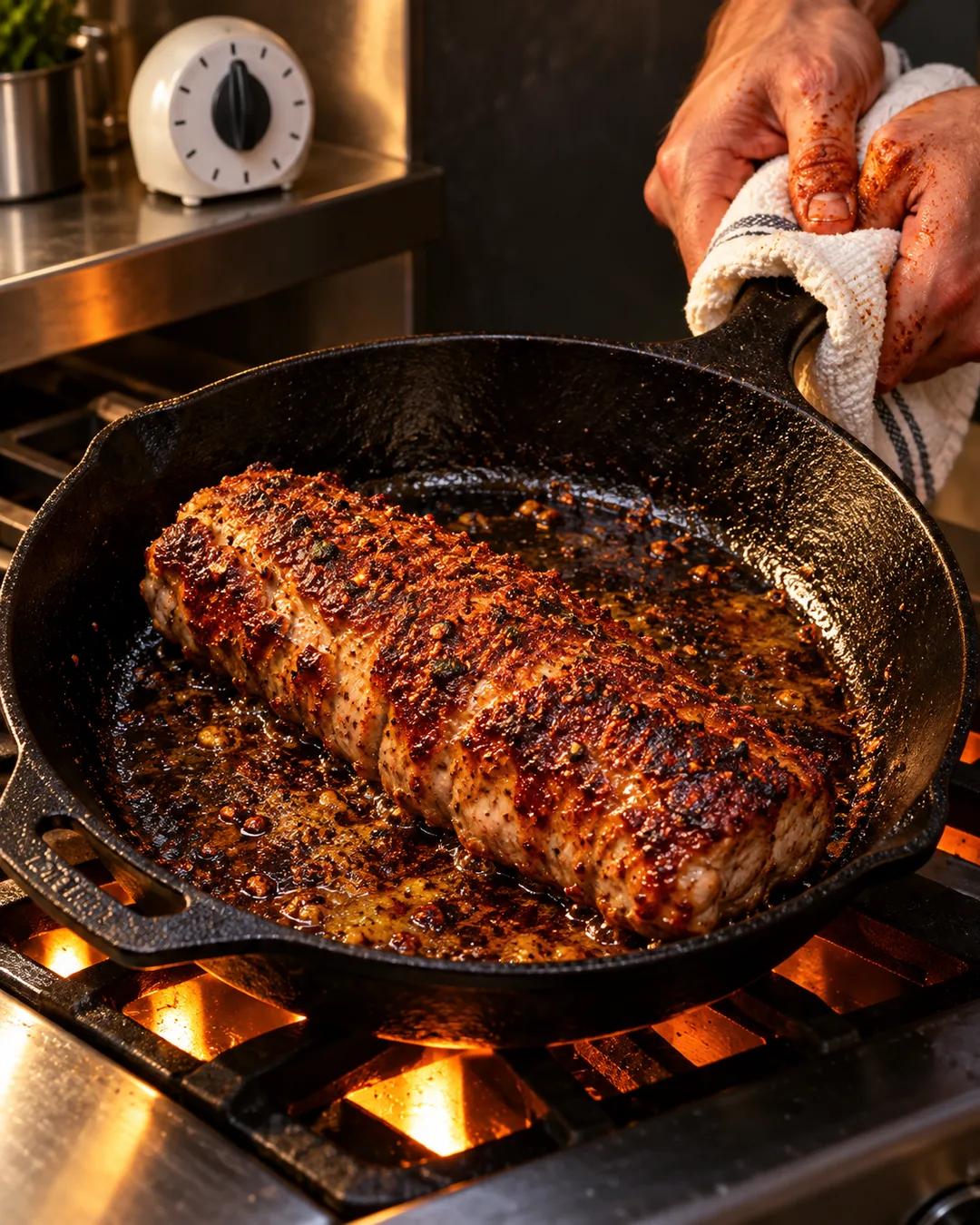
Be one with the pork

The night it went wrong
The night was Labor Day Sunday at Mesa Grill, a big, busy New York restaurant. The cook had two burners, and one was tied up with a scallop dish for a two-pan pickup. For hours the pork tenderloins went into the pan five at a time and came out overcooked. By the end, more than a hundred had gone wrong. A phone call to their father from Union Square and a cry in the walk-in followed.
Seven days with the pork
The next day the cook apologized to the chef. A week later the schedule went up on the wall the old-school way, and the same cook was down for saute on Saturday night. The chef answered the doubt with a deadline: seven days to be one with the pork. The cook took it literally.
For seven days the cook seared tenderloins, slid them into the oven, and watched the little clock in the kitchen. Four minutes, check the timer. Five minutes, check it again. The ancho chili rub left their hands red. Then, at one point, the pork glistened, and that meant it was ready. It was the first time the cook could get a mid-rare tenderloin on purpose.
No one had shown them how, and twenty-five years ago the chef never asked where the thermometer was. It hadn't even crossed anyone's mind. Learning the pork by watching it was when the senses clicked and cooking started to make sense.
Why does pork tenderloin overcook so easily?
Tenderloin is a muscle that does very little work, so it carries almost no marbling and very little connective tissue. Fat and collagen act as a buffer in other cuts, keeping them moist even when they run hot. Without that buffer, the muscle proteins tighten and squeeze out water as they heat, and the gap between juicy and dry shrinks to a few degrees. Food scientist Harold McGee describes this protein tightening in On Food and Cooking.
Why does meat keep cooking after it leaves the pan?
The outside of a piece of meat is always hotter than the center while it cooks. When it comes off the heat, that surface heat keeps flowing inward until the temperature evens out. This is called carryover cooking, and it can raise the center temperature by several degrees. Thicker cuts and hotter pans produce a bigger rise.
How do line cooks judge doneness without a thermometer?
Many professional kitchens teach doneness by feel. Raw meat is soft, and it firms up steadily as its proteins contract and lose water. Cooks press the meat and compare the resistance to the fleshy pad at the base of the thumb, which gets firmer as the fingertips move from loose to tightly pressed. With thousands of repetitions, that comparison becomes automatic.
Why does searing turn meat brown and savory?
Browning comes from the Maillard reaction, in which amino acids and sugars react at high heat. French chemist Louis-Camille Maillard first described it in 1912. It begins in earnest above roughly 300 degrees Fahrenheit and produces hundreds of new aroma compounds. A dry surface reaches that temperature sooner, because moisture on the surface holds it near the boiling point of water until it evaporates.