Korva is a scroll of the internet’s best ideas.
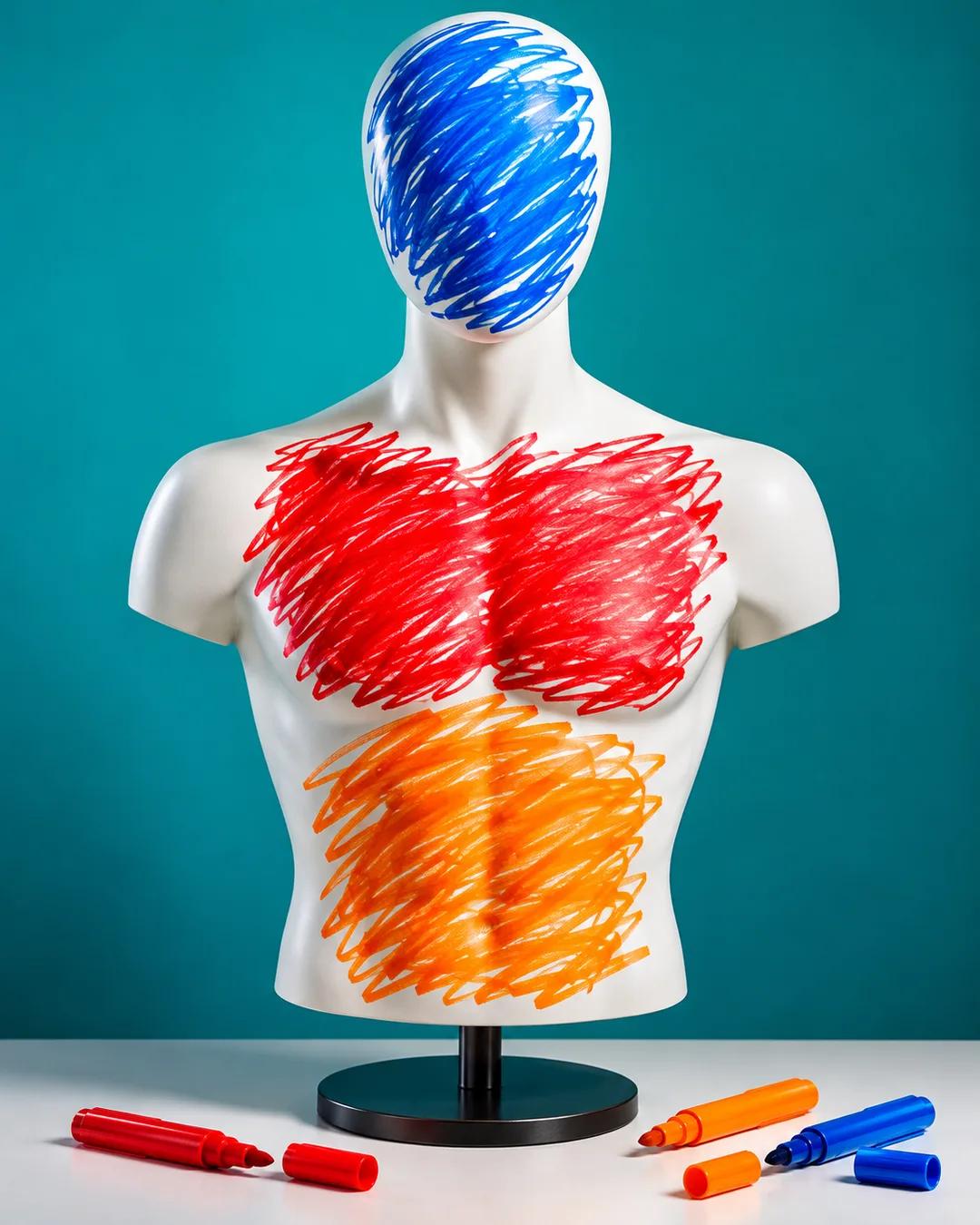
Body maps of emotion show concepts

Drawing on a mannequin
Participants in the study were given an emotion word such as sadness and asked to draw on a mannequin where on the body they think they would feel that emotion. No electrodes went on anyone. No movie clips made anyone feel the emotion. The task was a single word.
What the maps show
The maps therefore reflect people's concepts of how emotion words correspond to changes in the body. The Finnish researchers behind them went on to compare cultures and to look at how the concepts develop in children. Whether those drawn spots match where blood flow and other signals actually change during awe or anger is not known, because the studies have not been done.
What is still missing
Studies that do measure the body usually record a few signals like heart rate and blood pressure, an extremely crude slice of what is going on. A detailed, high-dimensional readout across the gallbladder, liver, kidney, and heart is what is missing. Reliable, distributed signatures of anger, fear, and sadness show up in brain imaging, and the brain and body are tightly coupled, so a similar signature across the body is a reasonable bet.
What do heart rate and skin conductance reveal?
In a 1983 study in Science, Paul Ekman, Robert Levenson, and Wallace Friesen had people form emotional facial expressions and relive emotional memories while measuring their bodies. Anger, fear, and sadness raised heart rate more than happiness, surprise, or disgust did. Anger raised finger temperature while fear and sadness lowered it. Those results were among the first to suggest that emotions carry different autonomic signatures.
How does the gut connect to emotion?
The gut is wired to the brain through the vagus nerve, and most of its fibers carry signals up from the body to the brain rather than the other way around. The gut also makes the large majority of the body's serotonin, with commonly cited estimates near ninety percent, produced by specialized cells in the intestinal lining. That serotonin acts mostly on the gut itself, regulating movement of its contents. Researchers study the exchange between gut and brain as a route by which the body influences mood.
More from Huberman Lab