Korva is a scroll of the internet’s best ideas.
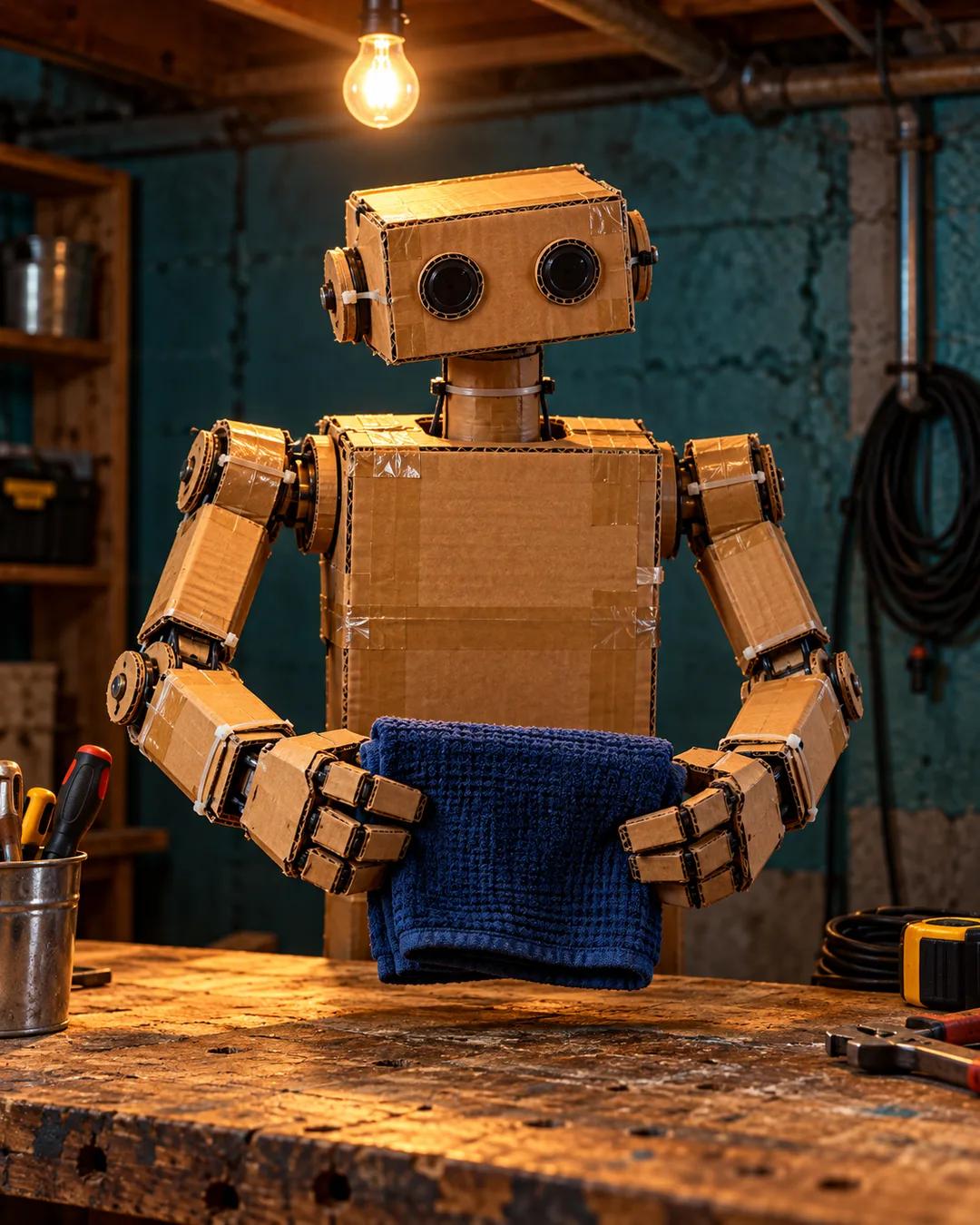
Cardboard in a Stanford basement

The Founders
Tony Zhou and Chang Ji were around 25 and still PhD students at Stanford when the venture firm Conviction was introduced to them. They had already worked at Toyota Research, DeepMind, and Tesla before they started Sunday Robotics.
The Data Problem
Robotics has a data problem. A common belief in the field is that an internet's worth of robot data would produce fully general robots everywhere, and nobody knows where that data comes from. Zhou and Ji treat it as an engineering constraint: the data doesn't exist, and there is no unlimited budget to buy it.
So their ideas go at the shape of the data and how it is collected: the cheapest way to gather it, in a form that covers real environments and real tasks, and how much of that cheap data carries over into model learning. Conviction said yes in the first meeting.
Two Years In
Less than two years in, the team has run hundreds of iterations of hardware, data collection, and task training, and tested the results in real-world environments. They expect semi-humanoid robots doing things in people's homes in beta by the end of this year, and if not this year, then next.
Why is there no internet of robot data?
Language models learned from text that people had already written and posted online, so the data came free. Robots need recordings of physical actions paired with what the robot sensed, and nobody has been posting those for decades. Each recording requires a real machine, a real space, and a motion to capture. In 2023, more than 20 research labs pooled their robot recordings into a shared collection called Open X-Embodiment to start closing the gap.
How can robot data be collected cheaply?
One approach is teleoperation, where a person steers a robot through a task while the system records every movement. Another skips the robot altogether: a Stanford project called the Universal Manipulation Interface, published in 2024, used a handheld gripper with a camera so people could record demonstrations anywhere. Because the camera sees what a robot gripper would see, the recordings can later train a robot arm. A handheld tool costs a small fraction of a robot and can be carried into kitchens and offices.
Why are homes harder for robots than factories?
A factory robot repeats one motion on parts that arrive in the same place every time. A home has changing light, soft objects, clutter, and layouts that differ from house to house. A home robot has to handle things it has never seen, like a crumpled towel or a mug lying at an odd angle. Industrial robot arms have worked on assembly lines since 1961, when the Unimate began lifting hot metal parts at a General Motors plant in New Jersey.
More from Invest Like the Best with Patrick O'Shaughnessy