Korva is a scroll of the internet’s best ideas.
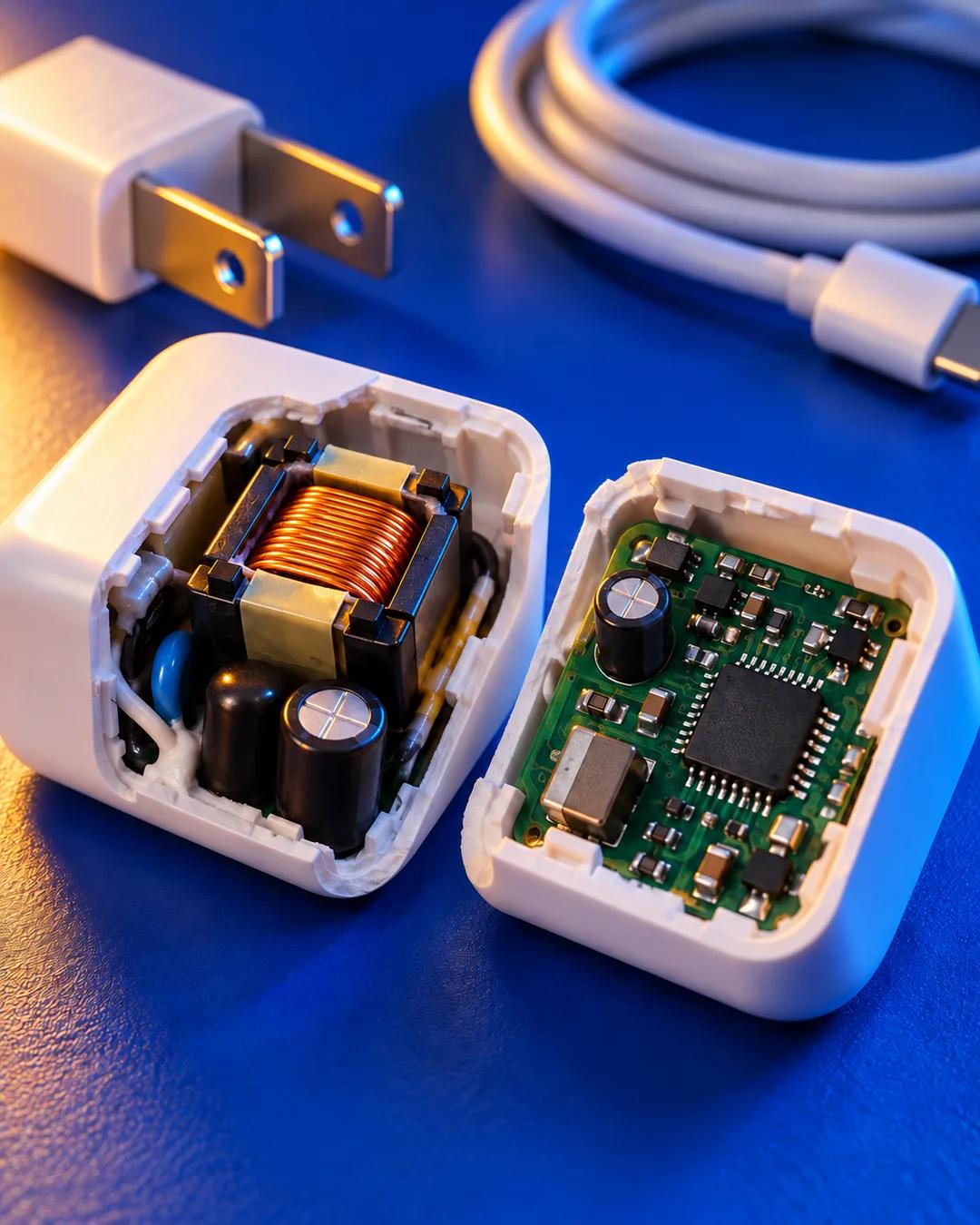
Chargers turn AC into DC first

Electricity from the wall arrives at somewhere between 100 and 240 volts, depending on where you live, flipping back and forth 50 or 60 times every second. A phone battery can't use any of that. It needs lower voltage direct current.
The first thing the circuit does is force the alternating current into direct current. The voltage then has to come down, but a transformer can't step down direct current. It needs a changing magnetic field to induce current in its secondary windings.
That is why a chip rapidly switches the direct current on and off, producing the alternating current the transformer needs. The step-down depends on the number of windings and the frequency, so a faster switch means fewer windings are required.
Gallium nitride chips make those tiny on-off switches fire 20 times faster than their silicon equivalents, thanks to a material science breakthrough. Transformers fed by them need fewer windings, which makes them more compact and reliable. They can also respond quickly to live battery status measurements from the phone, which lets the charger push out as many watts as possible without overheating the phone.
Why can't a transformer work on direct current?
A transformer works through electromagnetic induction. A changing current in the primary winding creates a changing magnetic field, and that changing field is what induces a voltage in the secondary winding. Steady direct current produces a constant magnetic field, and a constant field induces nothing. Michael Faraday described this induction law in the 1830s.
Why does a faster switch mean fewer windings?
In a transformer, the voltage induced per turn of wire rises with the frequency of the current passing through it. At a higher frequency, fewer turns are needed to handle the same voltage and power. Fewer turns means less copper and a smaller magnetic core. This is why the heavy iron-cored transformers of 50 or 60 hertz mains power are much larger than the ferrite ones in modern chargers, which run at tens or hundreds of thousands of hertz.
What makes gallium nitride switch so fast?
Gallium nitride is a wide bandgap semiconductor, meaning its electrons need much more energy to jump into a conducting state than they do in silicon. That lets it withstand higher voltages across a thinner slice of material. A thinner slice means less electrical charge to move on each switching cycle, so it flips on and off faster and wastes less energy as heat. Wide bandgap materials like this were first developed for LEDs and radio equipment before reaching chargers.
Why do old chargers feel warmer than new ones?
Every conversion step in a charger loses a little energy as heat. Slower silicon switches spend more time partway between on and off, and that is when the most energy is wasted. Larger transformers with more windings also lose energy in their copper and cores. A charger that switches faster and cleaner converts a larger share of wall power into battery power, so less is left over as heat.