Korva is a scroll of the internet’s best ideas.
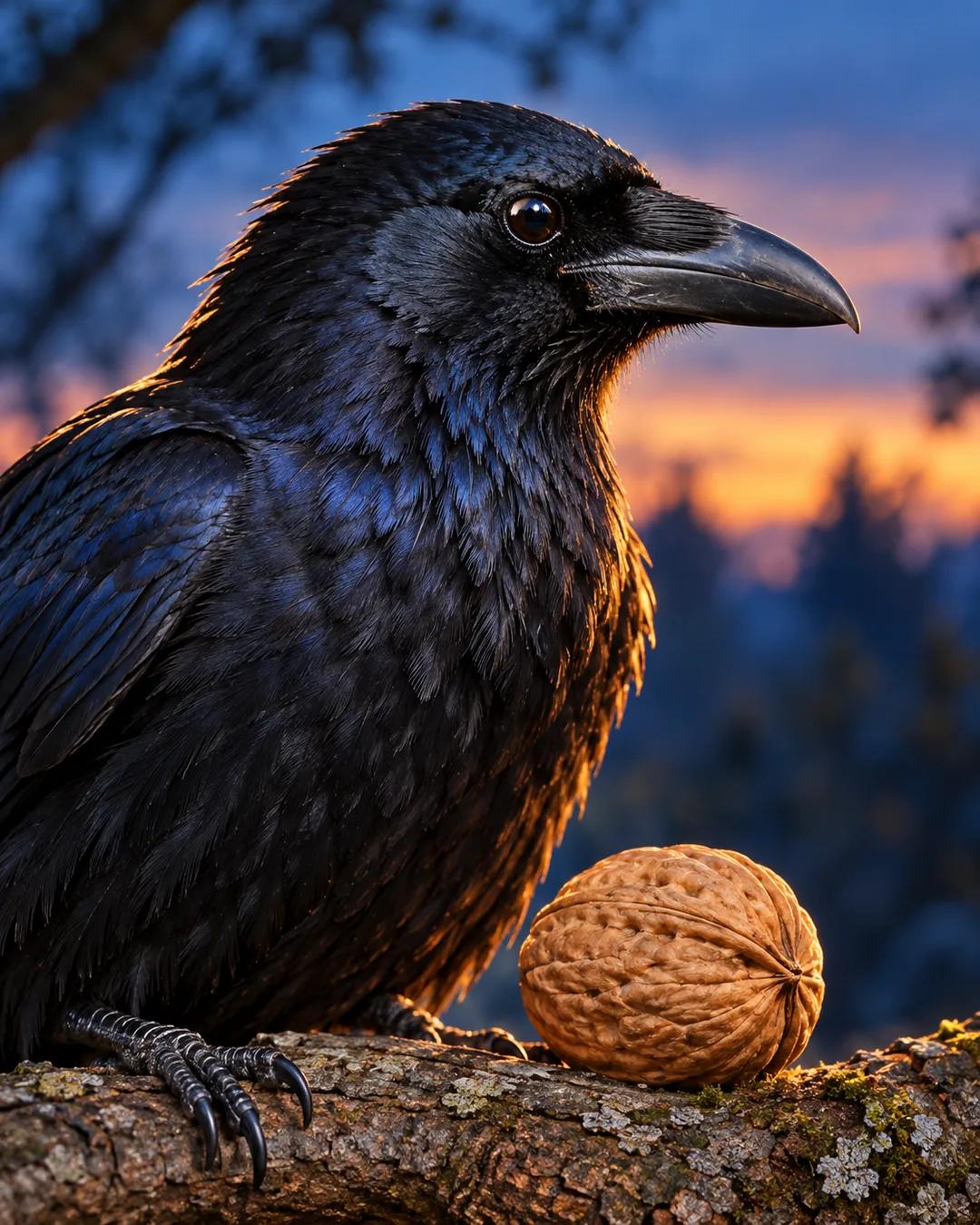
Crows are small flying monkeys

Brain size and body size
Brain size tracks body size across animals: fish have relatively small brains, then birds, then mammals, with primates, humans included, highest for their bodies. Within birds there is a lot of scatter. The ostrich has a very large body and a very small head, while jays, crows, and ravens sit well above the average bird line, above the mammal line, and near the primate line. The American crow has a slightly larger brain than the New Caledonian crow.
Lifespan and social life
Two other traits help them use that brain. They live 20 or 30 years in the wild, long enough to build up knowledge from their own experience. They are also social, so they can learn from watching others make mistakes or invent new tricks instead of having to make every mistake themselves.
Inside the crow brain
Their brains are also far more complex than anyone thought a few decades ago. They have a very large forebrain, as humans do, which weighs incoming information from the eyes, ears, and the touch receptors in the bill. It draws on the hippocampus, the spatial memory store, and the amygdala, which adds emotion to places and sensations, so crows form spatially relevant emotional memories just as people do.
Why are crow brains so powerful for their size?
A 2016 study in the Proceedings of the National Academy of Sciences by Suzana Herculano-Houzel and colleagues counted neurons in bird brains. It found that birds pack neurons much more densely than mammals do, so a small bird brain can hold as many neurons as a much larger mammal brain. Songbirds and parrots had neuron counts similar to many primates with larger brains. Crows and ravens are among the songbirds with the highest counts.
How can birds think without a layered cortex?
Mammals do most of their complex processing in a six-layered cortex. Birds do not have that layered structure, and for a long time scientists assumed that meant simple minds. Work by Onur Güntürkün and others has shown that the bird pallium is organized into clusters of cells and carries out functions similar to the mammalian cortex. The 2004 Avian Brain Nomenclature Consortium renamed several bird brain regions to reflect this.
Why does living in groups seem to grow brains?
The social brain hypothesis, proposed by anthropologist Robin Dunbar, holds that large brains evolved partly to track relationships in complex groups. It was first tested in primates, where group size tracks the size of the neocortex. Corvids live in close family groups with long-term pair bonds, and researchers have since applied the same idea to them. Birds in such groups often keep track of who is allied with whom.
More from TEDx Talks