Korva is a scroll of the internet’s best ideas.
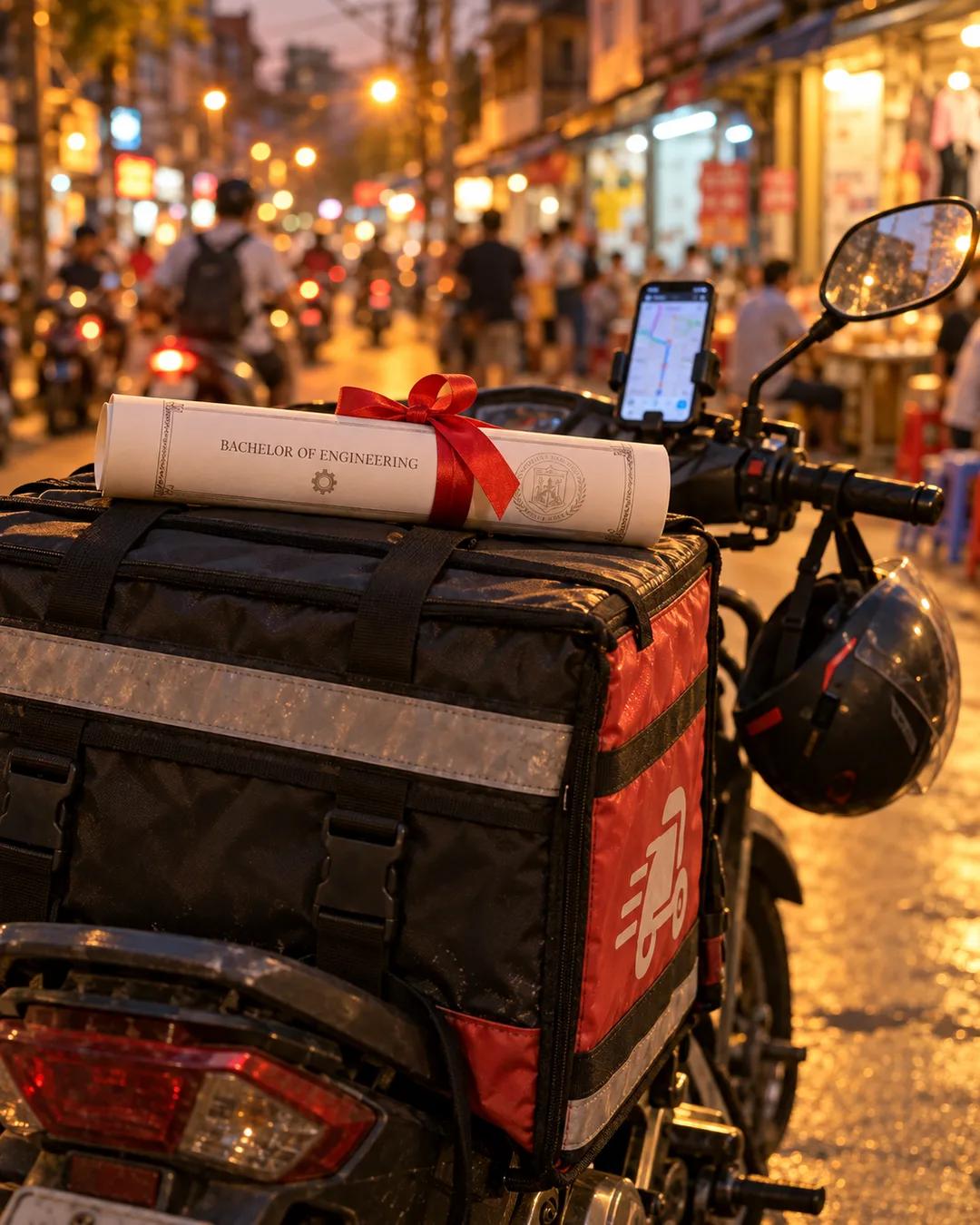
Engineers turned delivery riders

Degrees Without Jobs
In Tamil Nadu and many other states, families expect every son to become an engineer. Parents take loans and sell agricultural land to pay for the degree. When the job does not come, the graduate gets a bike and delivers food or parcels. All work has dignity, but it is not what the degree was meant for, and the education did not change their life.
Where Education Pays
Education still changes a life at the very top. An IIT graduate who does well can land a game-changing opportunity, though not every IITian does, and the NITs are okay. A few rungs lower, the degree stops helping, and what carries a child is their own resilience. The same holds in medicine and law, and cracking the UPSC changes a life, but very few do.
Why It Happened
India has no boom in manufacturing like the one China had, and everybody is now issuing engineering degrees, an inflation of degrees. On an election panel after Vijay won in Tamil Nadu, the frustration of Gen Z over this came up as one reason they backed him.
Why does India produce so many engineers?
Engineering has long been seen as a dependable route to a stable income. States such as Tamil Nadu built large numbers of private engineering colleges from the 1990s onward. Colleges expanded faster than industry could hire graduates. Tamil Nadu has long been among the Indian states with the most engineering colleges.
How did China's factories absorb graduates?
China's economic opening began in 1978, and special economic zones such as Shenzhen, established in 1980, drew foreign manufacturers. After China joined the World Trade Organization in 2001, its exports surged. Factories and the engineering firms around them hired tens of millions of workers. China's exports grew several-fold over the decade that followed.
Why do degrees lose value when everyone has one?
Sociologist Randall Collins argued in his 1979 book The Credential Society that as more people earn a degree, employers raise the requirement for the same job. The degree then works as a filter and not as a measure of skill. In the United States, jobs that once asked for a high-school diploma now commonly ask for a bachelor's degree, a pattern researchers call credential inflation.
More from Tomorrow, Today