Korva is a scroll of the internet’s best ideas.
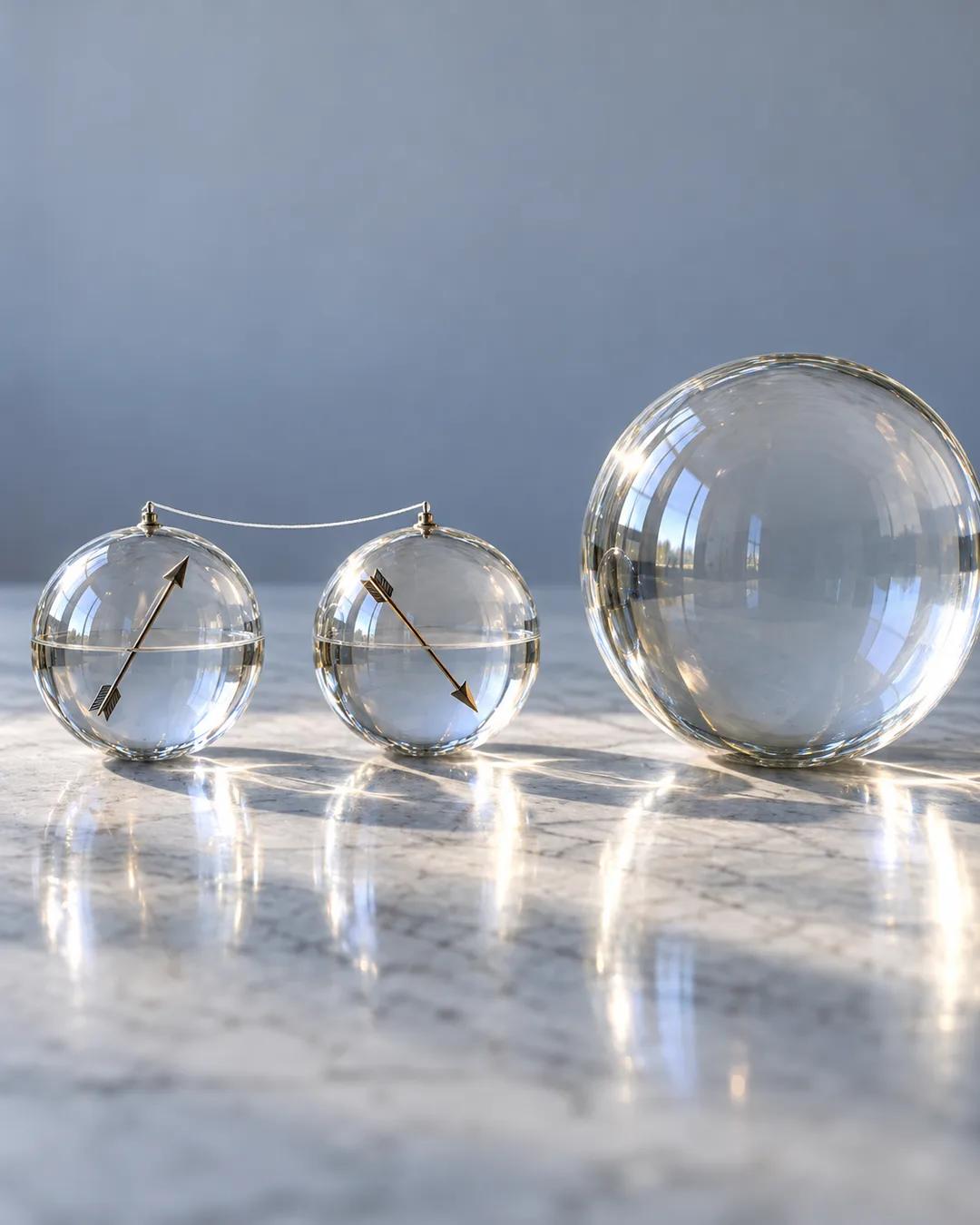
Entangled qubits resist classical simulation
What a qubit holds
A classical bit points up or down, one or zero. A qubit can point anywhere on the surface of a sphere, called the Bloch sphere. When it is measured, it falls to zero or one with a probability set by its angle, so before measurement it holds a linear combination of both values. That superposition gives some parallelism, because operations act on both values in a single state, but it isn't enough for a quantum advantage.
What entanglement adds
Entanglement supplies the rest. Certain operations link two qubits, and after that a local operation on one has a non-local effect on the other, so acting on a single qubit computes on both at once.
Use in machine learning
That higher-dimensional space is what quantum machine learning uses. Classical data, such as a set of patients with certain symptoms, gets embedded into qubits, some embeddings entangling them as they go. In the larger space, the correlations among the data points can be explored much more effectively.
Why does simulating entanglement cost so much?
Describing the state of n qubits in general takes 2 to the power n complex numbers, one for each possible pattern of zeros and ones. Each added qubit doubles the memory a classical simulator needs. At 16 bytes per number, 50 qubits would need about 18 petabytes. Entangled states are the ones that make this full description unavoidable.
How does a qubit's angle set its odds?
Measurement follows the Born rule, which says the probability of an outcome is the squared size of its amplitude. For a qubit tilted by a polar angle theta from the zero direction, the chance of reading zero is cosine squared of half theta. A qubit pointing straight up always reads zero, and one pointing straight down always reads one. Anything between gives a weighted coin flip.
How do we know entanglement is real?
In 1964 John Bell showed that any theory with hidden local instructions must obey a limit on how strongly distant measurements can correlate. Experiments by Clauser, Aspect, Zeilinger, and others found correlations that break that limit. These results ruled out local hidden-variable explanations. The 2022 Nobel Prize in Physics went to those three for this work.
More from Computerphile