Korva is a scroll of the internet’s best ideas.
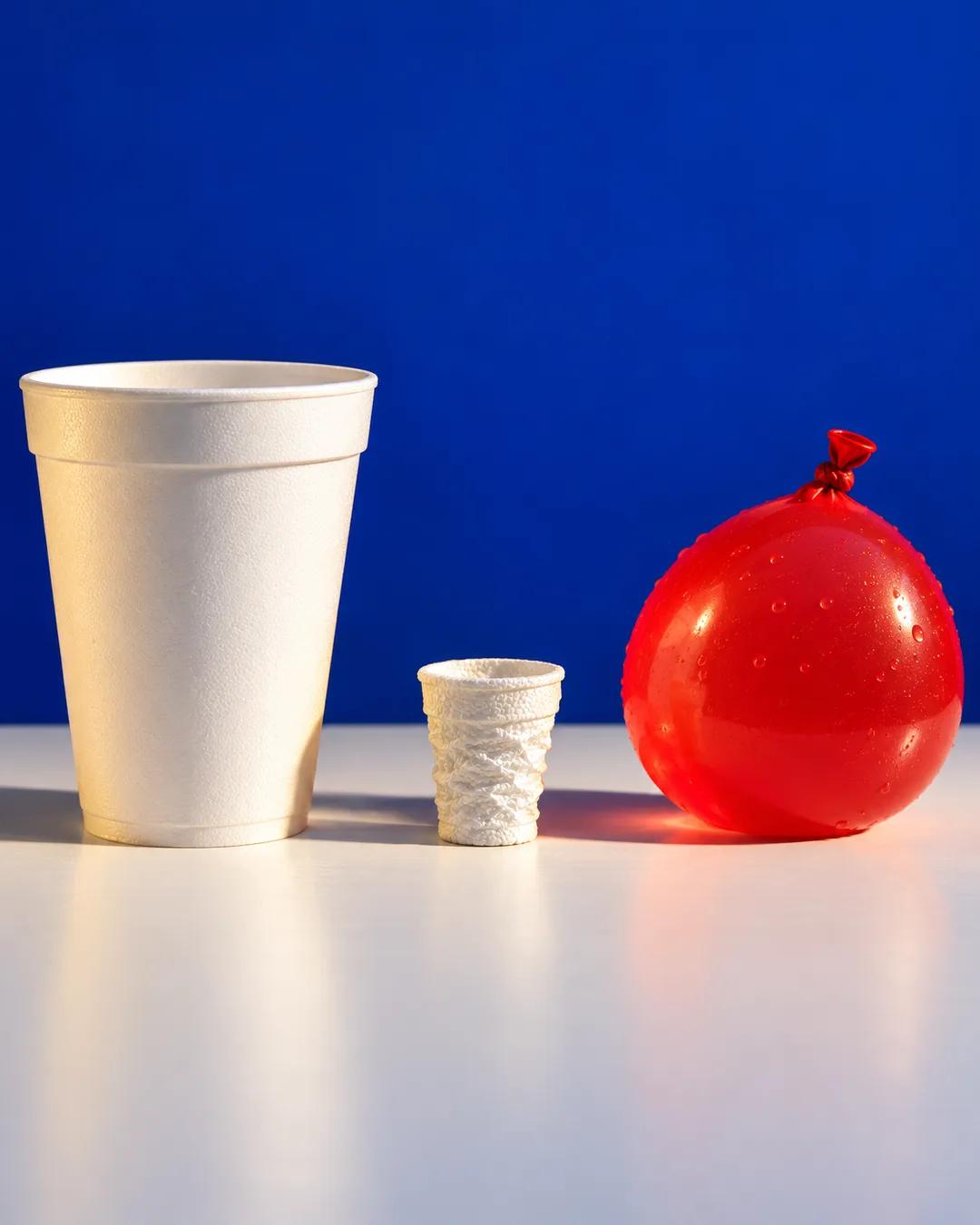
Foam cups shrink to shot glasses

The shrinking cup
On the Alvin submarine, an 8- or 12-ounce styrofoam cup gets placed outside a viewport. As the sub goes deeper and deeper, the pressure squeezes the air out of the cup, and it shrinks to the size of a shot glass. It stays shrunken when it comes back up.
Water balloons tied to the submersible show nothing at all, because they are full of water, and water is not very compressible. Its volume changes by about a percent.
Life without air spaces
That is the first trick for living in the deep sea: no air spaces. A scuba diver can go only so far before air spaces get crushed, but deep sea animals and microbes are primarily water, proteins, and fats. The third trick is a slight modification of their proteins, enzymes, and fats to handle the pressure and the cold.
Cold at the bottom
The cold is just above freezing in many cases, like a restaurant's walk-in cooler. There is no ice on the sea floor, because ice floats. What sits on the bottom is the coldest water can get before it freezes and turns buoyant.
Why is water so hard to squeeze?
Water molecules in a liquid already sit packed close together, so there is very little empty space to squeeze out. Even at the bottom of the deepest trench, where pressure is more than 1,000 times what it is at the surface, seawater is compressed by only about five percent. Air is the opposite, because gas is mostly empty space and shrinks in proportion to the pressure on it. A foam cup is full of trapped gas bubbles, which is why it collapses while the water balloon does not.
How do deep animals protect their proteins from pressure?
Pressure bends proteins out of shape, and many deep-sea animals counter it with small molecules in their cells. Research by Paul Yancey and colleagues found that fish living deeper carry more of a compound called TMAO in their tissues. TMAO stabilizes proteins against the squeeze. Their cell membranes also tend to hold more fats that stay fluid under pressure and cold.
Why is the deep ocean so cold?
Cold seawater is the densest, so water that chills at the surface near the poles sinks and spreads along the bottom. Much of the deep ocean was filled this way by sinking water in the North Atlantic and around Antarctica. Seawater is salty, so it stays liquid until about minus 2 degrees Celsius. The deep water spends centuries in this dark layer before it comes back to the surface.
More from Ologies with Alie Ward