Korva is a scroll of the internet’s best ideas.
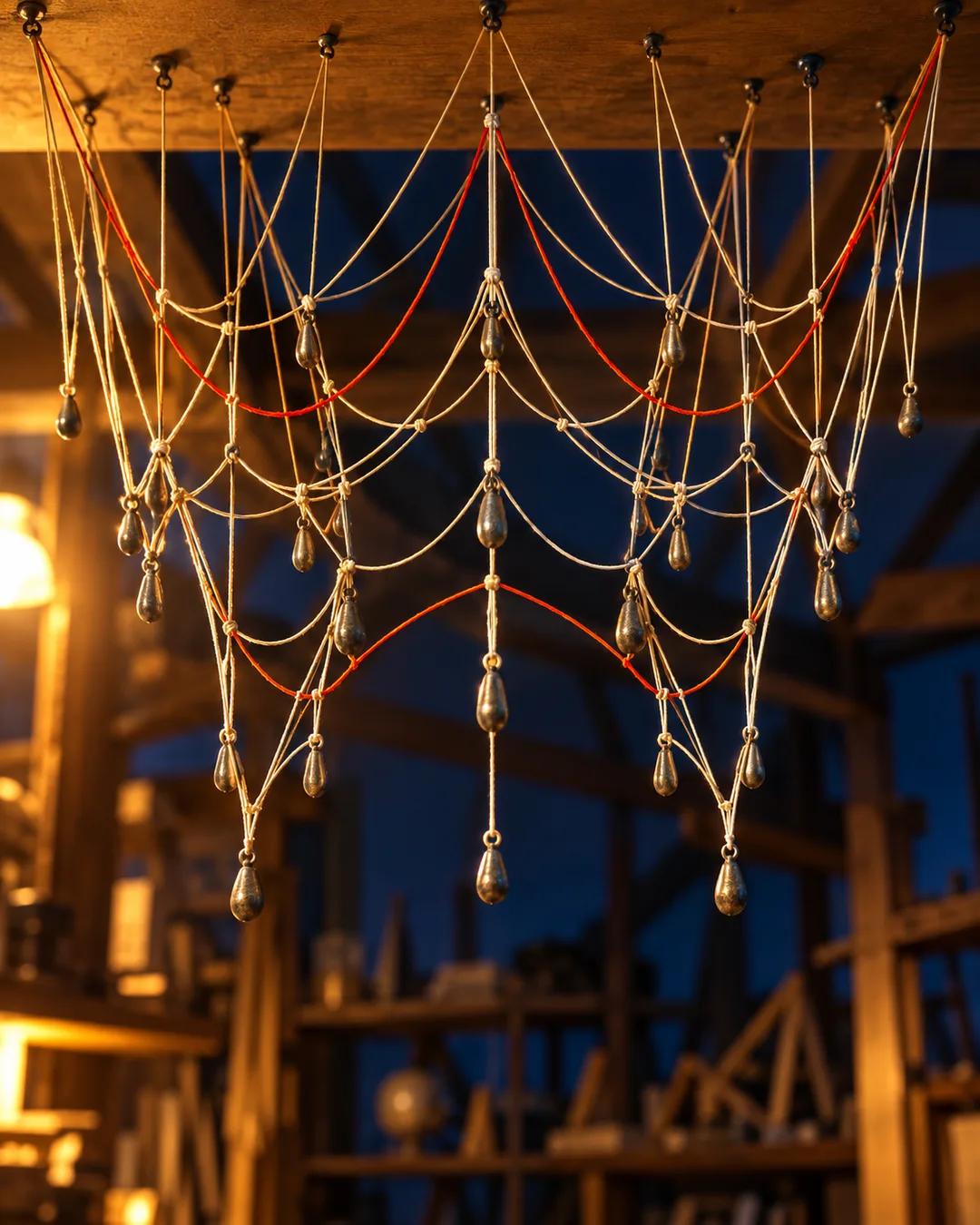
Gaudí designed arches with hanging strings

Why stone needs squeezing
Stone is strongest in compression. Squeeze a rock and it withstands enormous pressure, but pull on it and tiny imperfections let cracks grow until the whole stone fractures. Building in stone means keeping every block squeezed, which is why Roman arches and domes curve along an imaginary path of force called the line of thrust.
How strings map forces
A string finds that path on its own. A rope hung from one point drops straight down, a rope hung between two points sags, and more weight pulls it into a deeper parabolic arch, with the whole length in tension every time. Gaudí hung a floor plan at 1 to 10 scale in the air, tied strings to the anchor points where the columns would stand, and hung weights on the nodes where columns met new thrust vectors. Each weight stood for roughly 1/10,000 of the load the real column would carry.
The method existed before him, but he pushed it to leaning columns, odd angles, and no symmetry in the Güell Crypt. The string model on display in the Sagrada Família museum comes from the Güell Crypt, not from the basilica.
Leaving the strings behind
By the time he designed the Sagrada Família, he no longer needed the strings. He calculated the weight of the vaults, found the center of forces of each section, and drew the arch straight from the column base to that point. To him the two methods were the same, one born out of the other.
Why does a hanging chain become a stable arch?
A hanging chain carries its weight purely as tension, so every link pulls along the chain's own curve. Turn that curve upside down and the pulls become pushes, which means the same shape carries its load purely in compression. Robert Hooke stated this principle in 1675 in a Latin anagram, which says that an inverted hanging line stands as a rigid arch. A chain of uniform weight hangs in a catenary curve, while a chain carrying its load evenly across the span hangs in a parabola.
Why do cracks grow when stone is stretched?
Real stone is full of microscopic flaws. When the stone is pulled, stress piles up at the tip of each flaw and pries it wider, so the crack lengthens. When the stone is squeezed, the same flaws are pressed shut. British engineer A. A. Griffith worked out this behavior for brittle materials in a 1921 paper, studying glass.
How did Gaudí turn a hanging model into a building?
The church of Colònia Güell, in Santa Coloma de Cervelló outside Barcelona, was begun in 1898 for the textile workers' colony of the industrialist Eusebi Güell. Gaudí spent years on the hanging model, loading small bags with lead shot to stand in for the weight of the stone. He photographed the model and painted over the pictures turned upside down, so he could see the finished vaults. Only the crypt of that church was ever built.
More from Real Engineering