Korva is a scroll of the internet’s best ideas.
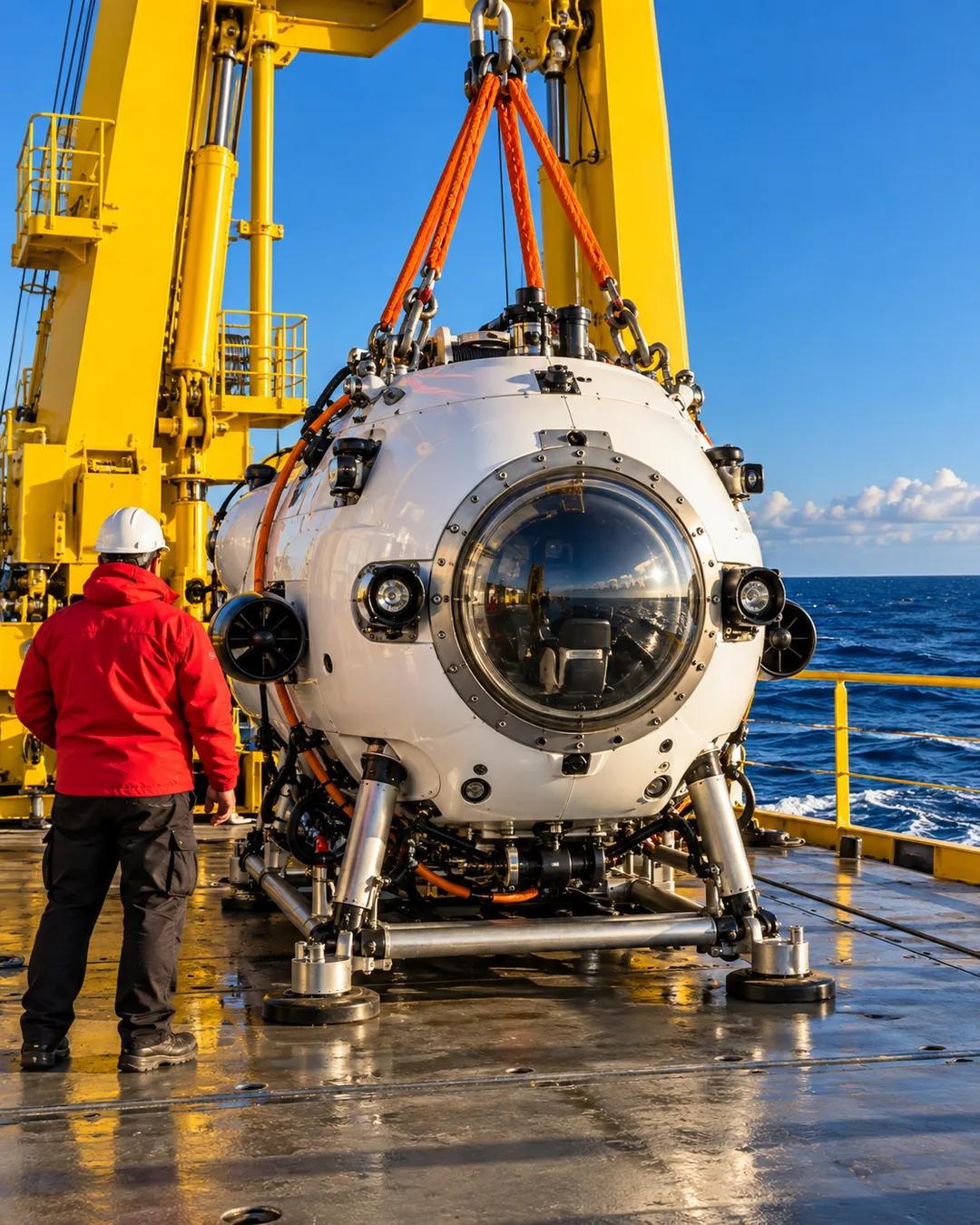
Half a school bus, three seats

Inside the titanium ball
Most of the submarine is batteries and flotation, so it can get home. The crew compartment is a titanium ball a little over six feet tall that holds a pilot and two scientists along with all the life support and electronics. One scientist who is 6'2" can stand up in it with his toes on the bottom and his head on the top.
The mother ship
Alvin lives on a mother ship called the Atlantis, which goes wherever the submarine needs to work. The crew wheels the sub out, and the people inside descend to the sea floor and stay there for about four hours.
A long record
The sphere is metal, and the more times it goes down and gets squeezed, the harder that metal becomes. Spheres do well under pressure. Alvin has completed more than 5,000 dives since the mid-1960s with no deaths. It recovered a hydrogen bomb that was accidentally dropped in the ocean, and it was the first crewed vehicle to take people back to the Titanic site.
Why is the crew compartment a sphere?
A sphere spreads the force of pressure evenly in every direction, with no flat faces or corners where stress can collect. That lets the walls be thinner for a given depth than any other shape would allow. Alvin's sphere is made of titanium, which is strong for its weight. The shape is the same reason that deep-sea pressure housings for cameras are often round.
Why does the sub carry so much flotation?
Alvin's flotation is made of syntactic foam, a material that packs tiny hollow glass spheres into epoxy resin. The spheres hold air-like voids that stay intact under pressure, so the foam stays buoyant at depth. Plain air tanks would collapse. The foam gives the sub the lift to rise when the weights are released.
How was the Titanic wreck found?
The wreck was found in 1985 by a team led by Robert Ballard and Jean-Louis Michel, using a towed camera sled called Argo. It lay about 3,800 meters down in the North Atlantic. Alvin followed in 1986 and carried a small robot, Jason Jr., which entered parts of the wreck. Those dives gave the first close views of the ship by a crewed vehicle.
More from Ologies with Alie Ward