Korva is a scroll of the internet’s best ideas.

Physics and supply chains
A software team that knows why its product works is left with go-to-market execution. A hardware team faces physics and a whole supply chain. TSMC is the name everyone knows, and about thirty other vendors matter too.
The performance ceiling
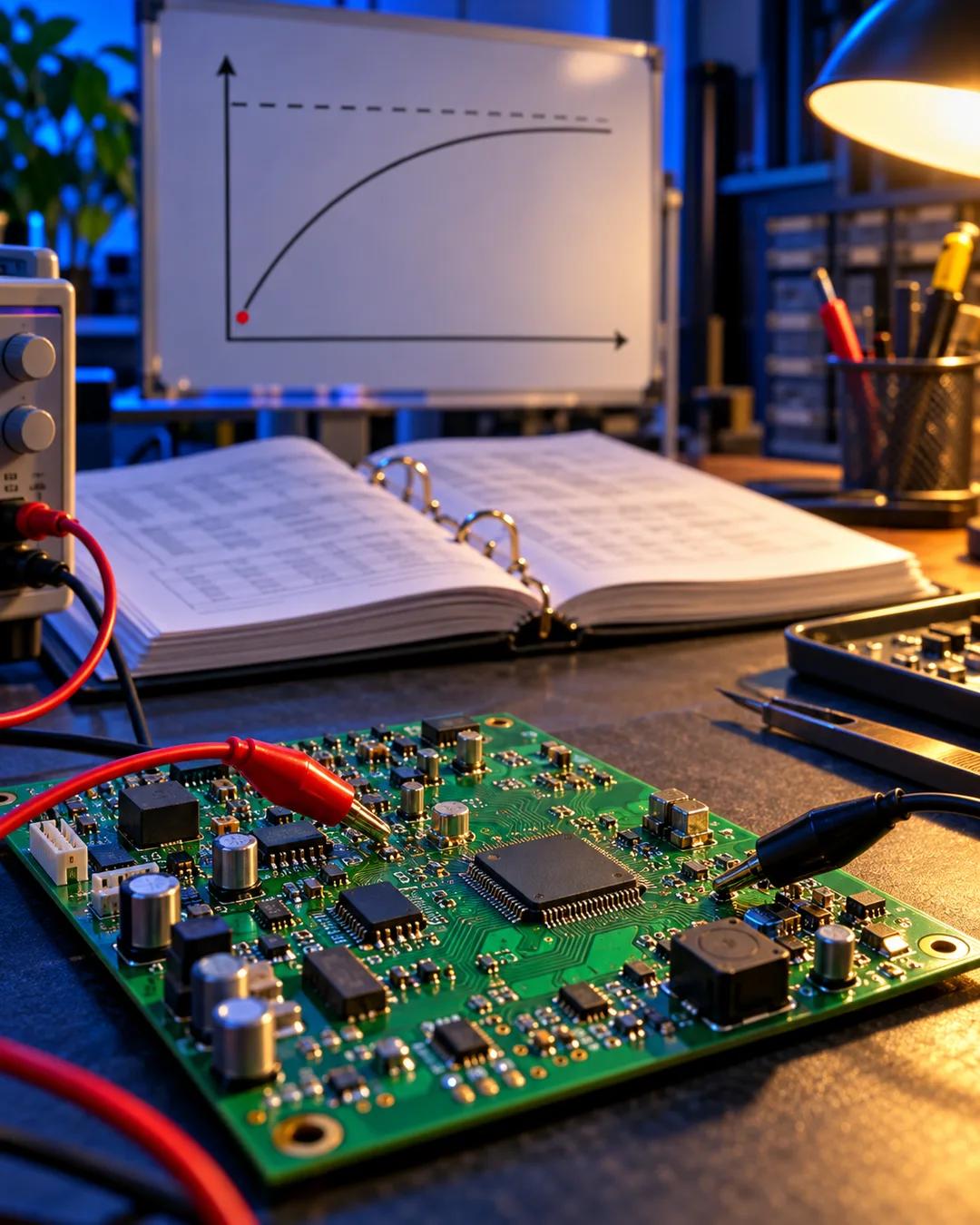
Simulations set a hardware design's roofline, the best it will ever perform. Every layer of software and reality, compilers and kernels included, takes away from that ceiling. A team might start at 10% of its roofline when the first part comes up, then grind for months and years to close the distance.
Control and geopolitics
Control differs as well. A software company owns its whole stack apart from the cloud underneath it. A hardware company depends on HBM, DRAM, and TSMC, and many of those links cross geopolitical borders, which puts geopolitics into the schedule.
How does the roofline cap hardware performance?
The roofline model, proposed in 2009 by Samuel Williams, Andrew Waterman, and David Patterson, bounds a program's speed by two limits. One is the chip's peak compute rate, and the other is memory bandwidth multiplied by how much math the program does per byte it fetches. Whichever limit is lower sets the ceiling. Plotted on a graph, the two limits form a sloped line that flattens into a roof.
Why is chip manufacturing concentrated at TSMC?
Building a leading-edge fab costs tens of billions of dollars, and few companies can fund one. TSMC, founded in 1987 by Morris Chang, pioneered the pure-play foundry model, in which a company manufactures chips designed by others. That let designers skip building fabs and pool demand at one manufacturer. Apple, NVIDIA, and AMD all use it.
Why is fixing a chip design slow?
A change to a chip requires new photomasks, the stencils used to print each layer. The new design then goes back through the fab, which takes months, and each round is called a respin. A software bug, by contrast, can be fixed and shipped the same day. At advanced process nodes, a full mask set can cost millions of dollars.
More from Invest Like the Best with Patrick O'Shaughnessy