Korva is a scroll of the internet’s best ideas.
Humans found words for agency

A burst of progress
Around 1000 BCE, Greece, the Hebrews, China, India, and Persia were small villages. Five hundred years later the Buddha, Confucius, and Socrates had lived, and technology, medicine, the arts, literature, and the first stirrings of political freedom had appeared. What changed is that people found the concept of agency, and the vocabulary for it, words like I can do it.
Homer's shift
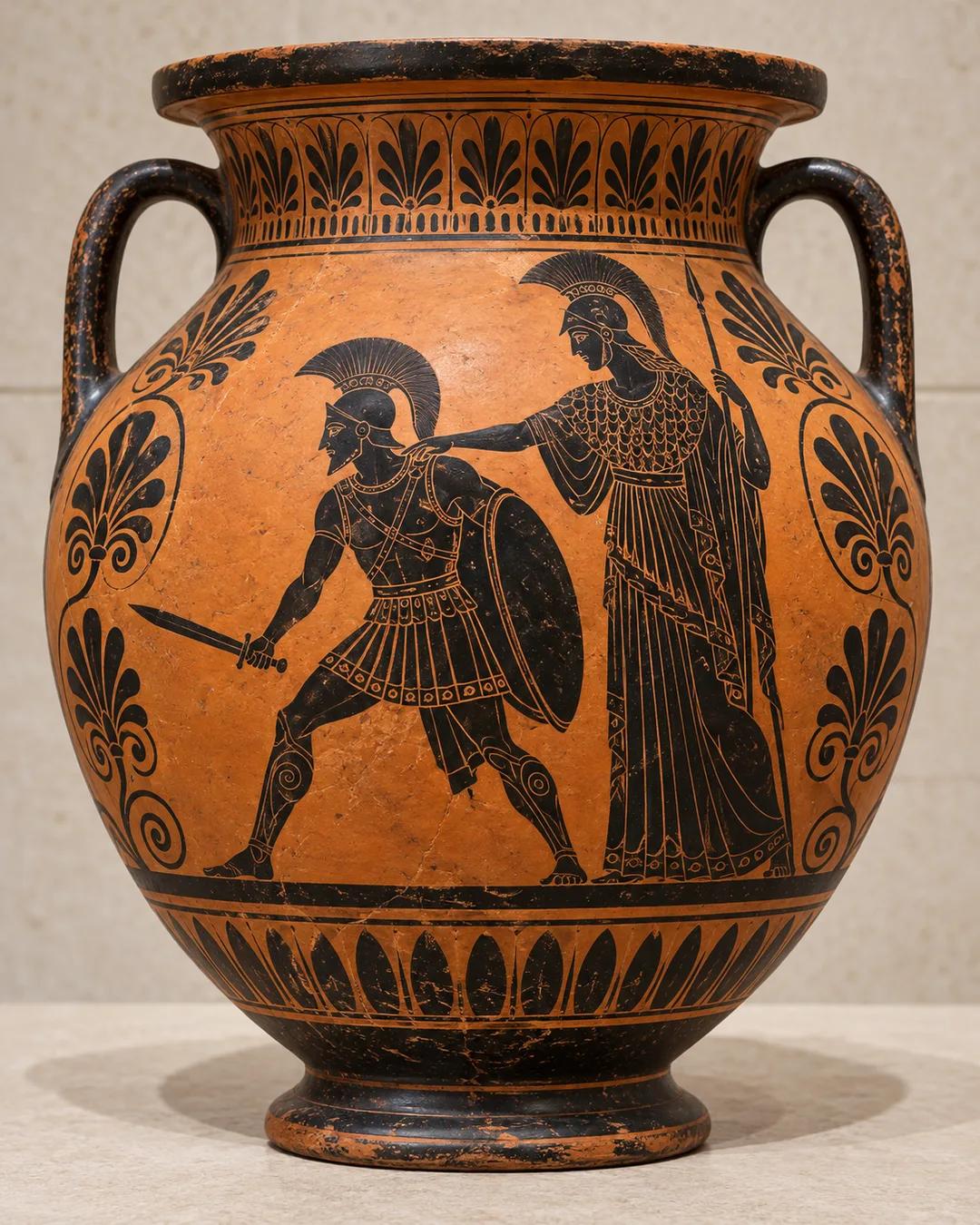
Homer shows the shift. In the Iliad, Achilles does not decide to act; Athena tells him to. A hundred years later, in the Odyssey, the gods have started to leave the stage, and Odysseus is a clever, cunning, wily man who acts for himself.
The Old Testament
The Old Testament follows the same pattern. The Torah is God commanding and humans obeying, with a few exceptions like choose life, while the prophets and the writings use more human agentic words and fewer divine ones. When AI rates each book for how agentic it is, the scores rise in a straight line, and they line up in a straight line with innovation, population, standard of living, political freedom, and technology.
Why did so many thinkers appear at once?
German philosopher Karl Jaspers named this stretch the Axial Age in his 1949 book The Origin and Goal of History. He placed it roughly between 800 and 200 BCE and pointed to Confucius, the Buddha, the Hebrew prophets, and the Greek philosophers as figures who appeared in regions with little contact. Jaspers saw it as a turning point when societies began questioning their own traditions. Scholars still debate whether the label fits.
Did Homeric heroes lack a mind of their own?
Classicist Bruno Snell argued in his 1946 book The Discovery of the Mind that Homer's characters had no single word for the mind or will as a whole. In his reading, actions come from parts of the body, such as the thumos, or from the gods. Later scholars have disputed how far this goes and have noted that Homeric characters often deliberate.
What do Odysseus's epithets show?
The Odyssey opens by calling Odysseus polytropos, often rendered as man of many turns. Elsewhere he is called polymetis, of many counsels, and polymechanos, of many devices. These describe him by his own cunning. All three are formulaic epithets repeated throughout the poem.
More from Hidden Brain