Korva is a scroll of the internet’s best ideas.
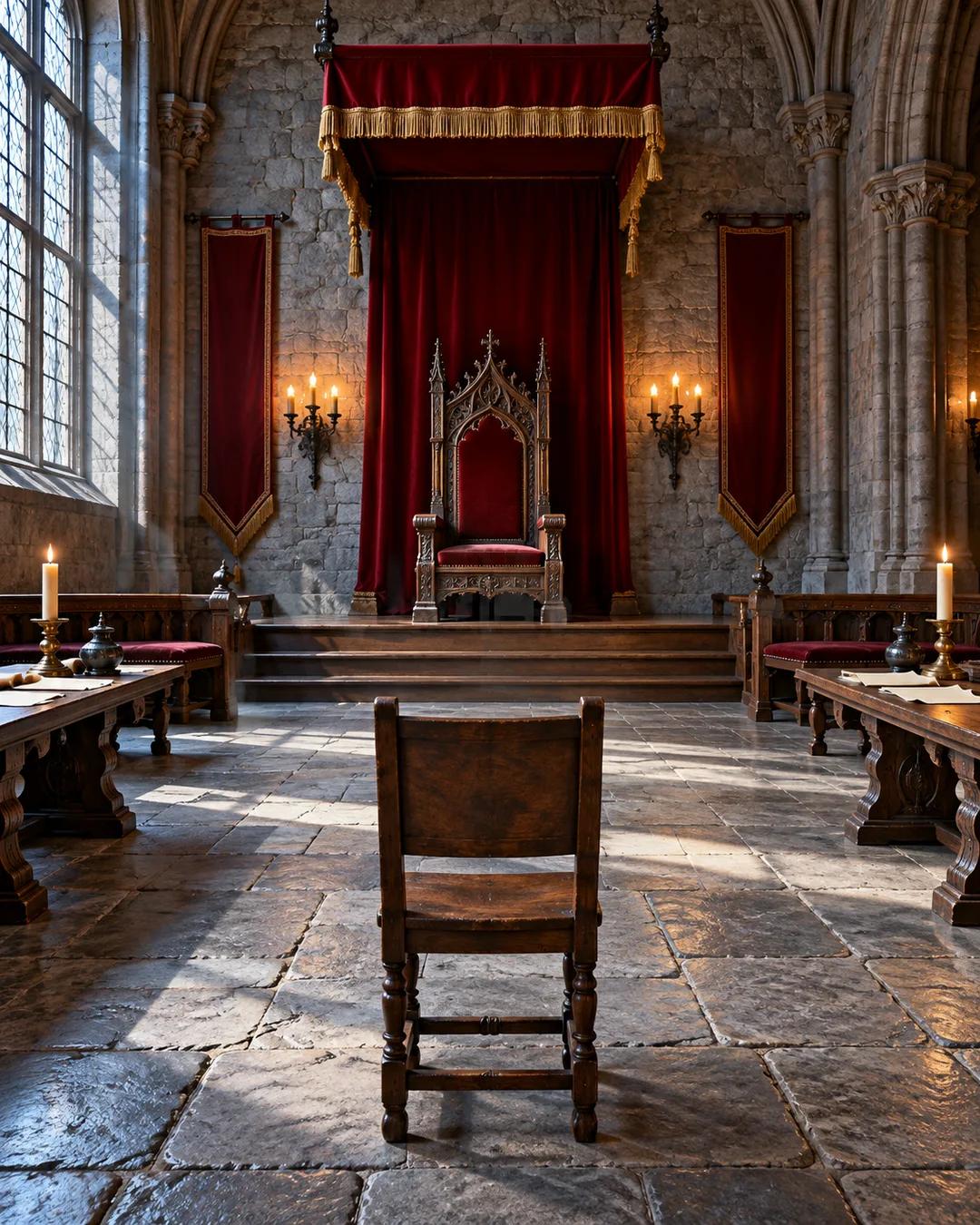
Mary faced an empty throne

The courtroom
The trial opened on 14 October 1586 in the presence chamber at Fotheringay Castle, the room where a monarch sat in state. Elizabeth was not there, but her throne stood under a great cloth of state emblazoned with her royal arms. Mary's judges were commissioners Elizabeth had appointed, privy councillors and peers on three benches around a central table, with William Cecil, Lord Burghley, in charge.
Persuading Mary
Mary at first refused to attend. A queen is no subject of Elizabeth, and appearing would amount to a confession that she was bound by English law. Sir Christopher Hatton talked her round: if she was innocent, she wronged her reputation by avoiding a trial, and the trial would go ahead without her. After a restless night she agreed. She entered shortly after nine in black velvet and a long white veil, and everyone stood and took off their hats. She was indignant that her chair sat below Elizabeth's throne.
The evidence
She had no lawyer, only three ladies in waiting. Burghley sat in her eye line, and on the bench facing the throne sat Sir Francis Walsingham, whom she was meeting for the first time that morning. Thomas Phillips had laid out the evidence, including the bloody letter. When Mary realised her correspondence had been read, she was stunned and wept. Then she attacked: the letters were not in her handwriting, and she could not answer for the plans of desperate men she knew nothing about. She accused Walsingham of tampering with her letters, which was exactly what he and Phillips had done.
On the second day she rose, forgave the commissioners for a charade, and crossed the room to speak privately into Walsingham's ear. No one heard what she said, but onlookers saw that he was angry.
Why did Mary say she could not be tried?
Mary held that she was an anointed sovereign, and that one monarch had no authority to judge another. The principle comes from the Latin maxim par in parem non habet imperium, meaning an equal has no authority over an equal. Elizabeth's side held that Mary had lived in England and was therefore bound by English law.
Why did an empty throne matter in Tudor ceremony?
A cloth of state was the canopy hung over a throne to mark the seat of the sovereign. Where it hung, the sovereign was considered present, even when absent in person. Courtiers in Tudor England were expected to bow when passing a cloth of state, whether or not anyone sat beneath it.
More from The Rest Is History