Korva is a scroll of the internet’s best ideas.
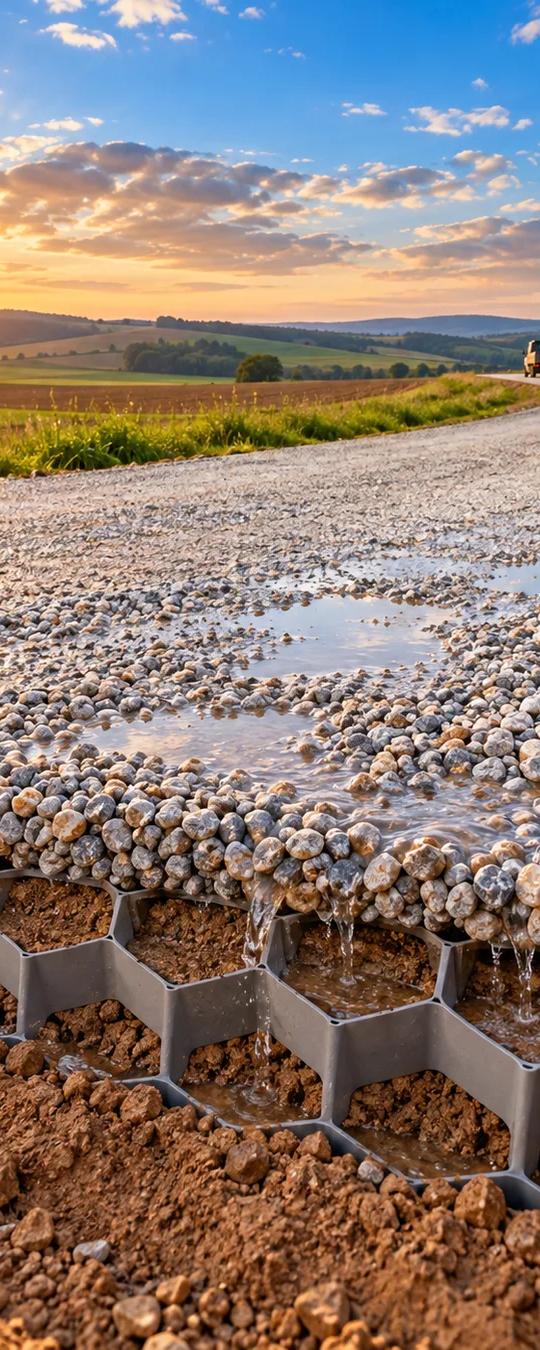
Mesh grips soil like reinforcing steel

What geotextiles do
Geotextiles are industrial strength fabrics that go down like a big bedsheet. They keep gravel from sinking into the mud beneath it, and some work as filters that let water through without carrying soil along. They have little strength, and they don't engage with the layers above or below, so they can move independently of the soil. Under heavy enough loads, the whole thing still ruts and sags.
Why geogrid grips
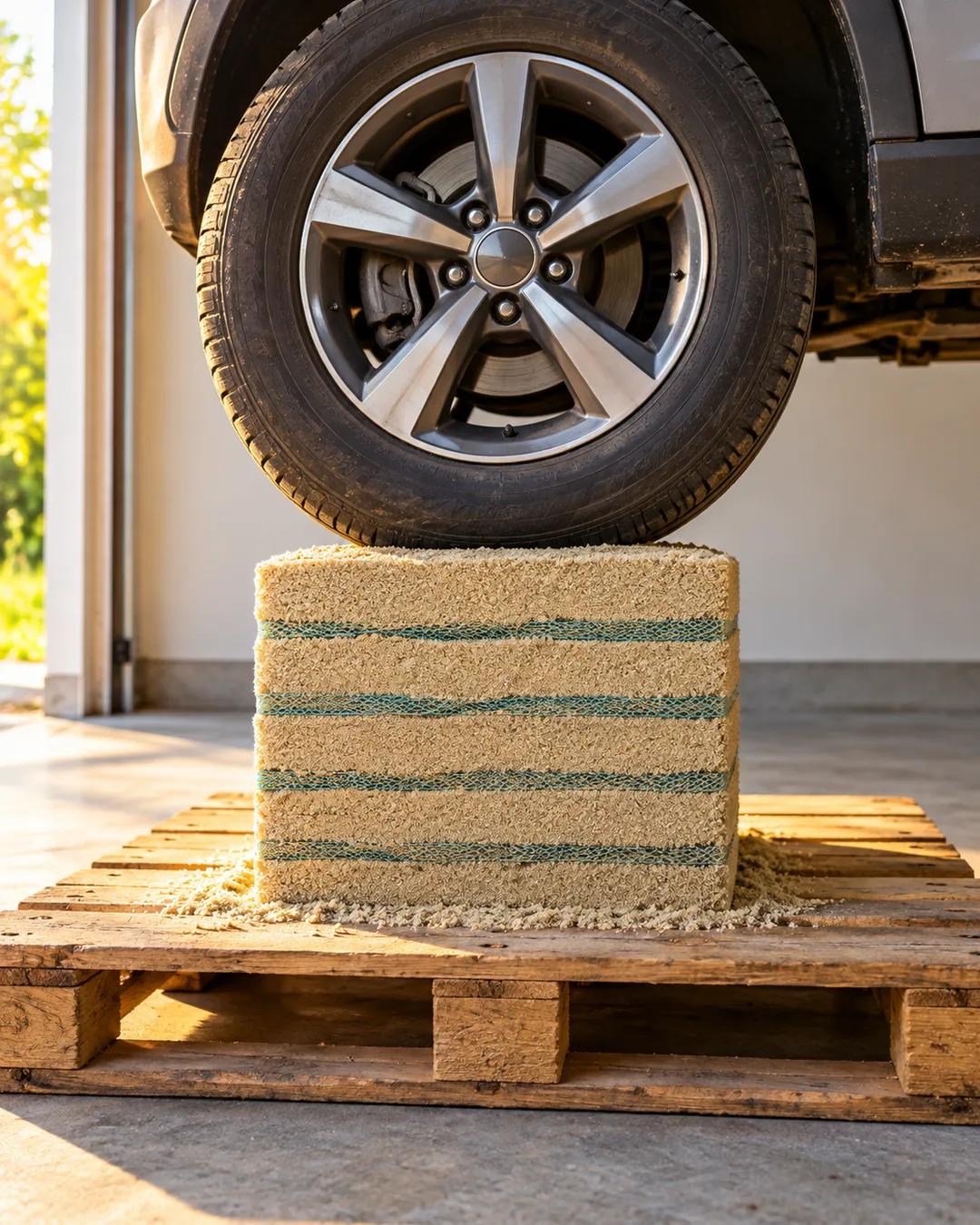
Geogrid is much stronger, and its openings let it grip the material on both sides. Reinforced earth retaining walls use this technology, and a lot of the retaining walls along highways are built that way. A cube of sand layered with fiberglass window screen was strong enough to hold up a car wheel.
The case for 3D cells
Geogrid is inherently 2D. It grabs the soil near it, and the farther from the grid the soil sits, the less the grid helps. A thicker layer needs several layers of grid stacked up, as in that sand cube, and that is where the 3D structure of geocells comes in.
Why does steel work inside concrete?
Concrete resists crushing well but cracks when stretched, with a tensile strength of roughly a tenth of its compressive strength. Steel bars take up that stretching force. Ribs rolled into rebar grip the concrete, and the two materials expand and contract with temperature at nearly the same rate, about 10 to 12 millionths per degree Celsius, so they do not pull apart as the weather changes.
How do reinforced earth walls stay up?
French engineer Henri Vidal developed the method in the 1960s. Layers of soil are compacted with strips or grids laid between them, and friction and interlock between the soil and the reinforcement make the soil mass behave like a solid block. The facing panels at the front only hold the surface in place. The first wall of this kind went up in France in the mid-1960s.
Why put fabric between gravel and mud?
Under repeated traffic, soft mud is pumped upward into the gaps of a gravel layer while the gravel is pushed down into the mud. That gradually ruins the drainage and strength of the gravel. A fabric between the two layers stops them from mixing while still letting water pass through. Engineers call this function separation.
More from Practical Engineering