Korva is a scroll of the internet’s best ideas.
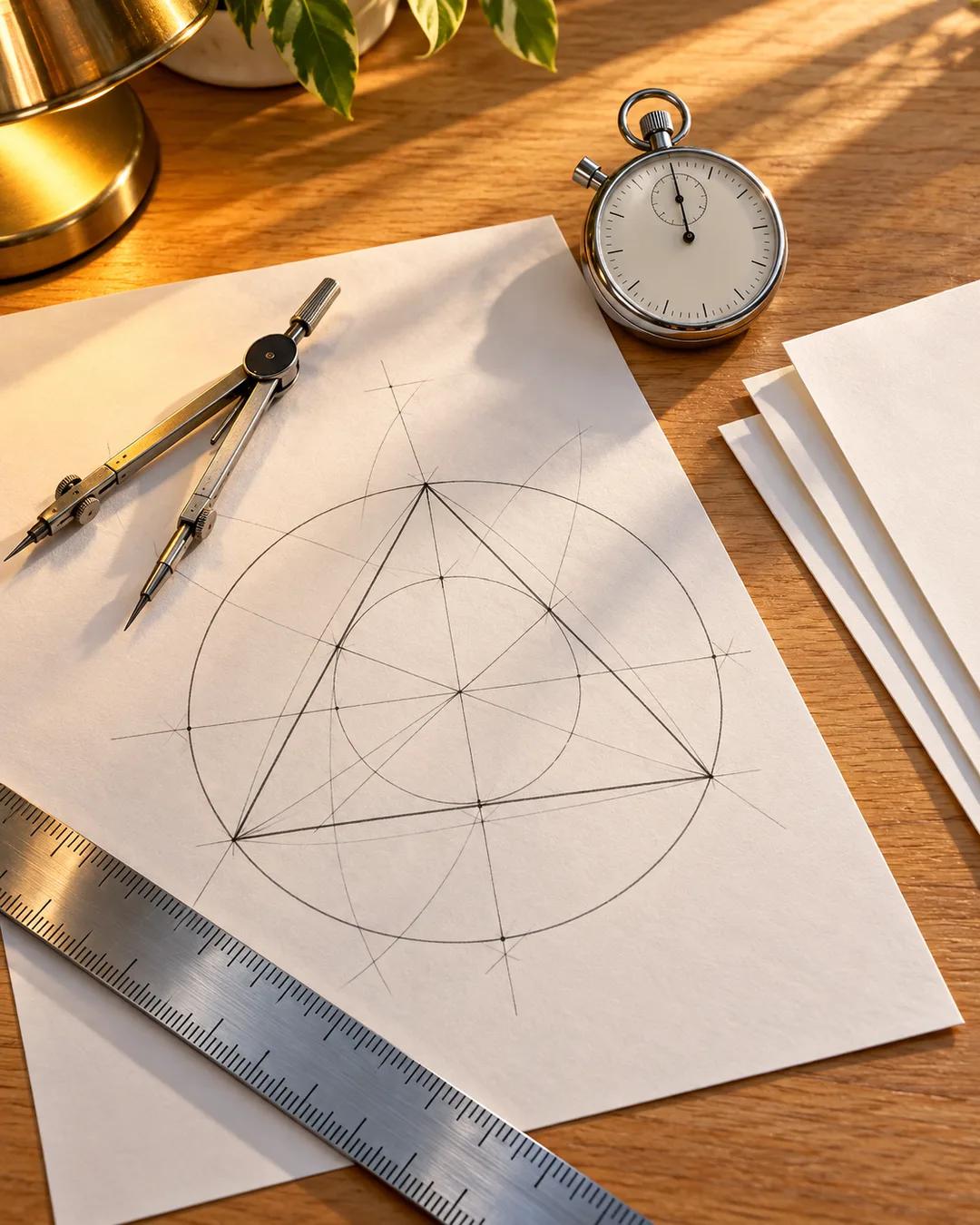
Olympiad geometry falls in nineteen seconds
The four categories are geometry, number theory, algebra, and combinatorics. Geometry has a brute force way in, and students have one too. The IMO's dirty secret is that a lot of its problems can be trained for.
Combinatorics is the wild card: much more playful, puzzly problems. There are four categories and six problems, so it is a toss-up which category gets two questions. In 2024 there were two combinatorics problems, and AI struggled on those. Had there been more geometry, it would have gotten a gold that year.
How can a program brute-force geometry?
Many geometry problems convert into algebra by placing points on coordinates. In 1978, Wu Wen-Tsun published a method that turns such statements into polynomial equations a computer can check mechanically. DeepMind's AlphaGeometry in 2024 combined a symbolic solver of that kind with a language model that suggests added constructions. It solved 25 of 30 benchmark Olympiad geometry problems.
How are Olympiad medals decided?
Cutoff scores are set after the exams are graded, so that gold goes to about one twelfth of contestants, silver to about one sixth, and bronze to about one quarter. About half of all contestants earn some medal. Each problem is worth seven points, and the maximum score is 42.
Why do combinatorics problems resist training?
Geometry and algebra have standard methods that cover many problems, such as coordinates and inequalities. Combinatorics problems often depend on a specific clever construction or counting argument. The area has fewer unifying theories that apply across questions, which is why Olympiad coaches describe each problem as nearly a new puzzle.