Korva is a scroll of the internet’s best ideas.
One lap equals half a wavelength

Finding the point
A point is found where a resistance circle meets a reactance circle, after dividing the impedance by the line's 50 ohms. A measured 36 ohms of resistance and 74 ohms of reactance becomes 0.7 plus 1.5j, which sits above the horizontal axis because the reactance is positive. The center of the chart, where normalized resistance is one and reactance is zero, is a perfect match with no reflection.
Reading the reflection
An arrow from the center to the point has a length equal to the magnitude of the reflection coefficient, 0.68 here, meaning the reflected wave is 0.68 times the forward wave. Moving along the line keeps that magnitude fixed, so the point traces a circle around the center. The standing wave pattern repeats every half wavelength, so 360 degrees of rotation equals half a wavelength.
Matching with copper and coil
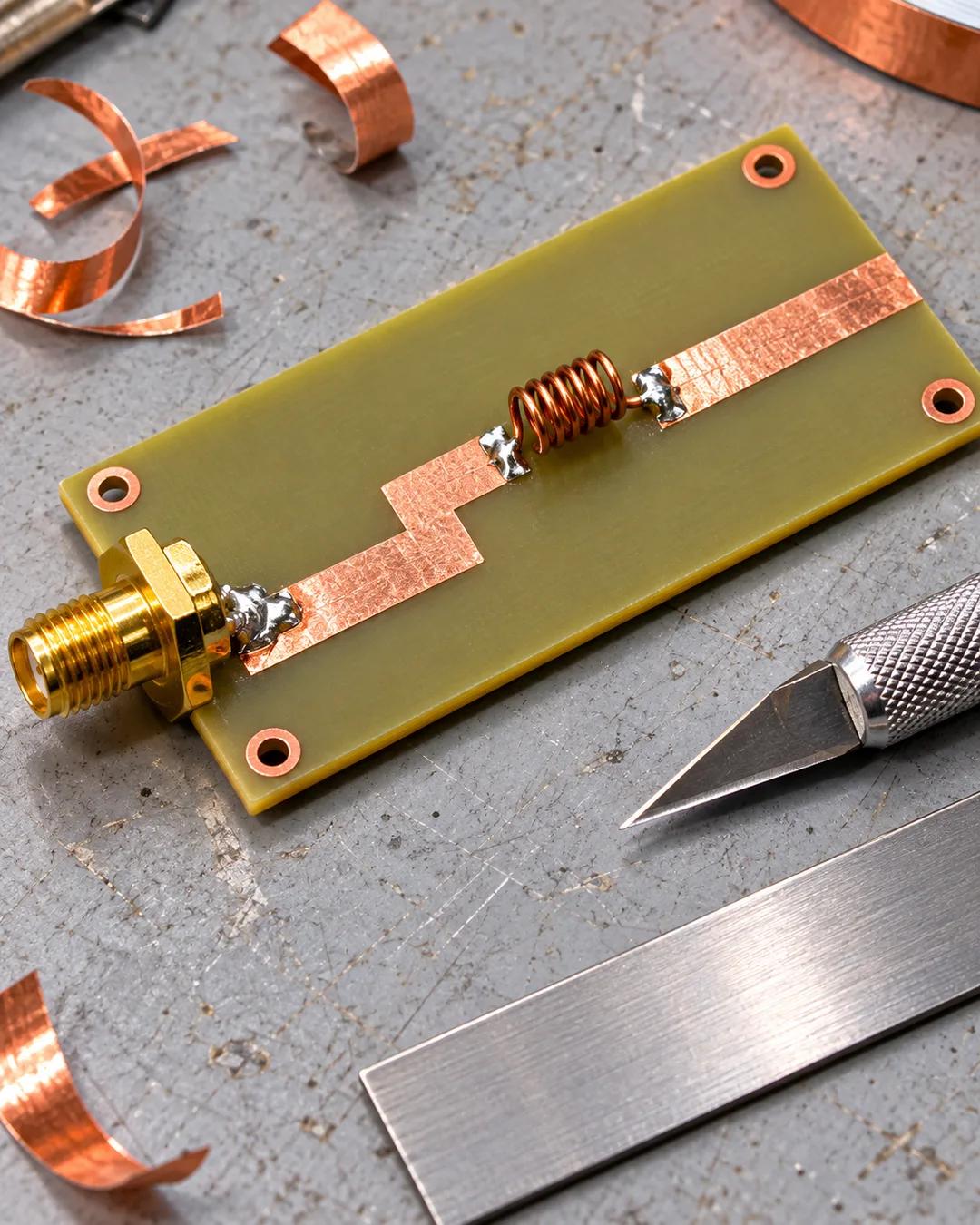
That circle crosses the circle of resistance one at two places. The nearer one was a 12 degree rotation away, which at 1,085 megahertz is 3.1 millimeters of line, and the next available spot called for 28 millimeters of extra line laid down in copper tape. A leftover reactance of about negative 1.8 was canceled with a series inductor of 13.2 nanohenries, and the reflections disappeared, with the highest power output of the whole test.
Why divide impedance by the line's 50 ohms?
Dividing by the line's characteristic impedance gives a normalized number, so one chart works for any line. A perfect match always lands on the same central point, whatever the line is made of. Radio equipment is commonly built around 50 ohms, while video and cable television systems commonly use 75 ohms. Both can be read off the very same printed chart.
How does moving along the line rotate the point?
The reflected wave makes a round trip, so each step along the line adds a phase shift of twice that distance, measured in wavelengths. The size of the reflection stays the same on a lossless line, so only the angle changes and the point slides around a circle. Moving toward the generator turns the point clockwise, and moving toward the load turns it counterclockwise. The outer rim of the chart carries a wavelengths scale for reading off these distances.
Why does a series inductor cancel leftover reactance?
Reactances in series add together, and an inductor has a positive reactance while a capacitor has a negative one. A component whose reactance is equal and opposite to the leftover leaves only the resistance behind. An inductor's reactance equals 2 times pi times the frequency times its inductance. At 1,085 megahertz, 13.2 nanohenries works out to about 90 ohms, which is 1.8 after dividing by 50.
More from Veritasium