Korva is a scroll of the internet’s best ideas.
One plaster fragment solved the windows

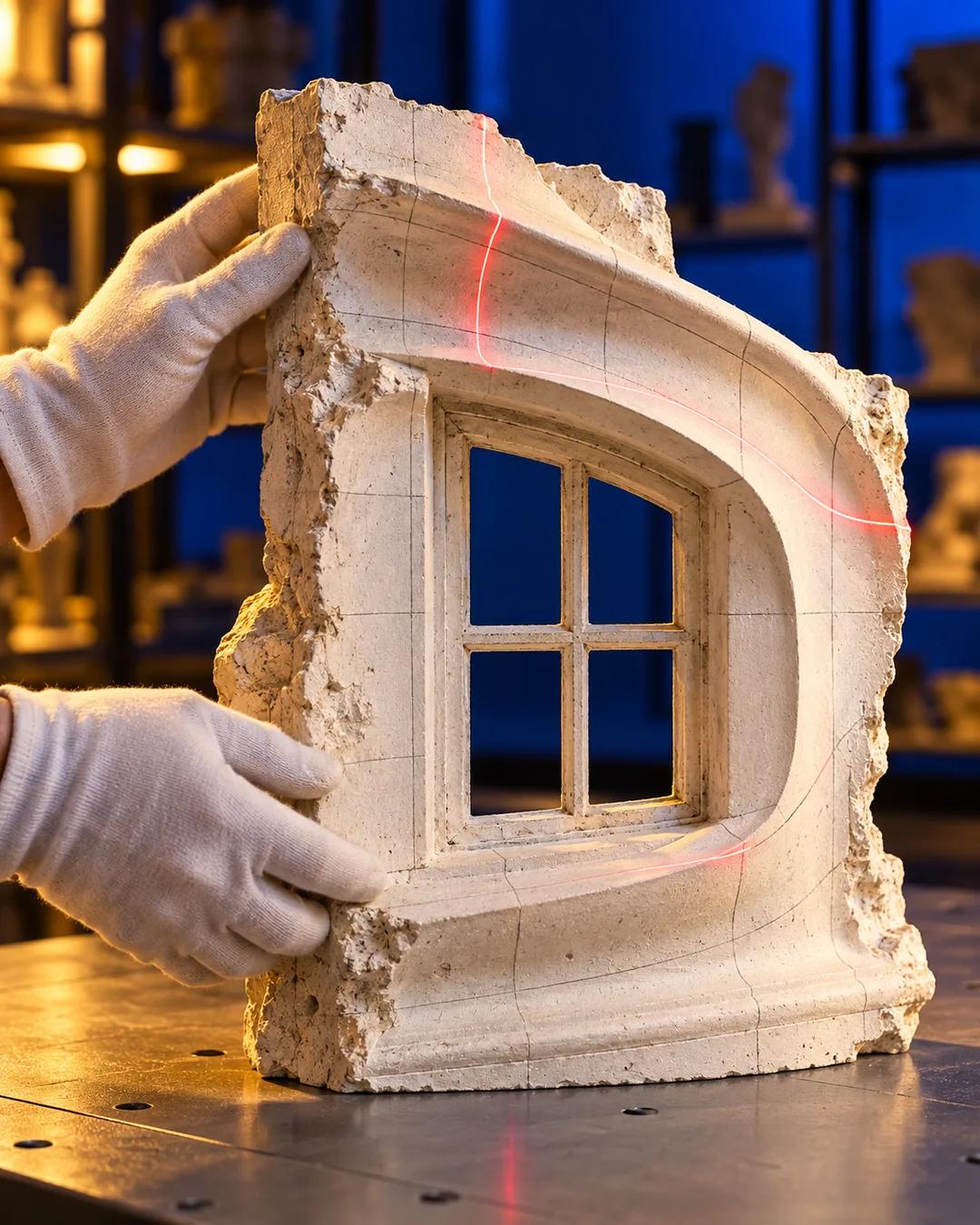
The surviving fragment
The fragment is a window from a scale model. Each pane is surrounded by a smooth surface, and Gaudí made it a ruled surface, one generated entirely from straight lines. This one comes from twisting a cylinder. Light enters without hard shadows and glides across the interior, which lets the stained glass do its work in the soft-edged windows with their vast fields of uninterrupted glass.
Fitting the variables
A ruled surface is defined by a set of variables that control its geometry. The architects scanned the plaster fragment, placed parametric hourglass shapes over each window, and adjusted the variables until the model matched exactly what Gaudí had built.
Locking in the design
With those values locked in, the rest got easier, like a Sudoku puzzle revealing itself number by number. From a single fragment they could reconstruct the design with mathematical precision. The vaults overhead use the same ruled surfaces scaled up with the same parametric method.
How do straight lines produce a curved surface?
Tilt a straight line relative to an axis and sweep it around that axis, and the line traces a hyperboloid, a surface that curves in two directions. Builders can form such a surface from straight timber, wire, or rods, which is far easier than shaping true curves. Gaudí used hyperboloids, helicoids, and conoids, which all belong to this family. Russian engineer Vladimir Shukhov patented a hyperboloid lattice tower in 1899.
Why do splayed window openings soften light?
A plain window cut into a thick wall creates a sharp contrast between bright glass and dark stone, which feels glaring. Widening the opening toward the inside lets light spread across the wall surface before it reaches the room. Architects call this a splay, and builders have used it since the Romanesque era.
How do you scan a fragment into a digital model?
A laser scanner measures the distance to millions of points on the object by timing reflected light. Software gathers those points into a cloud that records the object's shape. A mathematical surface is then fitted to the cloud by minimizing the distance between the points and the surface. The numbers that give the best fit are the surface's parameters.
More from Real Engineering