Korva is a scroll of the internet’s best ideas.
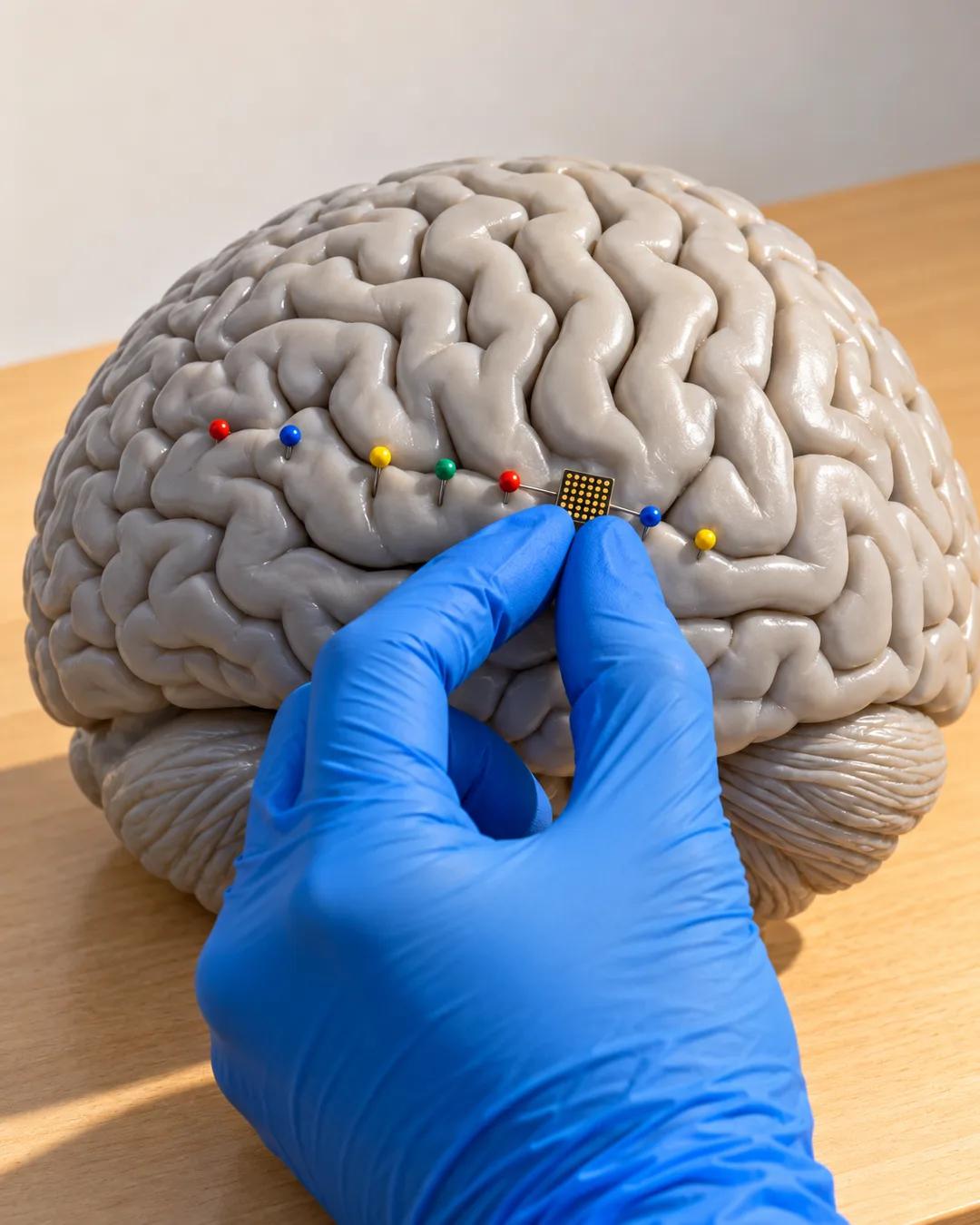
Place speech implants where speech is planned

Where decoders work best
Motor cortex holds two kinds of regions. Some control the muscles directly, the movements of the lips, tongue, and larynx. Others act as relays between higher-level language areas and those motor areas, and they seem to contain a higher-level representation of the speech sounds that need to be produced. Those relay regions are the ones to hit when decoding attempted speech. Across the BrainGate collaboration, decoder performance varies a lot between people, presumably in part because of how speech-selective the implanted sites are.
When planning is damaged
The problem sharpens when the speech motor planning part is no longer intact. A person may still think and still form a planned message without being able to program the movements that would carry it out. The language network is a candidate place to read from instead, and the answer is currently unknown.
Finding the best spots
To find the best spots, the plan is to scan a patient before surgery. fMRI maps the brain in space, and magnetoencephalography, a noninvasive magnetic detector of brain activity, records fast computations and representations. The fMRI data can also show which functional network a given MEG signal likely came from. Together they could triangulate the ideal sensor placement.
How do speech implants turn signals into words?
Electrode arrays in motor cortex record the activity of nearby neurons while a person attempts to speak. A machine learning model maps those patterns onto speech sounds, and a language model then assembles the sounds into likely words. A 2023 Nature study from Stanford reported a decoder running at 62 words per minute. Natural conversation runs at roughly 150 words per minute.
Why is producing speech such a demanding movement?
Speaking requires the lips, tongue, jaw, larynx, and breathing muscles to move in precise coordination within milliseconds of each other. Motor cortex sends commands to all of these muscle groups, each with its own timing. Damage anywhere in the chain can leave a person able to think a sentence while unable to say it. Conditions such as brainstem stroke and amyotrophic lateral sclerosis can produce this pattern.
How does magnetoencephalography detect brain activity?
Currents flowing through neurons produce tiny magnetic fields outside the head. MEG uses extremely sensitive sensors called SQUIDs to measure them, and the fields are billions of times weaker than the Earth's magnetic field. The method follows brain activity with millisecond timing, which fMRI cannot do. Its map of where the activity sits in space is coarser than fMRI's.
More from Wu Tsai Neurosciences Institute, Stanford