Korva is a scroll of the internet’s best ideas.
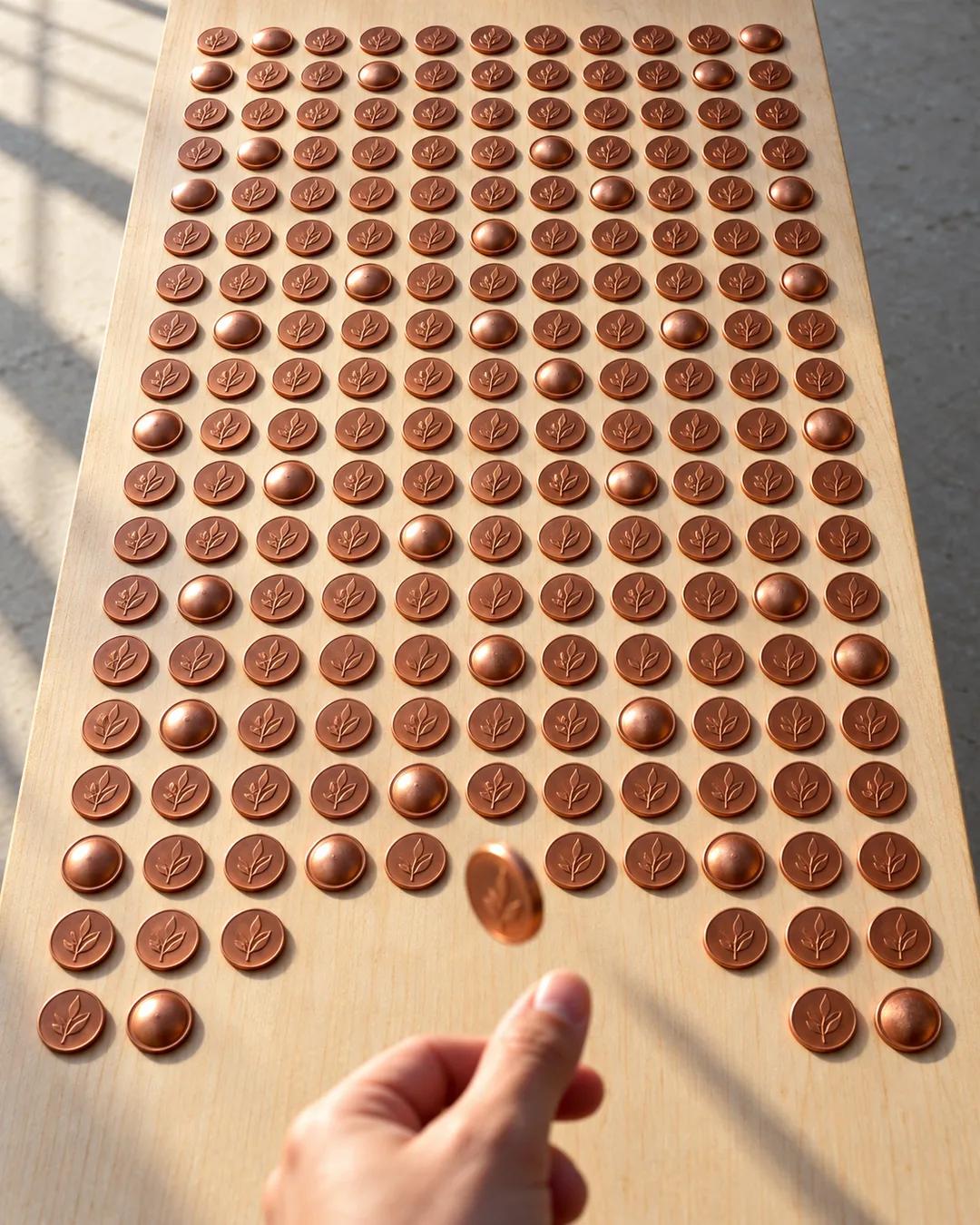
Quantum answers need many repeat runs
Reading out a result
To bring a result back to classical bits, the circuit ends in a measurement gate, usually drawn as a dial. It turns the quantum data into bits with a probability set by the angle of the data, so each measurement is one random draw from that probability.
Counting shots
Reconstructing the qubits precisely would take a huge number of these repeated runs, called shots. Usually the interest lies in one property of the quantum state, so the shots can be economized: the entire state never gets reconstructed, and an approximate sense of the outcome is enough.
Hybrid networks
The same measurement sits at every hop from quantum back to classical. In a quantum neural network, a layer of parameterized circuits, whose gates rotate qubits by an angle that training optimizes, can be followed by a classical neuron, and passing from one to the other means measuring.
Why can't one measurement tell us more?
The Born rule makes each measurement a single random draw from the state's probabilities. Measuring also collapses the state, so the superposition is gone after one reading. The no-cloning theorem, proved in 1982 by Wootters and Zurek and independently by Dieks, forbids copying an unknown quantum state to measure it again. The only option is to prepare the state afresh and run the circuit again.
How many shots give a trustworthy answer?
The error in an estimated probability shrinks with the square root of the number of shots. Cutting the error in half takes four times as many runs. For that reason, estimating one property to modest precision is cheap, while reconstructing a whole state is not. Full state tomography needs a number of measurements that grows exponentially with the number of qubits.
What makes a rotation gate trainable?
A parameterized gate rotates a qubit by an angle, and the expected measurement result changes smoothly as that angle changes. The parameter shift rule, described in work from several research groups around 2018 and 2019, shows how to compute the exact gradient by running the same circuit at two shifted angles. That lets standard gradient descent adjust the angles, the same way it adjusts weights in a classical network. The cost is extra circuit runs for every parameter.
More from Computerphile