Korva is a scroll of the internet’s best ideas.
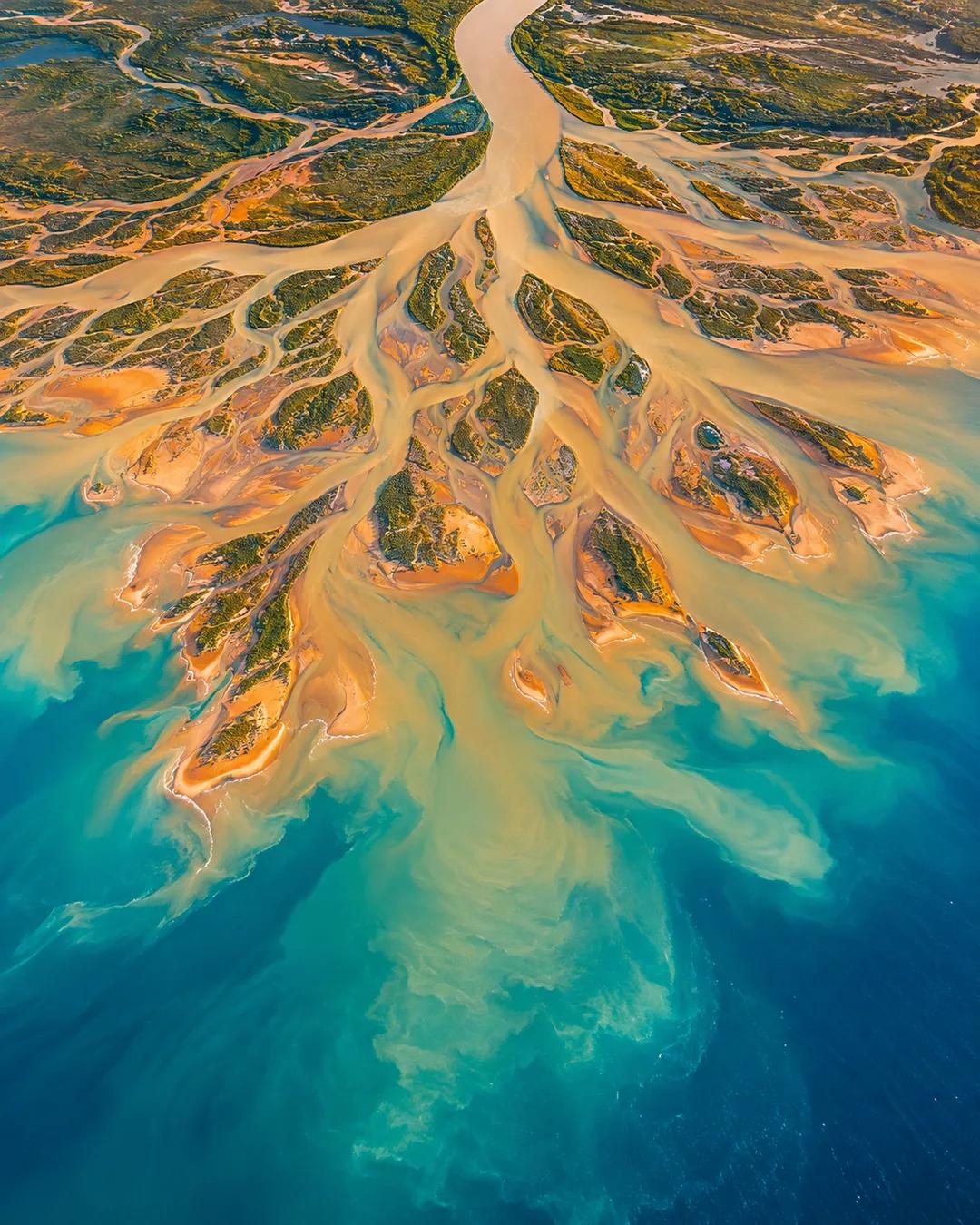
River deltas follow the same math
Deltas follow Hack's law
In April 2026, Tian Dong of the University of Texas, Rio Grande Valley and co-authors made the cover of Science by showing that Hack's law holds for deltas. Hack's law is the rule that a stream's length is proportional to its drainage area raised to the power of 0.6. A river hits a brick wall when it reaches the nonflowing ocean. The sudden deceleration makes the water drop the sediments it carries, and these pile up to form new land. The river's water splits into a network of channels that shift constantly as sediments build up and wash away.
Studying a flat landscape
Deltas are hard to study. Upstream, slope and elevation differences make it easy to calculate the area of land that drains into any given tributary, but deltas are flat and especially dynamic. Dong and his collaborators analyzed satellite data that let them distinguish land from water. They found that the length of a channel in a delta scales with the size of its nourishment area, the area it supplies with sediments, raised to the power of 0.6.
Two opposite networks
Tributary networks and distributary networks are opposites. Sediments are transported away from one end and deposited at the other, yet both abide by the same math. Geomorphologists are now considering why Hack's law should apply in this inverse context.
Why do delta channels keep shifting?
As a channel deposits sediment, its bed rises and the water slows. Eventually the flow breaks through its banks and jumps to a shorter, steeper path to the sea, a process called avulsion. The abandoned channel starves, and the new one builds its own lobe of land. The Mississippi has built several such lobes over the past several thousand years.
How can satellites tell land from water?
Water absorbs near-infrared light strongly, while soil and vegetation reflect it. Comparing images in near-infrared and visible green bands therefore makes water stand out. In 1996, Stuart McFeeters published a widely used formula for this, called the Normalized Difference Water Index. Applied to years of imagery, it lets researchers map channels that move from one season to the next.
How do waves and tides change a delta's shape?
In 1975, geologist William Galloway proposed classifying deltas by whether the river, waves, or tides dominate. The Mississippi, dominated by the river, extends long fingers into the Gulf of Mexico. Wave-dominated deltas such as the Nile have smoother, arc-shaped coastlines because waves redistribute sediment along the shore. Tide-dominated deltas, such as the Ganges and Brahmaputra, are cut by wide channels aligned with tidal currents.