Korva is a scroll of the internet’s best ideas.
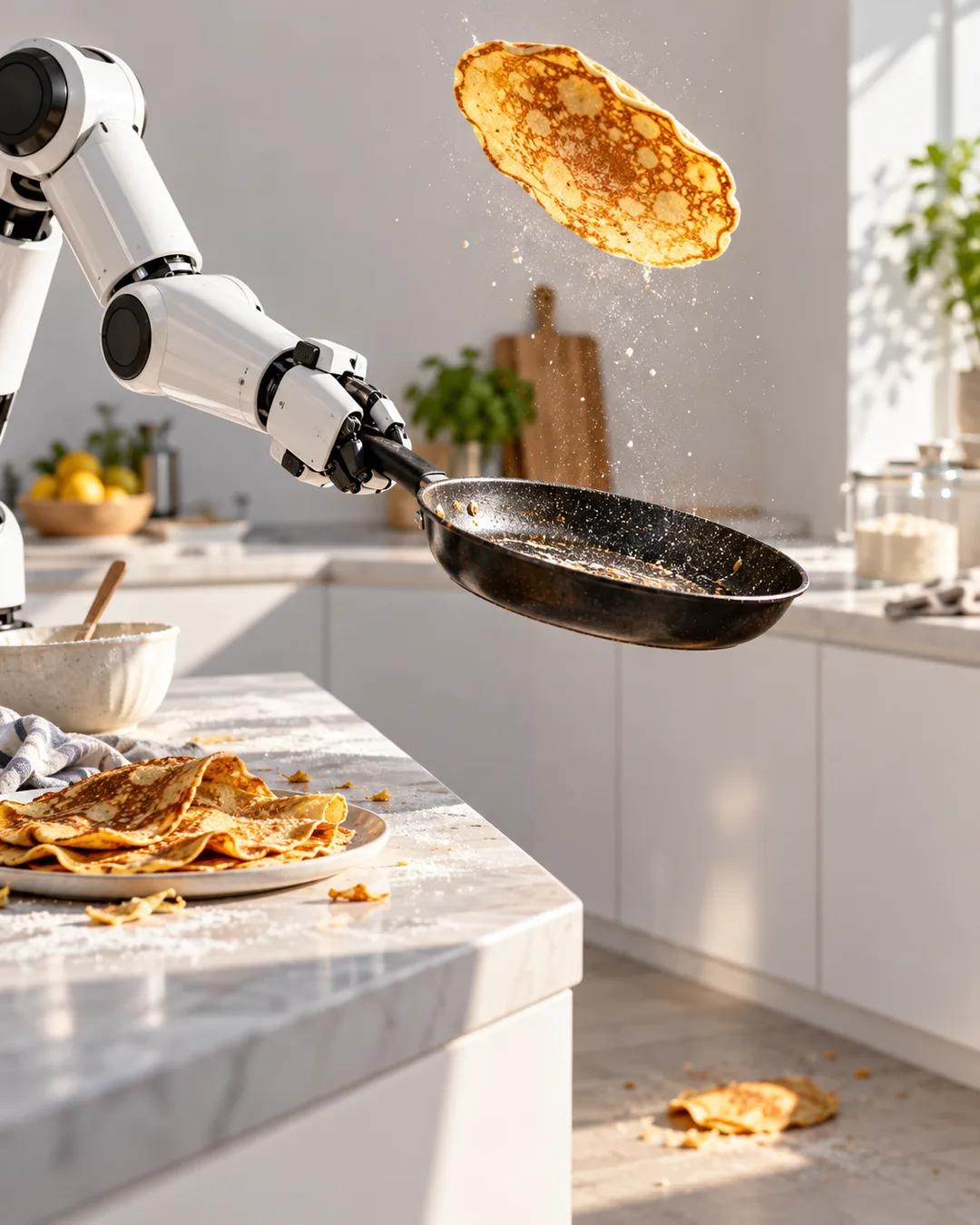
Robot flips pancakes after 50 tries

Demonstration and Feedback
A researcher in a lab worked with the robot, which was not programmed to move up, down, left, or right. The human demonstrated some good movements once, and from then on the robot tried movements and did more of the good ones and fewer of the bad.
Fifty Trials
There is no single correct way to flip a pancake, so nothing could be written out in advance. The early trials went badly. The third was still poor, and so was the fifth. After 10 trials the human stepped in to fix things again. By the 11th, the pancake was getting a bit more air, and at 15 trials it was still bad.
Every motion breaks down into x, y, and z movements, so doing more of something means more of the x, more of the y, or more of the z. The robot kept inferring what to repeat. After 50 trials, it flipped the pancake again and again.
Is this the famous pancake-flipping robot?
A 2010 study led by Petar Kormushev at the Italian Institute of Technology reported a robot arm learning to flip a pancake. The researchers first showed the arm a demonstration, then let it improve through repeated trials using reinforcement learning. After roughly fifty attempts, the arm flipped the pancake reliably. The work was published as a paper on motor skill learning.
Why is flipping a pancake hard to program?
A pancake bends and sticks to the pan, and its behavior in the air depends on its batter, its thickness, and the friction against the pan. No exact equation covers every case. A rigid object like a metal block is far simpler to model, since it keeps its shape. Roboticists treat soft and deformable objects as a long-standing hard problem.
How does a robot know which moves to repeat?
Many methods of this kind belong to the policy gradient family. Ronald Williams introduced a classic version, called REINFORCE, in 1992. After each trial, the method raises the probability of the movements that came before a good result and lowers it for those that came before a bad one. Over many trials, the movements that lead to success become the most likely ones.
More from CS50