Korva is a scroll of the internet’s best ideas.
Smuggled a mill in his head

Britain Guards Its Lead
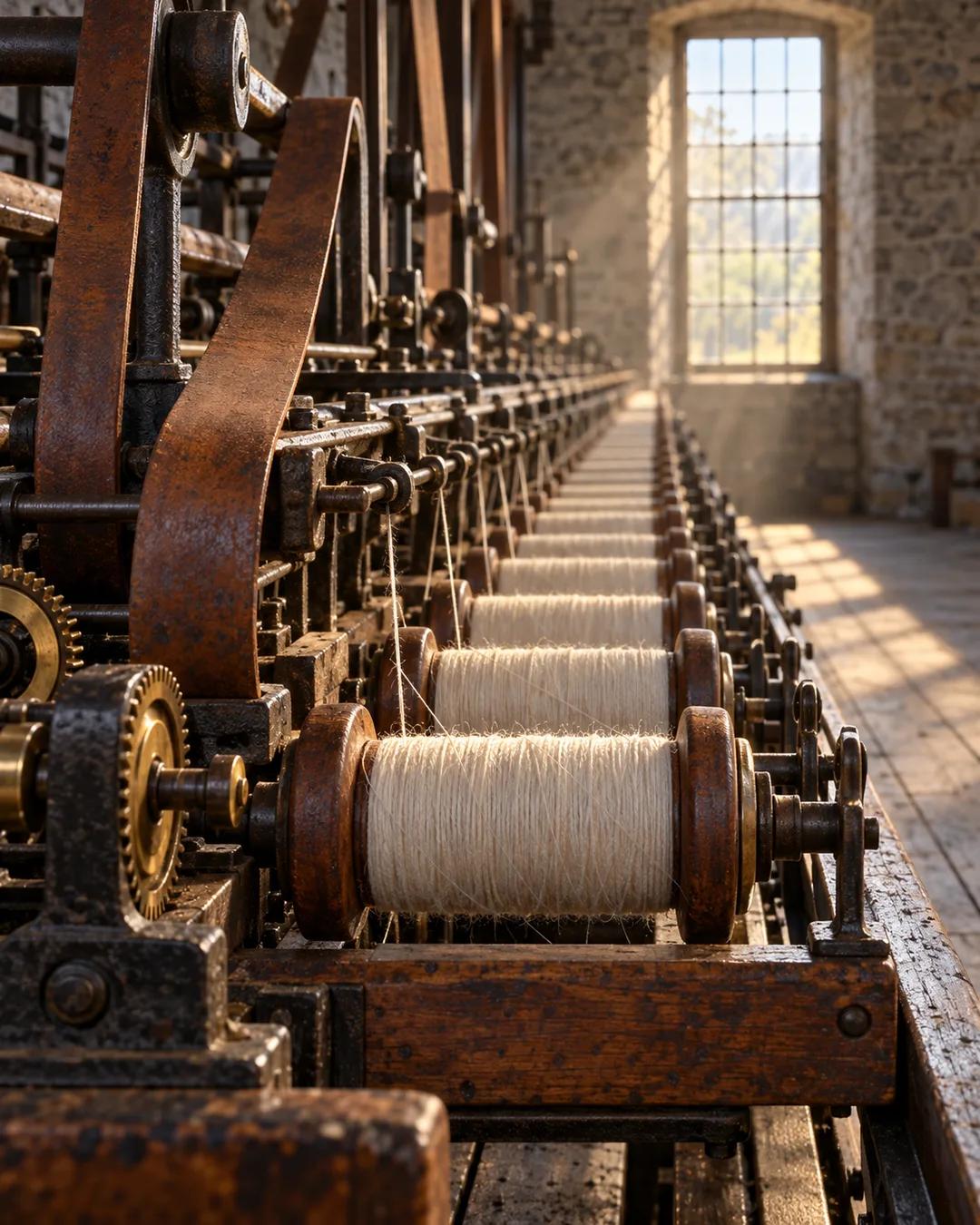
Britain's water-powered spinning frames gave it a textile lead nobody could touch, and the government guarded it. Textile machinery could not be exported, the blueprints could not leave, and the skilled mechanics who worked on the machines were barred from emigrating.
Escape and Rebuild
The young man, Slater, figured that staying in England meant an ordinary life, while taking the knowledge to the Americas could make him rich. He took an apprenticeship at a spinning-machine works and memorized the Arkwright frame piece by piece. Then he disguised himself as a farm laborer and boarded a ship for New York without a single scrap of paper on him.
In America he met a businessman named Moses Brown and rebuilt the whole intricate machine from memory. That moment was the birth of the American factory system and the end of the British monopoly.
Cotton and Slavery
It also changed the arithmetic of slavery. In 1789, plenty of Southerners expected slavery to fade away because growing tobacco and rice had stopped paying. Mills that could turn out textiles at an enormous rate created a bottomless demand for raw cotton, and that demand fed slavery in the South for many more decades.
Why did Britain ban exporting its machinery?
Britain wanted to keep its manufacturing lead at home, so Parliament passed laws in the 1700s to protect it. The Tools Act of 1719 banned skilled artisans from emigrating, and acts in the 1770s and 1780s extended the ban to textile machinery and the tools used to build it. Penalties included fines and imprisonment for anyone caught shipping equipment or recruiting workers abroad. Britain repealed the ban on emigration by skilled workers in 1825 and lifted most machinery export bans in 1843.
How did Slater learn the machine so thoroughly?
Slater served an apprenticeship under Jedediah Strutt, a partner of Richard Arkwright, at a mill in Derbyshire. Over several years he rose to oversee the mill's operations, which put him in daily contact with every part of the equipment. That training covered both how the machines were built and how they were kept running. His first machines began spinning at Pawtucket, Rhode Island, in December 1790.
Why did textile mills drive up demand for raw cotton?
Mechanized spinning and weaving multiplied how much thread and cloth one worker could produce, and each mill needed a steady supply of raw cotton to keep running. Southern growers got a major boost when Eli Whitney patented his cotton gin in 1794, which sped up the removal of seeds from short-staple cotton. According to US Census Bureau historical statistics, American cotton output rose from a few thousand bales in the 1790s to roughly 4 million bales by 1860.
More from The Rest Is Science