Korva is a scroll of the internet’s best ideas.

Why one tool falls short
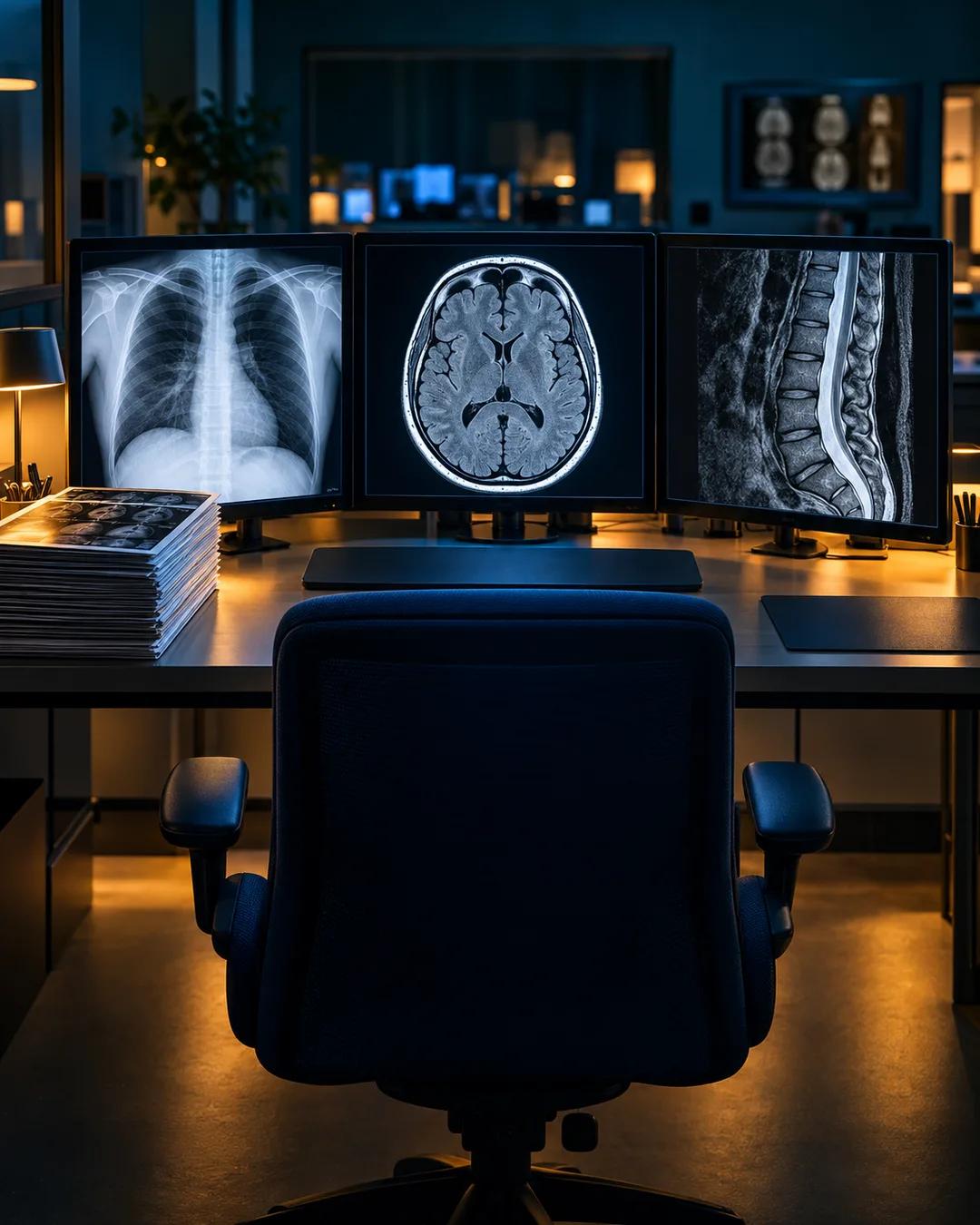
His premise held up. AI can be trained to read radiology images better than humans, and studies have shown it. The trouble starts with data: the combined training set doesn't exist anywhere. Companies go after one narrow thing, like chest CTs, but a working radiologist reads a mix every day, from X-rays to CTs to MRIs of every part of the body. A tool that handles one scan type out of twenty or forty barely changes the day.
How healthcare pays
Then there is the way healthcare pays. The whole industry is organized around reimbursing doctors for their readouts, and liability follows every missed finding, with malpractice attached. AI ends up as a co-pilot first: it handles some parts, the radiologist handles others, and they check each other. Over time the AI reads more and more of the scans, but the stretch from here to there is long.
Why demand grows
In the meantime, the world needs more radiologists, not fewer. Imaging gets cheaper, so everyone gets more of it, a Jevons paradox effect, and more scans need more people to read them.
Why do AI tools cover only one scan type?
Imaging models are usually trained on one scanner type and one part of the body, because each combination produces images with a different look and needs its own labeled examples. Labeling means a radiologist marking up thousands of scans, which is slow and expensive. Hospitals also keep images in separate archives, so assembling a broad set is hard. Most AI imaging tools the FDA has cleared are built to detect a single kind of finding.
Why does cheaper imaging mean more radiologists?
The economist William Stanley Jevons noticed in 1865 that more efficient steam engines made Britain burn more coal, not less. When something gets cheaper to use, people find many more uses for it, and total demand can outgrow the savings. Cheaper scanning works the same way, since more scans get ordered and each one needs a reader. Jevons laid out the observation in his book The Coal Question.
Why did Hinton expect radiology to go first?
Radiology work is digital images paired with written reports, which gives machine learning a large supply of examples to learn from. Image recognition was also the field where deep learning broke through, when a network won the ImageNet contest in 2012. Hinton's students Alex Krizhevsky and Ilya Sutskever built that winning network. Hinton later shared the 2018 Turing Award with Yoshua Bengio and Yann LeCun.
More from Invest Like the Best with Patrick O'Shaughnessy