Korva is a scroll of the internet’s best ideas.
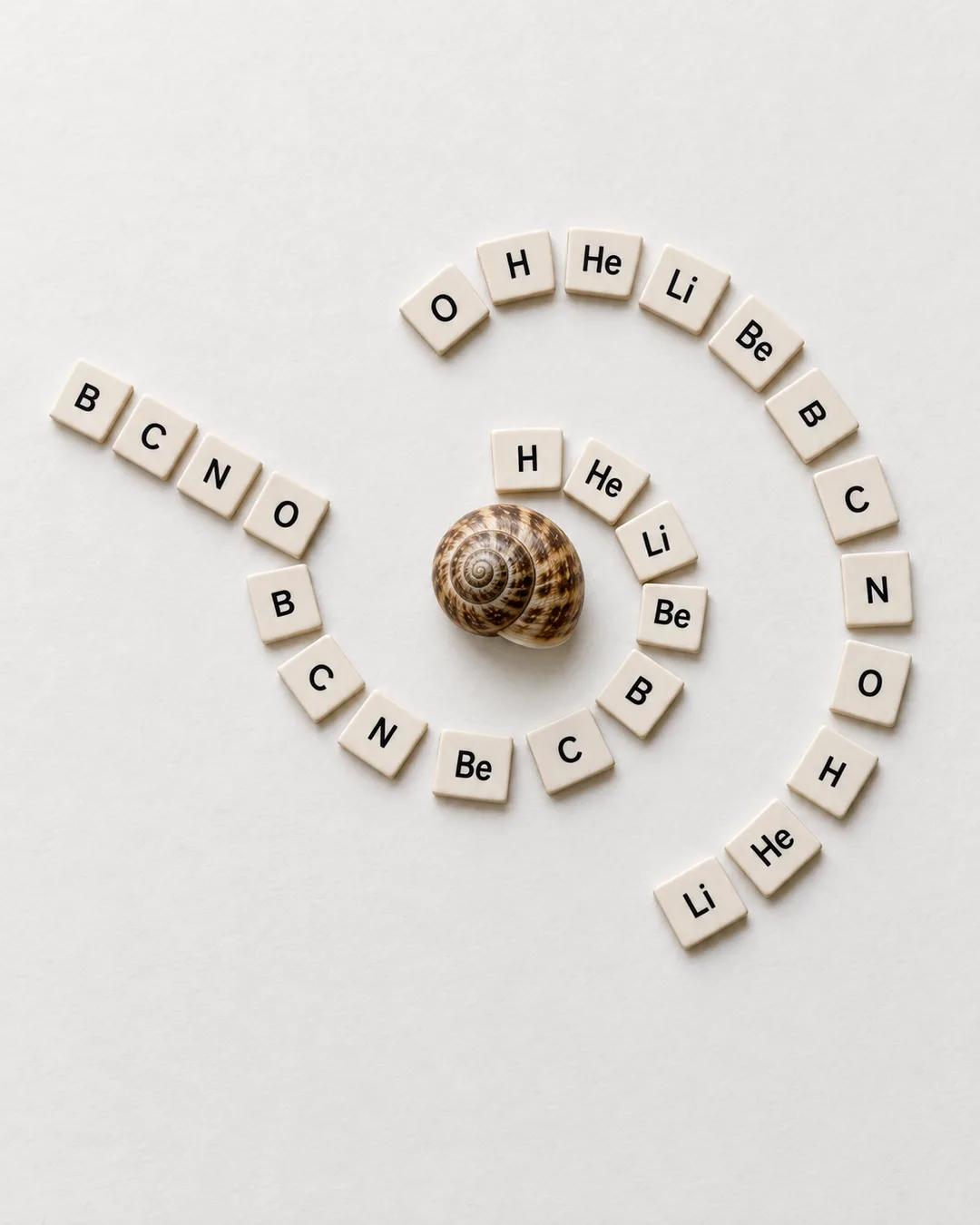
The periodic table as a snail

The Standard Table
The standard periodic table reads left to right and top to bottom, with each element holding one more proton than the last. Columns share properties: the first column reacts with water, and the far right column is inert. Elements 58 to 71, the lanthanides, are pulled out into a little satellite table below, and the actinides go with them, because keeping them in throws off the pattern of the table above.
Winding the Spiral
The periodic snail starts in the middle with hydrogen and spirals out through helium, lithium, beryllium, boron, carbon, and nitrogen. After enough turns, the lanthanides break off the spiral as a rectangular detour, followed by the actinides. The spiral then resumes through the transition metals, which include copper, nickel, chromium, titanium, gold, and silver.
Chemistry Stays in Columns
The snail keeps the chemistry in columns, the same way Mendeleev's arrangement does. The noble gases sit in a line, and the alkali metals and alkaline earth metals line up too. A third leg comes off the spiral for the undiscovered super actinides, and the version in question runs all the way to oganesson, element 118.
Why are lanthanides pulled out of the table?
Lanthanides fill an inner electron layer called the 4f subshell, which adds a row of 14 elements in period 6. Placing them inline would stretch the table to 32 columns across, which is awkward on a page. Pulling them below keeps the table 18 columns wide, the layout printed on most classroom charts. The lanthanides also behave so similarly to one another that they are notoriously hard to separate chemically.
Why did Mendeleev leave gaps in his table?
In 1869 Dmitri Mendeleev arranged the known elements by atomic weight and chemical behavior, and when a pattern broke he left an empty space rather than force an element in. He predicted the properties of the missing elements, including one he called eka-aluminium. In 1875, French chemist Paul-Emile Lecoq de Boisbaudran discovered gallium, whose density and other properties closely matched the prediction. That match helped win acceptance for the periodic law.
Why do elements in one column behave alike?
Elements in the same column have the same number of electrons in their outermost layer, and those electrons drive chemical reactions. The alkali metals in the first column each have a single outer electron that they give up easily, which is why they react so vigorously with water. The noble gases have full outer layers, which makes them largely inert. Helium, with two electrons filling its only layer, sits with the noble gases for the same reason.
More from The Rest Is Science