Korva is a scroll of the internet’s best ideas.
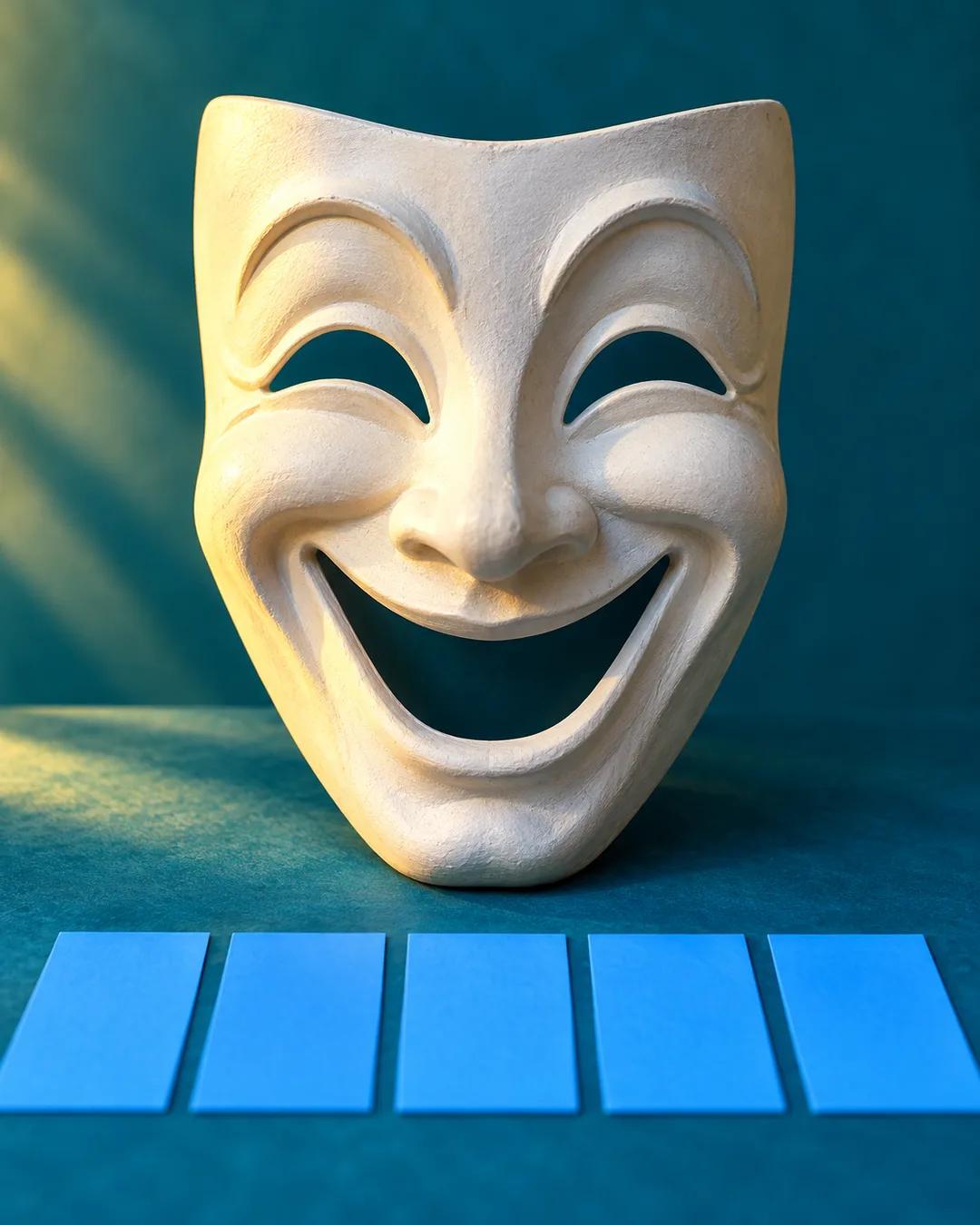
Those famous faces were posed

Ekman's universal faces
In the 1970s, Paul Ekman went to New Guinea and claimed that people in every culture recognize the same basic emotions from facial expressions: happiness, surprise, fear, anger, disgust, and sadness, with contempt sometimes added. Lots of AI companies and computer algorithms still rest on the idea that emotion can be read off a face.
What the studies measured
A review of the whole literature, co-authored by Lisa Feldman Barrett and Ralph Adolphs among others, found that people tell how someone feels from a face far less well than expected. The pictures are posed facial expressions by actors, very extreme, and not what people see walking around. The task is multiple choice: here is a list of emotion words, pick the one that matches the face. Handing someone emoticons and emotion words to match would work just as easily, and it would show only that an association exists by convention.
Real faces, real life
When people see real-world expressions and generate a word freely, the answers vary much more. Dog owners show the same gap. Many are convinced they can tell when their dog feels guilty about something it did, and in controlled experiments they perform at chance. In daily life nobody judges a feeling from a single frozen face. People ask how someone is doing and take in the whole situation.
Why do dog owners misread guilt?
In a 2009 study in the journal Behavioural Processes, psychologist Alexandra Horowitz of Barnard College had owners leave the room after telling their dogs not to eat a treat. Some dogs ate the treat and some did not, and the owners were then told the opposite of the truth in some trials. The guilty look appeared most when owners scolded their dogs, whether or not the dog had actually eaten the treat. The look tracked the owner's behavior, not the dog's deed.
How did emoticons become a shared convention?
The first widely cited smiley, the sequence of a colon, a hyphen, and a parenthesis, was proposed by computer scientist Scott Fahlman at Carnegie Mellon University in 1982. He posted it on a campus message board to mark jokes so that readers would not take them seriously. Within months it spread to other networks, and users invented dozens more. No one needed to see a real face for the symbols to work, only to agree on what they meant.
More from Huberman Lab