Korva is a scroll of the internet’s best ideas.
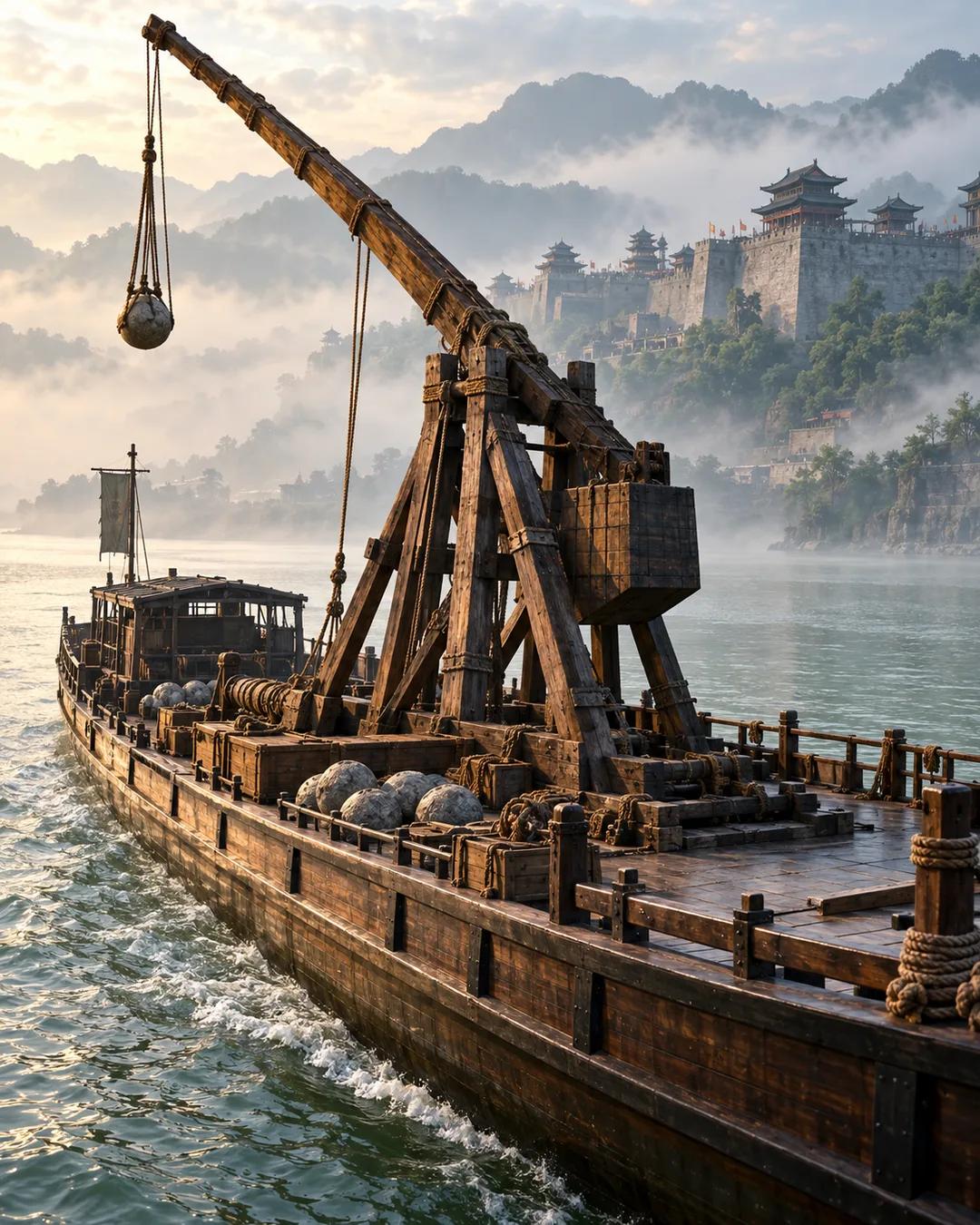
Trebuchets mounted on boats

Weak Walls on the River
The Southern Song relied on a line of ships chained across harbors, the wide Yangtze, and the sea. The general Aju, a grandson of Subutai who had seen the Red River campaign go wrong, studied the Yangtze and every small river around it. He saw that the cities were heavily fortified on the land side, where invasion was expected, and that their walls facing the water were weak, protected only by that line of boats.
Trebuchets on Ships
Engineers from the Mongol Ilkhanate in Persia built a special kind of trebuchet, a heavy catapult, and adapted it to work from a boat. It threw heavy objects and incendiary bombs. The first city fell, and so did the next. The navy broke down the walls, and the army moved in after, working down the Yangtze city by city.
To the Mongols a boat had been a floating cart. A boat with a trebuchet was a giant bow and arrow. The campaign carried them down to Hangzhou, the capital of the Southern Song.
How did Persian engineers reach China?
Kublai Khan brought engineers from the Middle East to China for the siege of Xiangyang, which began in 1268. Two of them, Ismail and Ala al-Din, built counterweight trebuchets in about 1273. Xiangyang had held out against the Mongols for about five years. It fell soon after the trebuchets went into action, and the road down the Han and Yangtze rivers opened.
How does a counterweight trebuchet work?
A counterweight trebuchet has a long arm pivoting on a frame, with a heavy box of stones or earth on the short end. Lowering the box to cock the arm and then releasing it swings the long arm up and flings the load from a sling. Earlier traction trebuchets needed teams of men pulling on ropes. The counterweight version could throw much heavier stones with a smaller crew.
More from Lex Fridman Podcast