Korva is a scroll of the internet’s best ideas.
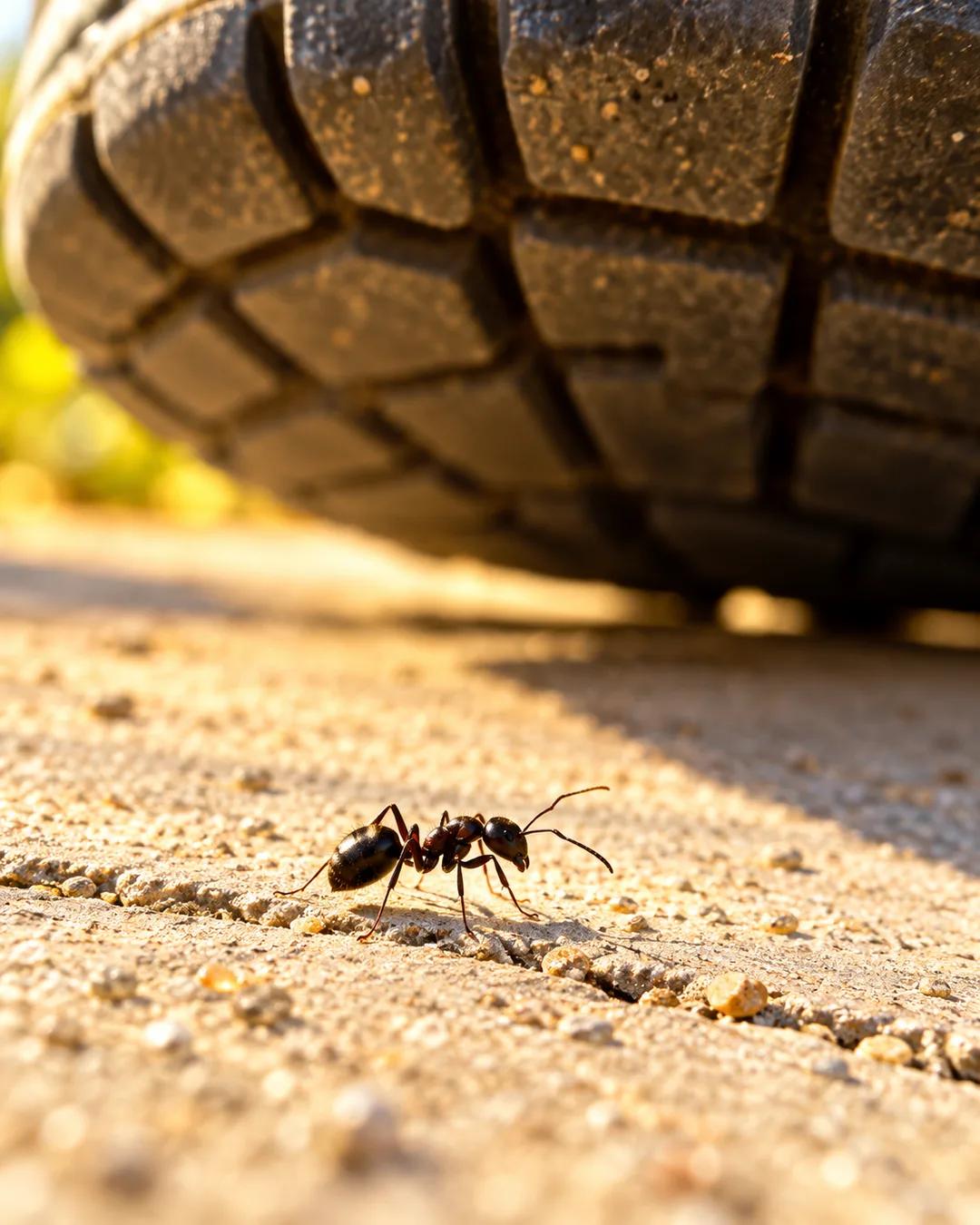
We might be the ant

The ladder of minds
Picture human DNA as 100 pieces, and a chimpanzee as the closest relative with 98 of them. People put chimpanzees in labs and zoos, and nobody walks up to one to start a meaningful conversation. An ant, at about 75 of 100, gets stepped on without anyone noticing, and nobody has ever stopped to talk to an earthworm.
Humans as the baseline
Apply the same ladder to a species from far beyond Earth. Humans tend to treat themselves as the baseline for intelligence, which is why aliens are imagined as gray, bipedal beings that resemble people. A visiting species could just as easily see humans as the ant, to be stepped on, or as the chimp, to be rounded up and studied.
The opposing view
The opposing view holds that humans are a late stage of intellectual development among multi-celled organisms, with more advanced life elsewhere that may no longer be biological.
Why do chimps and humans share so much DNA?
In 2005, the Chimpanzee Sequencing and Analysis Consortium published the chimpanzee genome and found that its DNA sequence is about 98.8 percent identical to the human sequence. The figure reflects a common ancestor who lived roughly 6 to 7 million years ago. Differences in when and where genes switch on account for much of the gap in anatomy and cognition. Those millions of years of separate evolution account for the remaining differences.
Why do we picture aliens as grey humanoids?
The grey alien with a large head and black eyes took hold in popular culture after Betty and Barney Hill reported an abduction in 1961. Earlier science fiction had already imagined big-headed, small-bodied humanoids as the future of humanity. Whitley Strieber's 1987 book Communion put a grey face on its cover. Communion reached the bestseller list.
Why might advanced life not be biological?
SETI Institute astronomer Seth Shostak has argued that any civilization able to send signals across space has probably been technological for only a short time before building machines that outthink it. Machine minds could endure long space travel, radiation, and vast stretches of time in ways biological bodies cannot. Philosopher Susan Schneider made a similar case in her 2019 book Artificial You. Shostak has presented the argument in talks and writing for the SETI Institute.
More from The Joe Rogan Experience