A 15-year-old refugee judoka goes for gold at the Youth Olympics
After fleeing Congo, losing a baby in the family to violence, and growing up short of food, uniforms, and school fees, he now has a shot at gold in Dakar.
 Global News Podcast · Israel election too close to call
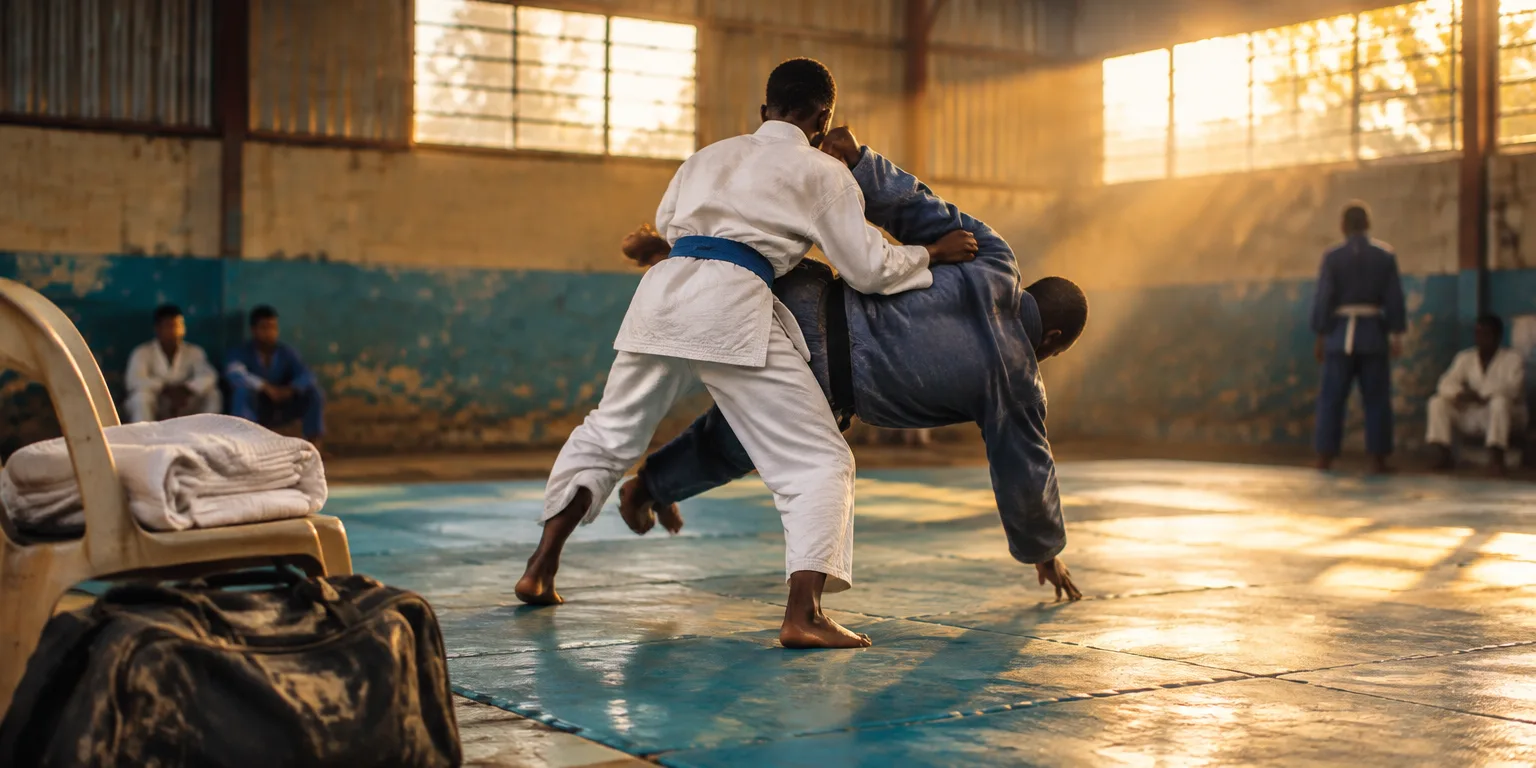
On a training mat just outside Kenya's capital, teenage Ano Yafunga throws his coach to the mat. The coach is also Ano's father.
Arnold Yafunga also competed in judo, the Japanese martial art centered on throws and holds. He first brought Ano onto the mat at age 7, and has coached him ever since.
That practice is taking Ano to the most important competition of his short career. He is among a half-dozen athletes set to break new ground in Dakar, Senegal, as the inaugural refugee squad at the teenagers' version of the Olympics, the Olympics' competition for teenage athletes. The Dakar Games will mark the first time an Olympic competition has taken place on African soil.
"I was crying tears of joy because I didn't expect to be selected," Ano said on learning he had made the team.
The family's road to Nairobi was marked by loss. In 2017, violence drove them from the Democratic Republic of Congo. Arnold said people who wanted to kill him attacked his family while he was detained elsewhere, and the assault killed his seven-month-old child.
They eventually reached Kakuma, a sprawling settlement in Kenya's north, housing over 200,000 displaced people. Arnold said life there was a struggle. "There was no food and we felt we were not living like human beings," he said.
They relocated to Kenya's capital in 2018, but daily existence did not get much easier. Ano said he had no judogi, the heavy cotton uniform worn for judo, and no bus fare to local competitions, adding, "There's no money for school fees." Then the International Olympic Committee, which runs the Olympics, started a program to help refugee athletes pursue their dreams, he said.
The committee first fielded such a squad at the adult Summer Games in Rio in 2016. In Paris two years ago, boxer Cindy Ngamba, originally from Cameroon, earned the squad's first-ever medal, third place.
For Arnold, his son's selection is proof that a refugee label need not end an ambition. "Refugees are human beings like everyone else. Being a refugee does not mean your life is over," he said. "Refugees can also do things that surprise people." He said judo has given his son discipline that follows him at school and home. "In judo, every time you fall, you gain the strength to keep going."
At home, Ano said, the line between father and coach blurs. "He is my coach in the house," he said. "At home, you can be strict because of the discipline."
In the buildup to Dakar, the refugee athletes have been mentored by Eliud Kipchoge, Kenya's two-time Olympic marathon champion. Ano said he has learned discipline, respect for his coach and focus, and he has made Kipchoge a promise: "As I promised him, I'll bring the gold medal here."
Questions people ask
What are the Youth Olympic Games?
They are an Olympic competition for teenage athletes, roughly ages 15 to 18, with summer and winter editions. Dakar was awarded the 2026 Summer Youth Olympics, the first Olympic event to be held in Africa, after a delay from 2022.
How does the refugee Olympic team work?
The International Olympic Committee selects and funds athletes who cannot compete for their home countries because they have fled war or persecution. The first senior refugee team competed at Rio 2016, and the team has grown at each Games since, with its own flag and anthem.
What is Kakuma camp?
Kakuma is a large refugee camp in northwest Kenya, opened in 1992, that hosts more than 200,000 people from countries including South Sudan, Somalia, and Congo. Residents generally cannot work freely outside the camp and depend heavily on aid, though some move to cities like Nairobi.