A 1940s Contest Created the Chicken We Eat Today
Breeders competed to grow a faster bird with more cheap protein, and farm birds have grown faster and bigger ever since.
 The Economist · Why is chicken so cheap?
In the 1940s, breeders in America were invited to enter a contest for the best meat chicken. The prize was for a Chicken of Tomorrow, a bird that would put more protein on the table for less money.
For most of history, that idea would have sounded unlikely. Chickens were first domesticated more than 8,000 years ago from a small wild bird in Southeast Asia, and for thousands of years they stayed small and slow growing.
The contest set out to change that by rewarding fast growth. It showed that breeders could select chickens for meat traits. Breeders crossed and selected birds for meat, not eggs.
That fast growing bird is the chicken we eat now. There are 23 billion chickens alive at any given time, about ten times as many as any other bird species, and chicken is the meat whose output is expanding most rapidly. Pound for pound, its price has fallen sharply.
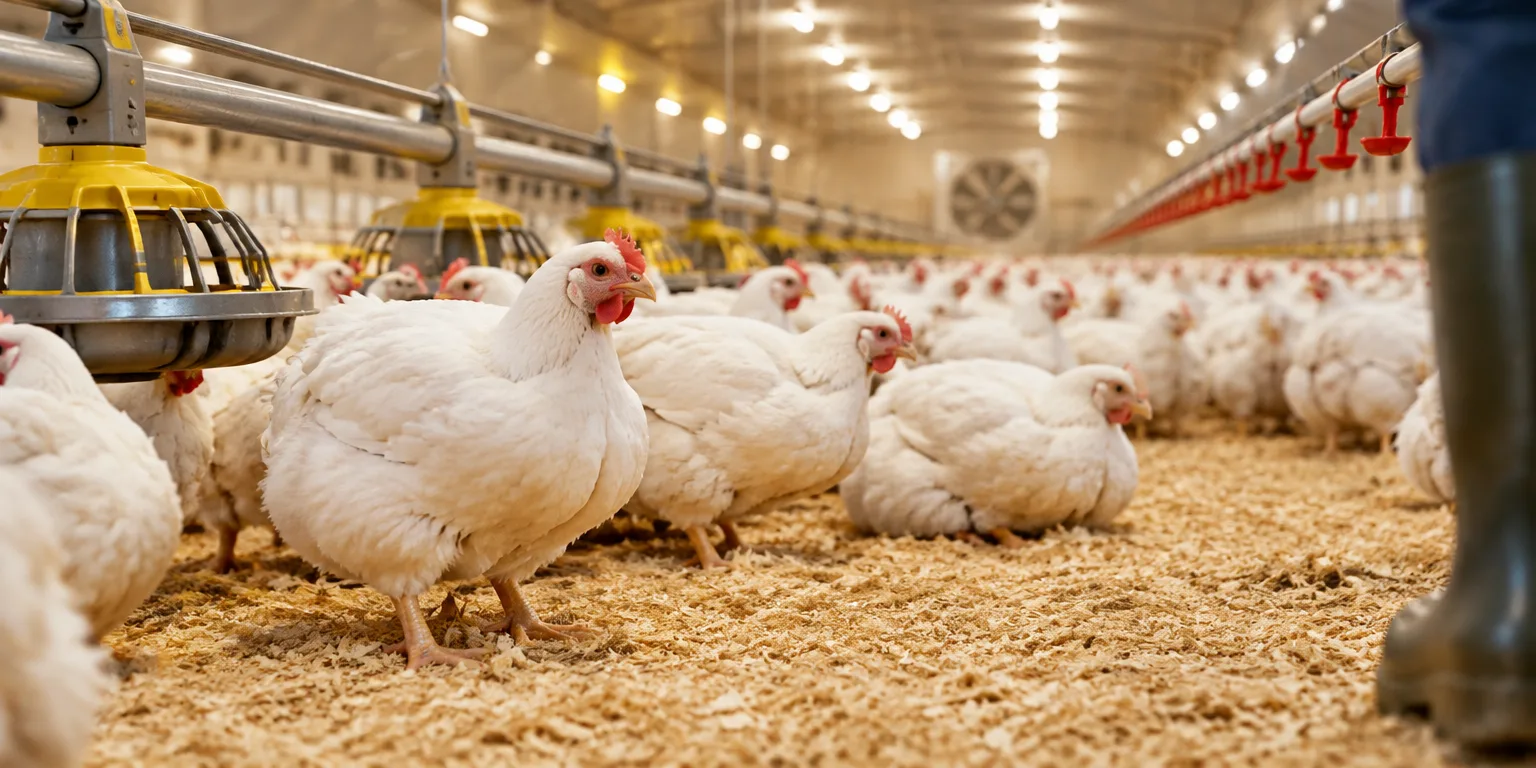
The result can be seen on a modern broiler farm, where chickens raised only for meat are watched closely from hatching to slaughter. The consultant David Speller, who advises on about 3 million chickens in Britain, uses cameras and carbon dioxide monitors to track them. On one of his farms, 45,000 birds in a single barn are managed by one computer, and two workers can look after 200,000 birds.
Their lives are tightly controlled from start to finish. Farmers manage them with artificial light and controlled temperature, and the birds put on weight more quickly and reach larger sizes than earlier farm birds. They survive only with constant human support.
The change shows in the body itself. Chickens are roughly fourfold the size of 1950s birds. That contest's goal shaped the modern broiler, and the inexpensive chicken in the supermarket reflects that goal.
Questions people ask
How fast does a modern meat chicken grow?
The modern broiler reaches slaughter weight in about five to six weeks, often around 35 to 40 days, compared with several months for older farm chickens. It converts feed to body weight unusually efficiently, which is a major reason chicken is inexpensive. That speed is the direct legacy of selecting for fast growth.
Who won the Chicken of Tomorrow contest?
The contest was sponsored by the grocery chain A&P along with agricultural officials, and the national judging finished in 1948. Winners included lines developed by Charles Vantress and by Henry Saglio, whose Arbor Acres birds became famous. Those winning bloodlines were folded into the breeding companies that still supply almost all commercial broilers.
Could today's meat chicken survive if farmers let it live?
Broilers are selected to keep growing muscle very quickly, so if they live past slaughter age their skeletons, hearts, and lungs often cannot support them. They can develop leg problems, heart failure, and other illness. A traditional backyard hen, by contrast, can live for many years.