A Burning City Baked Its Library Hard and Saved It
Ashurbanipal built one of the world's first organized libraries, and the blaze that destroyed his capital baked its clay books like pottery.
 Stuff You Missed in History Class · Ashurbanipal
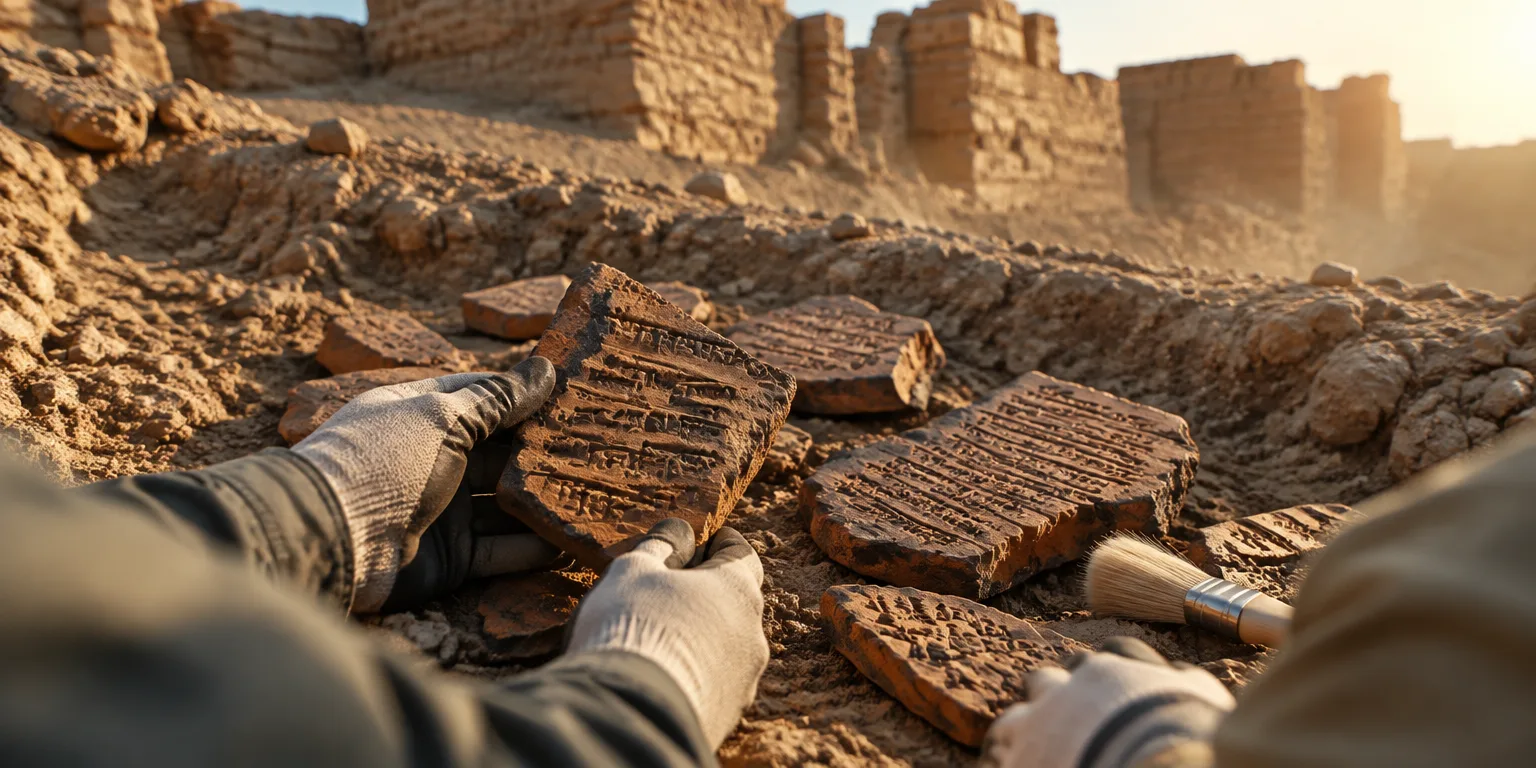
In 1849, English archaeologist Austen Henry Layard and his assistant Hormuzd Rassam, a Mosul-born scholar who would later train at Oxford and establish himself as an Assyriologist, started excavating Nineveh. Out of the dirt came clay fragments covered in cuneiform, writing made by pressing wedge-shaped marks into clay.
They were pulling up the remains of a library that had burned more than 2,400 years earlier. It belonged to Ashurbanipal, king of Assyria, who ruled from Nineveh, his capital on the Tigris River in what is now northern Iraq.
The find was one of the oldest known libraries that was gathered and organized on purpose as a repository of knowledge, and it is the largest collection of Assyrian texts in the world. Excavations have unearthed more than 20,000 tablets and fragments, many stamped with standardized notes that suggest they were labeled and cataloged. Tablets turned up around the remains of the Southwest Palace, the North Palace, and the temples of Ishtar and Nabu, though it is not clear whether that is where they were kept or where they landed in the chaos.
A lot of Assyrian literature survived because it was in that collection. Among those survivals is the Epic of Gilgamesh, a long poem about a king searching for eternal life, including its famous flood story with clear echoes of the Noah flood story in Genesis. The library also held medicine, mathematics, history, dictionaries, legal records, and texts on astrology and magic.
The reason any of it survived is that Nineveh was destroyed. When the city was sacked in 612 BCE, fire swept through the palaces. The heat baked the clay tablets hard, like pottery in a kiln, and fallen rubble then covered and protected them. The same fire largely destroyed a different form of book, writing boards that were slabs of wood or ivory covered with wax for writing. The tablets were also cracked apart and strewn about.
That scattering was made worse after the rediscovery. Rassam continued digging after Layard moved on, finding another huge collection starting in 1852 at the site then known as Kuyunjik, under Ottoman control. The diggers did not fully record where each fragment was found, focused as they were on shipping treasures to England. Much of the Kuyunjik material went to the British Museum, with some going to the Louvre through French digs. Scholars are still fitting broken pieces back together.
Questions people ask
What is the Epic of Gilgamesh?
The Epic of Gilgamesh is a long poem written in Mesopotamia about 4,000 years ago, following a king of Uruk who seeks eternal life after the death of his friend. One tablet tells of a great flood sent by the gods, with a survivor building a boat, sending out birds, and landing on a mountain, closely paralleling the Noah story.
How does cuneiform writing work?
Cuneiform is one of the earliest writing systems, made by pressing a cut reed into wet clay to leave wedge-shaped marks. It was used for about 3,000 years to write several languages, including Sumerian and Akkadian, for everything from tax receipts to epics. Once dry, or especially once baked, the clay becomes extremely durable.
Why would fire preserve clay instead of destroying it?
Unbaked clay stays soft and crumbles in rain and damp soil, so most everyday tablets would have decayed. Intense heat drives out the water and hardens the clay into ceramic, which can survive for millennia underground. Archaeologists find the same effect at other burned ancient sites.