A California oil pipeline rusted from the outside until it burst at half pressure
In some sections, investigators found 89% of the steel wall had worn away, and a brief pump restart was enough to break it open.
 welfarecapital.substack.com · Sable Offshore Corp (SOC) - Deep Dive #5
The pipeline that caused California's 2015 Refugio oil spill did not burst because pressure inside it was unusually high. It burst because the steel itself was unusually thin.
Line 901, a 24-inch steel pipe then operated by Plains All American Pipeline, ruptured at 721 pounds per square inch of pressure. That was only 56% of its maximum operating pressure of 1,341 pounds per square inch, the safe limit reported by the company to federal investigators.
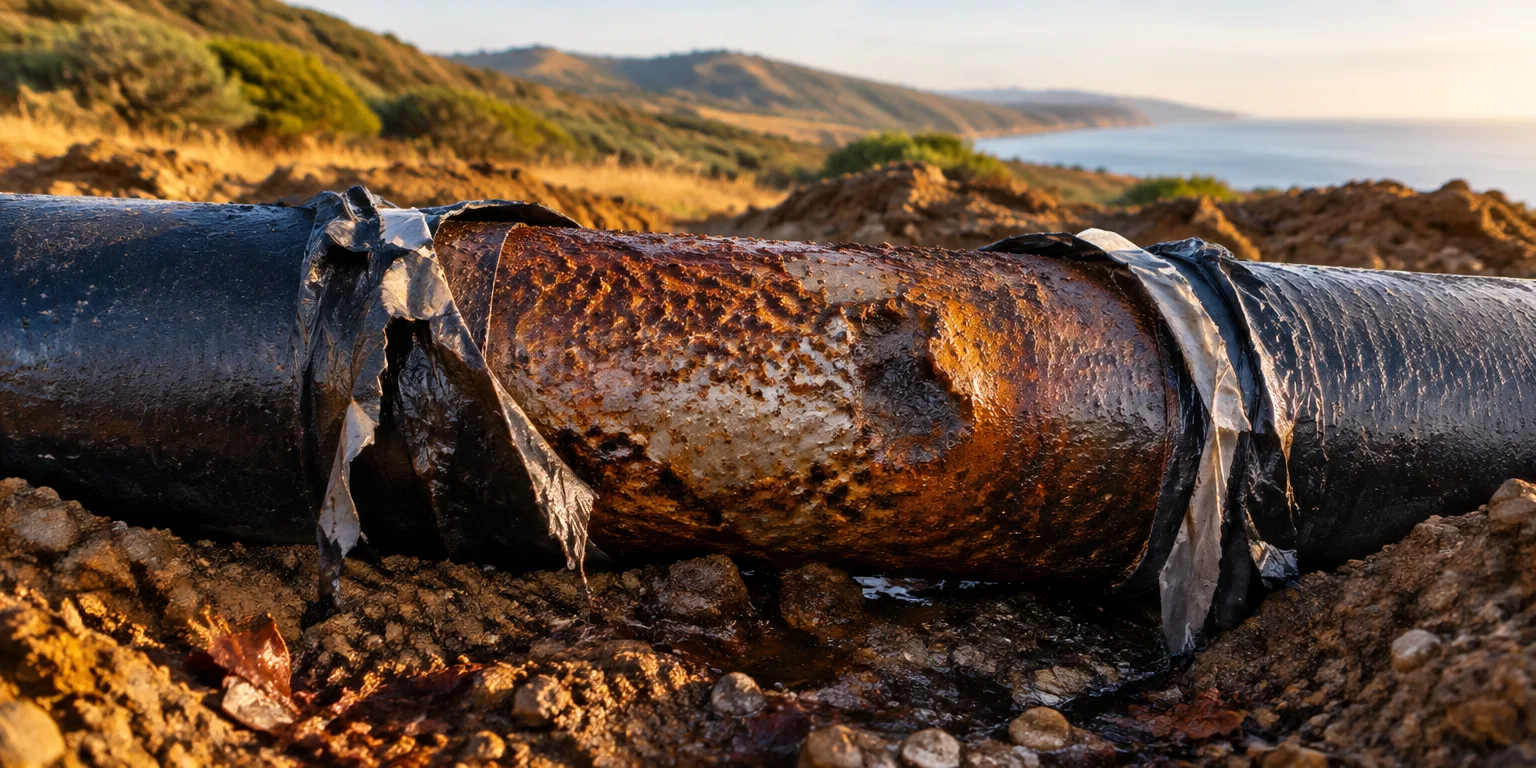
The thinning started on the outside. The steel was painted with a coal-tar coating, then covered with foam insulation and wrapped in plastic tape. The system was supposed to keep water away from bare metal. Water got through instead, touched the steel directly, and rusted it from the outside in, helped along as trapped water warmed and cooled through the year.
In places, investigators later found that 89% of the wall thickness had worn away. The company had inspected the line in 2012 and seen signs of rusting, but it appears nothing was done to fix it, and federal inspectors later found that some corroded spots had been missed entirely. In an investigation published in 2016, the Pipeline and Hazardous Materials Safety Administration, the federal pipeline safety agency, blamed three things: weak protection against outside rust, failure to find and fix it, and failure to detect the rupture quickly.
The final trigger came when a pump was shut down by accident. Because oil flowed from Line 901 into a sister line, Line 903, shutdown of a pump on Line 903 left oil in Line 901 with nowhere to go. Pressure at the Las Flores Canyon station feeding Line 901 rose to 696 pounds per square inch. Operators stopped pumping, then restarted about four minutes later. Pressure spiked to 721 pounds and then collapsed to 199 pounds as oil escaped through the break. Investigators said that unusual sequence should not have been enough to break the line open completely.
The leak released 3,400 barrels, more than 100,000 gallons. Cleanup cost about $100 million. The company estimated $257 million including legal damages, net of insurance, and paid about $60 million. Regulators then effectively shut down oil production from ExxonMobil's Santa Ynez Unit, which depended on the line. Exxon spent about $80 million a year keeping the idle fields in preserved condition, while the new owner, Sable Offshore, says it has more than 30 repair crews working to return both 30-year-old lines to as new condition.
Questions people ask
What does maximum operating pressure mean?
Maximum operating pressure is the highest pressure a pipeline is rated to carry safely, based on its diameter, steel strength, and wall thickness. It is measured in pounds per square inch gauge, or psig, meaning pressure above the surrounding air. A rupture at 56% of that rating strongly suggests the pipe had weakened.
Why would restarting a pump cause pressure to spike?
Oil is nearly incompressible, so if a downstream pump stops and upstream pumps keep pushing, pressure builds quickly in the trapped section. Restarting an upstream pump adds another surge. In a full pipe with nowhere for oil to go, even a modest surge can find the weakest spot.
How can a pipeline rust from the outside?
Buried and insulated steel can rust from the outside when groundwater, rain, or condensation gets under the coating and stays there. The coating can hide the damage from view, so operators rely on electronic inspection tools sent through or along the pipe. If those surveys miss a spot, or no repair follows, the pit keeps growing.