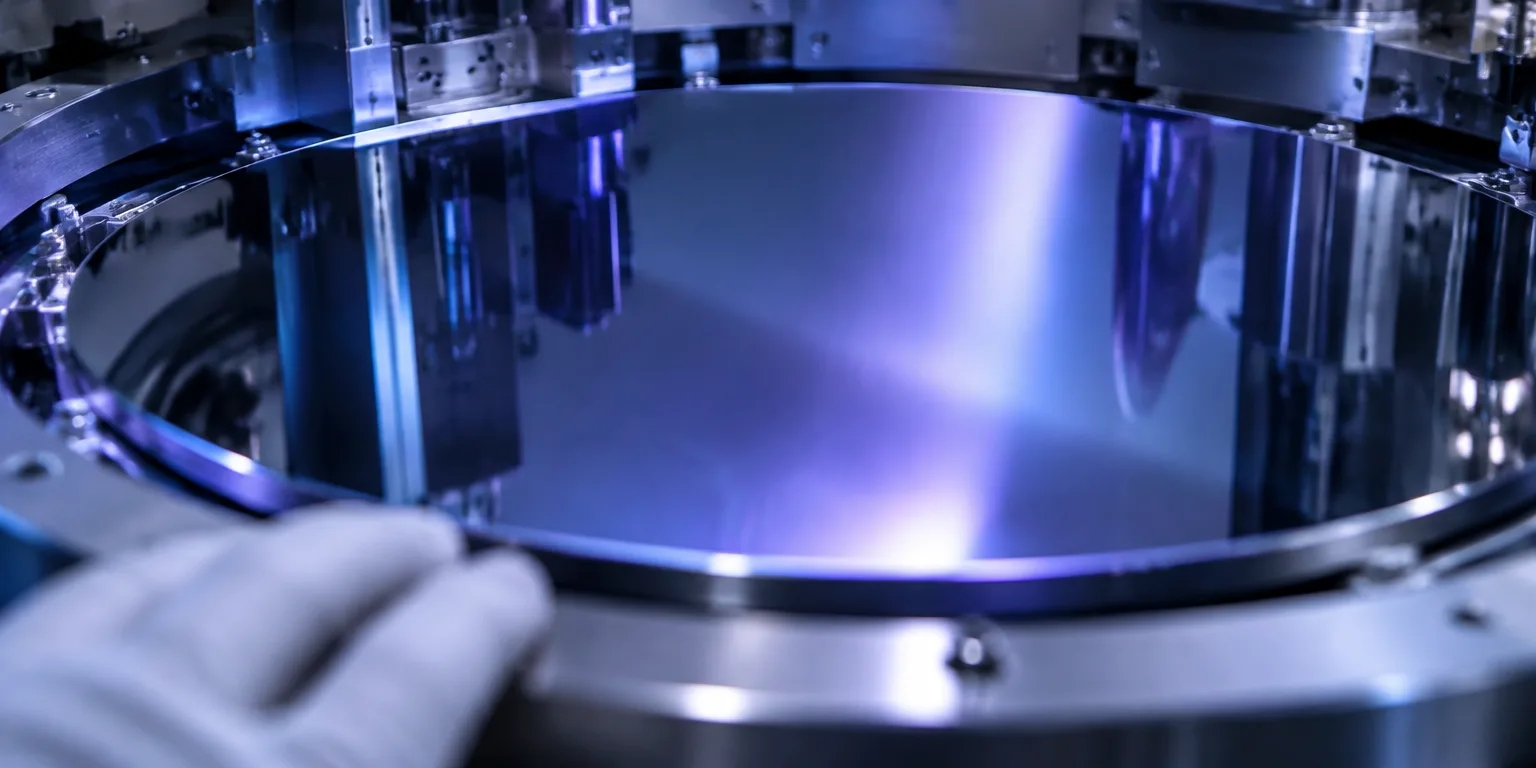
A chipmaking mirror is so smooth that, at the size of Germany, its tallest bump would be a millimeter
A household mirror is rough by comparison, with bumps thousands of atoms high.
 Veritasium · The World's Most Important Machine
The mirrors inside the machine that prints the world's most advanced microchips are so smooth that if one were enlarged to cover Germany, its highest point would rise roughly a millimeter.
They have to be that smooth because of the light they steer. It is extreme ultraviolet light, with a wavelength of about 13.5 nanometers. A wavelength is the length of one light wave, and this one is far shorter than visible light.
Light acts like a ball on rough ground. A football bounces straight up off cobblestones, while a small bouncy ball hits the same stones and shoots sideways. Bumps that seem tiny to us scatter such short light in the same way.
A household mirror has roughness averaging about 4,000 silicon atoms. These mirrors average about 2.3 silicon atoms. The newest ones are smoother still. Enlarged to the scale of Earth, the worst imperfection would be as thin as a playing card.
Questions people ask
What is extreme ultraviolet light?
It is light with a wavelength of about 13.5 nanometers, far shorter than the 400 to 700 nanometers of visible light. It is absorbed by air and glass, so the chipmaking machine works in a vacuum and steers the light with mirrors instead of lenses.
How do you make a mirror that smooth?
They are built from dozens of alternating ultrathin layers that each reflect a little light. Atoms are knocked off a source material and settle onto the mirror, a messy process that leaves bumps and gaps, which engineers smooth with a gentle ion beam that helps atoms settle into place.
Does so much smoothness cost light?
Yes. Each mirror reflects only about 70% of the light, so after six mirrors and the patterned mask only about 8% remains. That is why the machine needs such an intense light source, made by blasting molten tin droplets with a laser tens of thousands of times a second.