A crow given a straight wire bent it into a hook to get food
After jabbing with a straight wire failed, she made a new tool, and seemed to be working from a plan.
 TEDx Talks · Crows, smarter than you think | John Marzluff | TEDxRainier
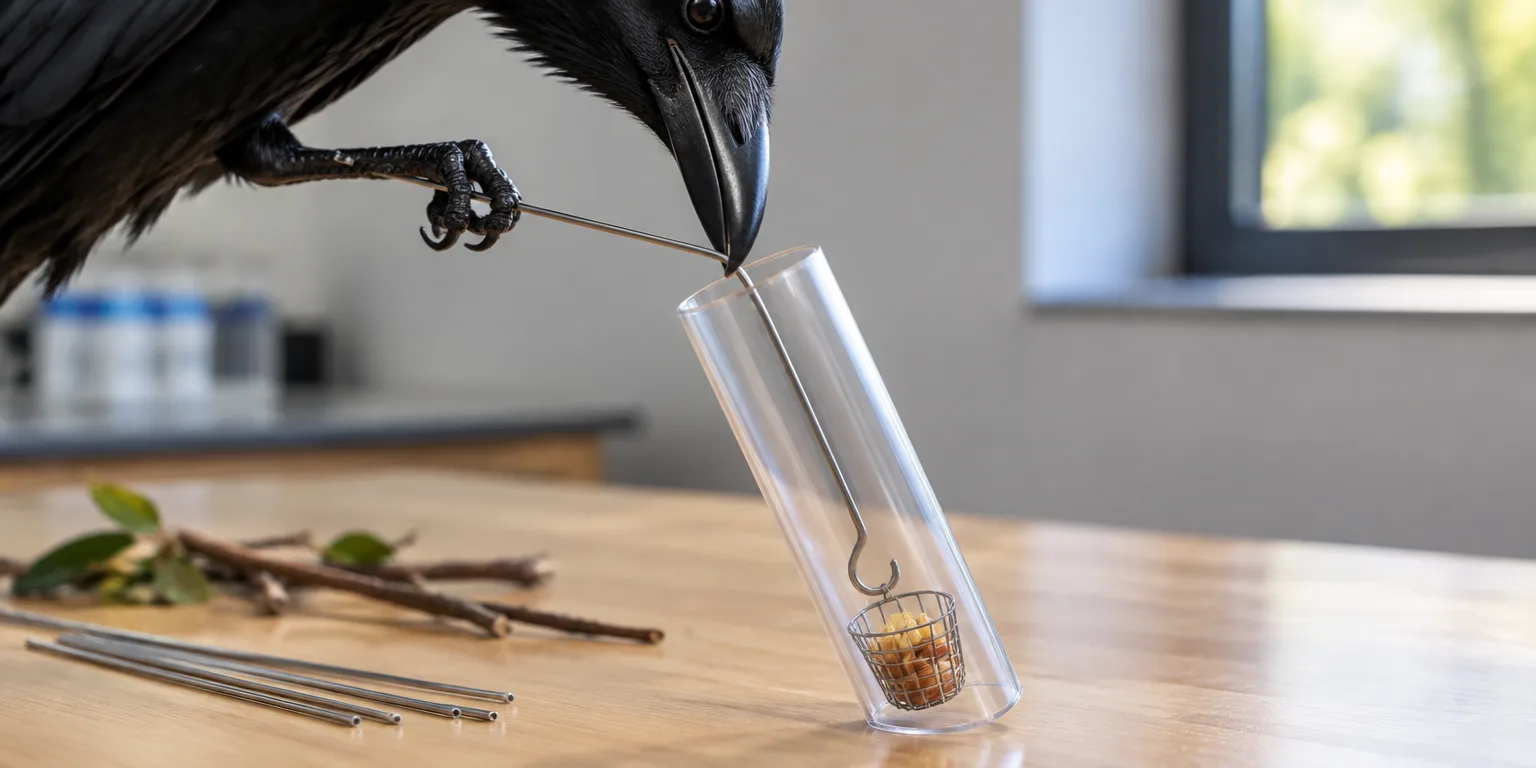
The basket sat at the bottom of a clear tube, full of food and just out of reach. All Betty had to get it was a straight piece of wire, nothing like the twigs and leaf stems she used back home.
Betty is a New Caledonian crow, a bird from Pacific islands that have no woodpeckers. On those islands, a lot of insects and other food sit hidden under bark and in soil, where a woodpecker's long tongue could reach them. Betty's kind gets at that food by trimming stems and sticks into tools to skewer the hidden bugs.
In footage recorded at Oxford and shared by John Marzluff, a University of Washington professor who studies birds, Betty first does the obvious thing. She picks up the wire and tries it out, probing and jabbing the way she might chase an insect in bark, hoping friction alone will catch the basket and pull it up.
It does not work.
That failure is what makes what happens next worth watching. Betty does not just keep jabbing. She changes tactics, and does something Marzluff says small children would not think to do. She bends the wire.
With one end now shaped into a hook, she lowers it again, snags the basket, and lifts her meal out of the tube. For Marzluff, the bend mattered because it suggested she had a plan. Making a tool is normal for her species, which regularly makes and uses tools to find food, but choosing a strange new material and then switching methods after the first method failed looked like something rarer.
She seemed, he said, to have "steps figured out in her head": try this, and if that does not work, move to the next sequence. Scientists once doubted that birds, and many other animals, could solve a problem with that kind of insight, understanding the nature of the puzzle and thinking ahead to fix it.
That kind of insight is his evidence, Marzluff said, that bird brain is misused as an insult and should be taken as a compliment. Betty had solved the puzzle with wire that was not the sort of thing she was used to finding at home, to reach food she could see but could not touch.
Questions people ask
Do New Caledonian crows really make tools in the wild?
Yes. In the wild they trim twigs, stems, and leaves to probe for insects under bark and in crevices, often shaping one end to skewer or hook prey. Different birds can favor different shapes, and young birds learn by watching older ones.
Had Betty been taught to bend wire?
Betty was captive and had experience handling wire-like material, but researchers described the hook-making as spontaneous because she had not been trained to bend wire. Other crows later solved similar puzzles, though not all bent wire on the first try.
Why are crows so good at solving puzzles?
Corvids, the family that includes crows, ravens, jays, and magpies, have very large brains for their body size, live 20 to 30 years, and are highly social. That combination supports individual learning, memory, and learning by watching others.