A dangling cable cut to the right length can act like a radio part
Cut to the right length, an open stub mimics any capacitor or inductor and wipes out wasted reflections.
 Veritasium · The Scariest Chart In Electrical Engineering
A short piece of radio cable, left dangling and connected to nothing at one end, can do the job of a capacitor or an inductor if you cut it to exactly the right length.
The trick fixes reflections. When a radio signal travels down a cable to an antenna, any mismatch makes part of the wave bounce back, and the lost power never broadcasts. Engineers fix it by canceling the leftover reactance, the timing mismatch between voltage and current caused by capacitance and inductance, as distinct from ordinary resistance.
On the Smith chart, the circular diagram engineers use to track resistance and reactance together, both an open circuit and a short circuit sit on the outer rim, where the reflection is largest. An open has infinite resistance and a short has none, but neither absorbs power, so every bit of the wave reflects.
That rim is the secret. Moving along a cable changes the timing of the reflection, which walks the measurement around that rim, completing a circle for each half wavelength of added line. Start at an open or a short, add a little length, and you pass through every possible reactance. In other words, a dead end plus the right length of line can imitate any capacitor or inductor.
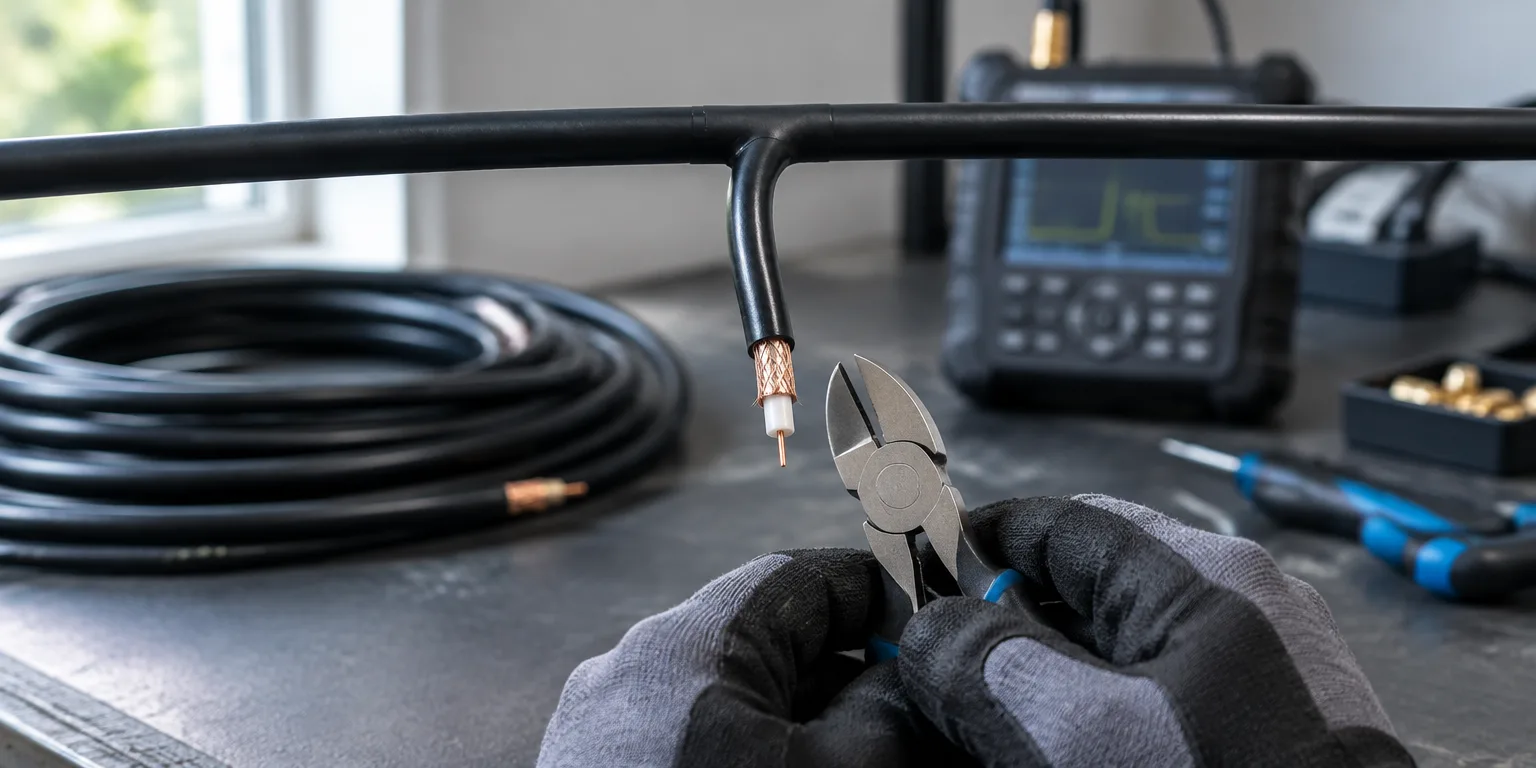
In the demonstration, earlier steps had left a remaining reactance of negative 1.8, so the stub had to supply positive 1.8 to cancel it out. The fix was a side branch made from the same coaxial cable that carried the main signal. The branch was spliced into the main line, with its far end left open and unconnected.
The length sets the timing of the returning wave, like a cove off a river that sends water back after hitting the rear wall. The calculation called for a stub about 77 millimeters long to get that timing right. Because the pattern repeats, a 92 millimeter length gives the same effect, so the team started long and snipped shorter while watching the reflections fall to zero.
The repair uses no different kind of part, only a short piece of the same cable that carries the signal. A stub wired in line would mean cutting the main cable, so engineers usually connect it side by side instead, using a flipped version of the chart made for that case.
Questions people ask
What exactly is coaxial cable?
It is the round cable used for television antennas and lab radios, with a center wire surrounded by insulation and then a braided metal shield. That geometry keeps the spacing between the two conductors constant, so the cable carries high frequency signals cleanly. The stub in the story is just a short side piece of that same cable.
Why not just use a real capacitor or inductor?
At radio frequencies above roughly a few hundred megahertz, ordinary parts become lossy and imprecise, and their tiny leads act like extra antennas. A printed trace or a cut piece of cable is more predictable, cheaper, and can handle more power. That is why phones, routers, and radar often use traces and stubs instead of lumped parts.
Does the stub length work for every station or channel?
No, it works exactly at only one frequency because wavelength changes with frequency. Move to a different channel and the same physical length is a different fraction of a wavelength, so the cancellation drifts. Designers either accept a narrow match or combine several elements to keep reflections low across a band.