A Democratic Campaign Worker and a Conservative Neighbor Unite to Fight Data Centers in Alabama
They disagree on politics but agree the projects threaten their creek, their air, and their voice in Town Hall.
 Marketplace · A divided government could shift the bond market
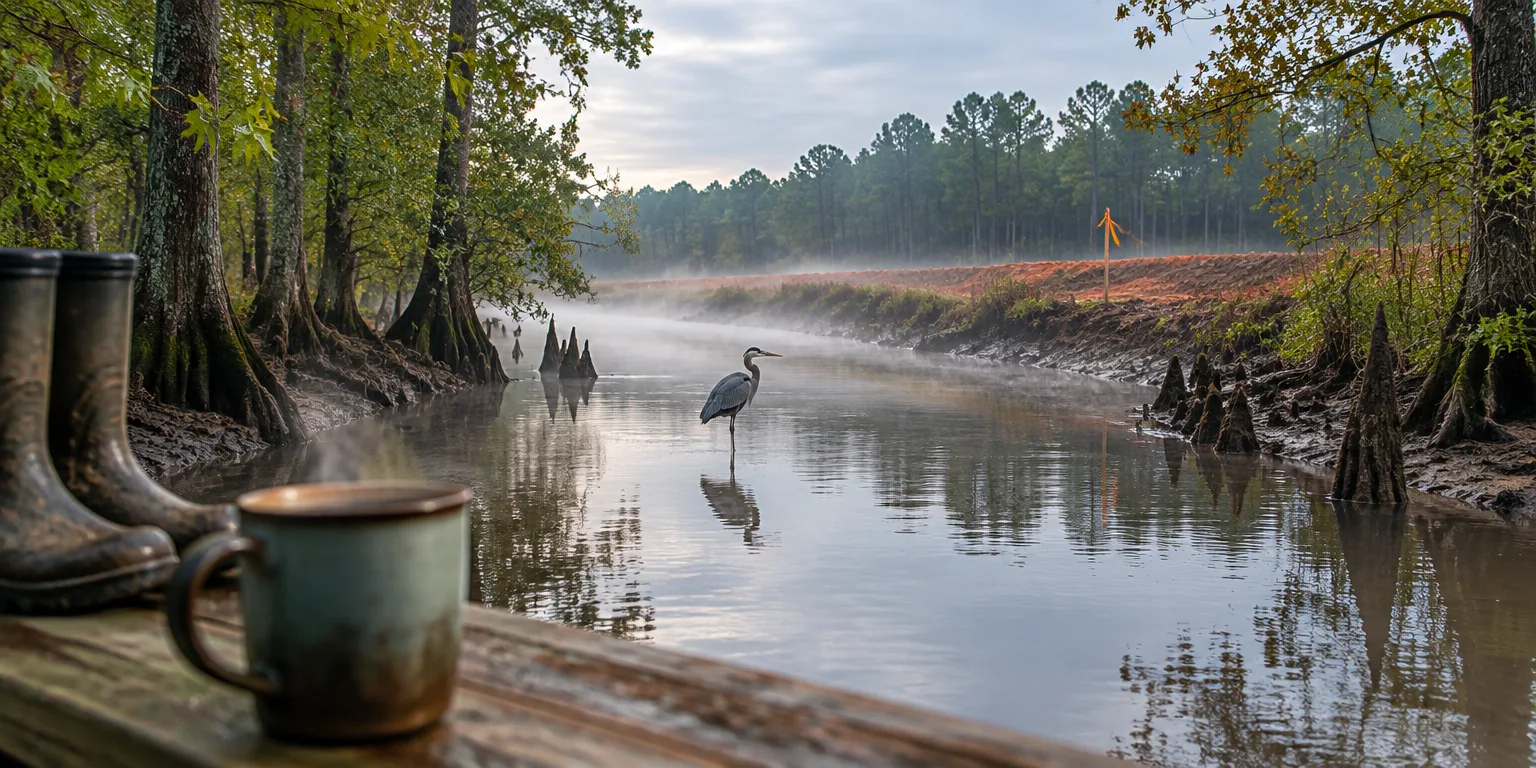
Every morning, Rachel Schaefer drinks coffee beside the creek behind her house in Alabama, watched by a blue heron standing on one leg.
Schaefer makes her home in Cottondale, down the creek from Brookwood. Brookwood is a community of roughly 2,500 residents, set to the west of Tuscaloosa by about 20 miles. She describes herself as pretty conservative.
This year she has teamed up with an unlikely ally, Thatcher Rotenberry, who studies at the University of Alabama and grew up in Brookwood, and who has a job with a Democratic House campaign in a deeply Republican area. Together, they are trying to stop up to three data centers proposed for Brookwood.
Rotenberry fears a facility might raise the temperature of nearby air by up to four degrees, a figure he ties to research in the Yale Environmental Law Review. He also points to noise, heat pollution, air pollution, and water pollution near the middle school he once attended.
Schaefer worries about runoff reaching her creek and harming wildlife. “Are we really going to risk all of our environmental magical places so that we can play harder on our phones?” she said.
The developer closest to building is Applied Digital, with a reported 3.2 billion dollar project. An employee, Nick Phillips, told a Brookwood town hall the site would have forested buffers to limit noise and light, would not raise utility rates, and would not send toxic wastewater into the creek.
Phillips said any coolant that needed to be removed would be trucked off site. He said the company wants to go where it is wanted, and that conversations around the county have been very positive.
Rotenberry said he first heard about a possible campus in June, when a developer announced a project at an undisclosed location. He said the town council then moved to rezone a residential neighborhood without explaining the reason.
According to Rotenberry, Mayor Joe Barger had signed a nondisclosure agreement, came to an early meeting, and warned, “you would be cut off from speaking if you said the words data center.” Rotenberry recalled officials insisting the vote was only about rezoning, leaving residents asking what the rezoning was for.
Barger says the reason was disclosed on the day the council approved the rezoning in September. After that, municipal leaders approved what was described as a 314 million dollar incentive to support building the facility.
Barger says there is only one Brookwood project, not three, and he defends the process. He said the nondisclosure agreement only stops him from sharing sensitive details with rival developers. “They trusted us and elected us to be in these positions. They need to trust us,” he said.
Opponents note that a second lot had already gotten a new zoning label for a business linked to data-center work, and a third lot has an owner whose listed location is connected with a firm named Provident Data Centers. The lead developer is still waiting for permit approval.
For now, Schaefer sounds resigned. “There’s nothing we can do about it,” she said. “We hope it just doesn’t destroy everything.”
Questions people ask
Why would a small town offer a $314 million tax break for a data center?
Cities and states often reduce property or sales taxes for a period to compete for the jobs, utility payments, and long term tax base a large project can bring. Critics argue the benefits can be small compared with the cost, because data centers employ relatively few people once built, while supporters say any new investment helps a small town.
Do data centers really affect heat, noise, and water?
They use large amounts of electricity to run computers and cooling systems, and the waste heat can warm nearby air. Many also use water for cooling, though designs vary widely, with some using closed systems or trucking used coolant off site. Local effects depend on the size of the facility, the cooling method, and the buffers around it.
What is a nondisclosure agreement doing in a town rezoning?
A nondisclosure agreement is a contract that bars a person from sharing specified confidential information. In economic development deals, companies sometimes ask local officials to sign one during negotiations over sites and incentives. Officials say secrecy protects competition, while residents say it keeps them from weighing in until key decisions are made.