A Dozen Robots Folding Unfamiliar Laundry Show Why Being Slow Does Not Matter
Laundry is complex and dexterous, but slowness does not matter, making it an ideal test for learning robots.
 Invest Like the Best with Patrick O'Shaughnessy · Eric Vishria - A Decade of Lessons Investing in Software & Hardware - [Invest Like the Best, EP.486]
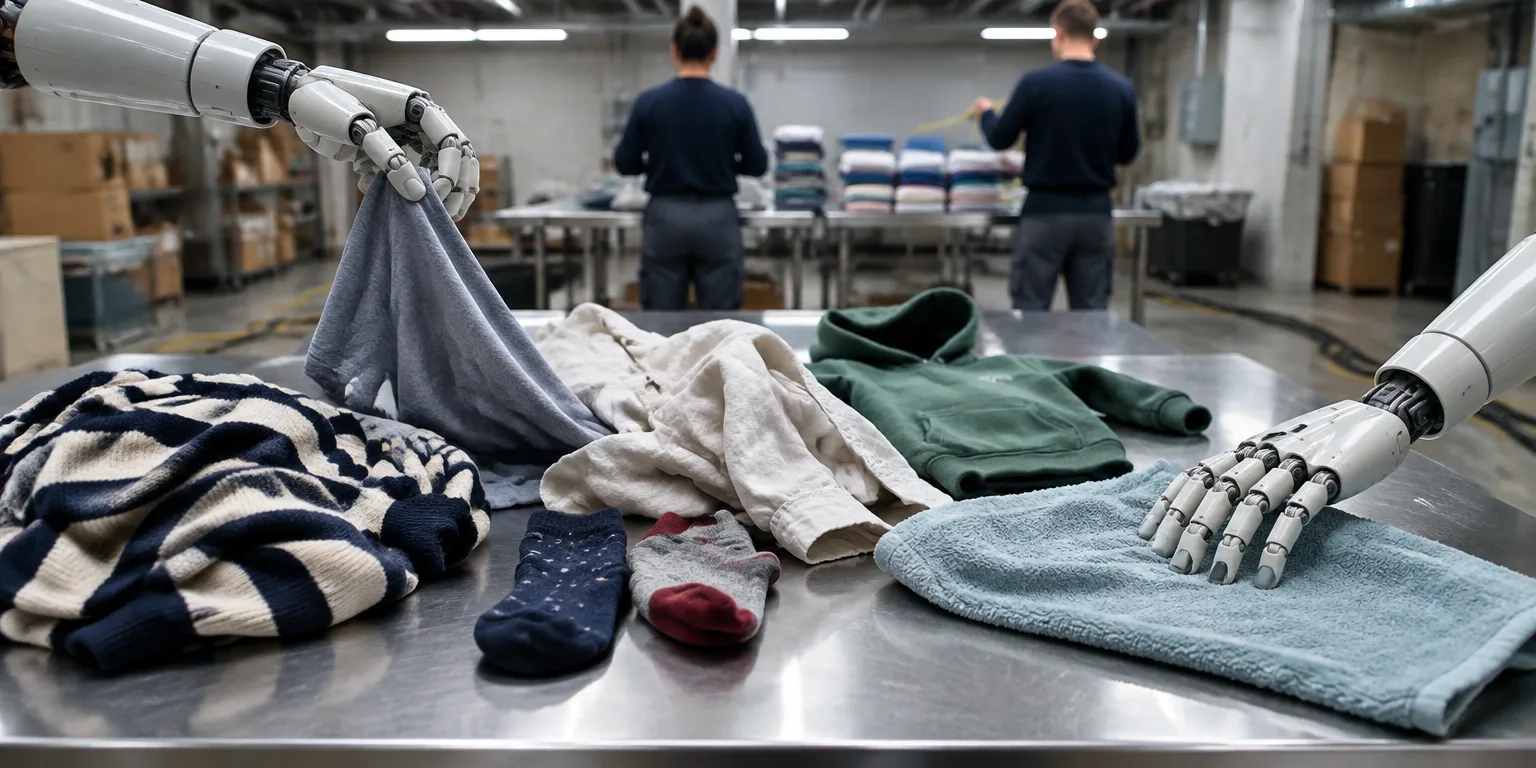
In the basement of an office building, a dozen robots stood around tables folding laundry. Not the same shirt, over and over, but unfamiliar piles, one odd item after another. It was not a staged demo, just machines practicing through trial and error.
Watching them was Eric Vishria, an investor in the company behind them, Sunday Robotics, which is working on household robots. His first look at the company had been in a basement lab at Stanford, where the system was built around a crude cardboard glove. Now there were finished hands, and piles of clothes, and people picking up each folded item and measuring it.
That measuring was the tell. The team was checking each fold to make sure it was done properly and building a rigorous baseline for what counted as good. Vishria remembers thinking, "oh my God, this is happening."
What is happening is a shift in what robots can attempt, and why laundry is a good place to try. Vishria says repetitive tasks in controlled environments, the work of assembly lines and manufacturing lines, are "more or less solved." What is not solved is slightly altered jobs out in messy, everyday places, where every item is a little different. That is where artificial intelligence plus robots is needed.
The bottleneck is training data: robots have no vast online library of physical experience to learn from. Language models started from a huge body of internet text, a vast store of human knowledge. There is no equivalent store of physical experience, and Vishria says roboticists are trying to fill the gap with video, simulation, and teleoperation, having people remotely guide robots to generate examples.
Sunday's answer borrows from both language models and self driving cars. Model makers learned that not all internet data was equal, and prioritized high value sources like Wikipedia and GitHub over junk. Vishria says carmakers like Tesla and Waymo owned the whole chain from car fleet to model, using cars on the road to collect very high quality driving data to train their own driving software, with Tesla doing this with its customer owned fleet and Waymo working the same way. Sunday did the same for hands by designing gloves together with its robot hands, so the movement of a human hand transfers cleanly to the machine.
The plan is to collect excellent data to train a general movement model first, what engineers call pretraining, and then add a small set of task examples on top to teach a new skill, what they call post training. The laundry pile suggests this pipeline can produce what Vishria calls emergent behavior, new capability that was not explicitly programmed.
Laundry is a good test because it is the right kind of hard. It is arbitrary and complex and requires dexterous manipulation, picking up soft, wrinkled, uneven things. But it is not time sensitive. As Vishria puts it, "If it takes three times longer, so be it. Who cares?" It can just run all day, while staff measure the folds.
Questions people ask
Why is folding laundry so hard for a robot?
Picking up a T-shirt requires judging shape, weight, stretch, and wrinkles, all of which change every time. The robot must grip soft material without a fixed handle, figure out where the edges and corners are, and then move precisely to fold it. Factories avoid this by using rigid parts and fixed positions.
How does a robot learn a physical skill without an internet of examples?
They learn from demonstrations collected with instruments like sensor gloves, plus video of people doing tasks and practice inside simulation. That high quality set is used to train a general movement model first, then engineers add a smaller set of examples for a specific job and refine it with trial and error. It mirrors how language models are trained broadly and then tuned for a task.
When will one of these robots fold laundry in my home?
Robotics has long been called "always 10 years away," and the basement setup is not yet a home product. In my view as the writer, a home version is probably still distant, since a reliable, safe, and affordable home robot would need better hands, lower costs, and proof it can do many chores, not just one.
What did Tesla and Waymo prove that robot makers want to copy?
Tesla collected driving data from its customer owned fleet and used it to train its driving models. Vishria says Waymo worked the same way, and that both gathered very, very high quality data. Sunday Robotics is applying that same whole chain approach to hands instead of cars.