A Giant Bag of Carbon Dioxide Works Like a Battery
Squeeze the gas into a liquid to bank electricity, then let it expand through a turbine to get the power back.
 Half as Interesting · Why This Giant Bag of CO2 is Actually Useful
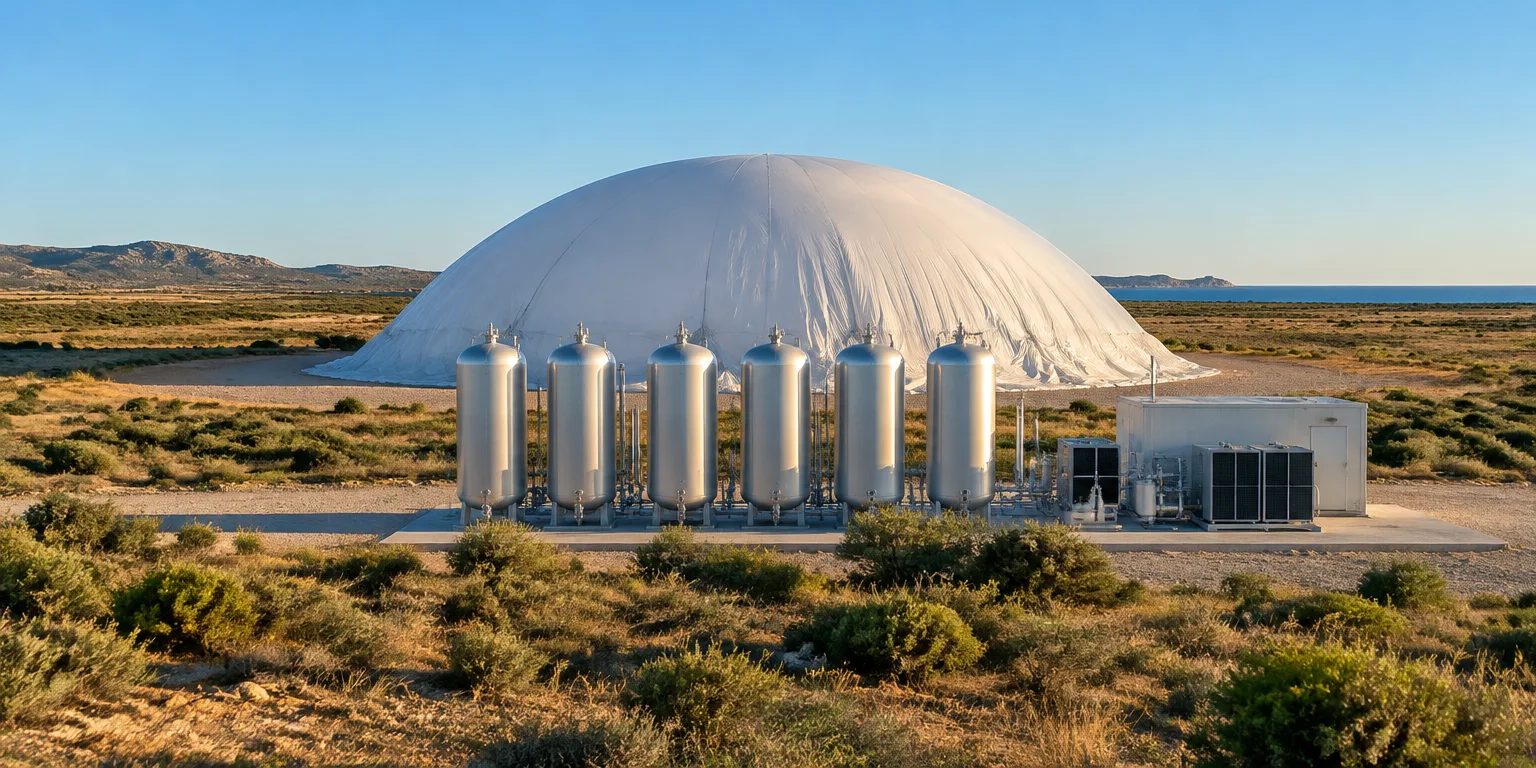
In Sardinia, a huge fabric dome breathes in and out like a pillow. It is actually two bubbles in one, an outer shell that stays up all the time and an inner bubble that holds 2,000 to 2,200 tons of carbon dioxide. When the system is full of gas, the inner bubble is inflated, and when the gas is put away, it goes limp. The bubble itself just holds the gas. The energy is stored as liquid carbon dioxide in tanks nearby.
The trick is what carbon dioxide does under pressure. Squeeze it hard enough and it turns into a liquid even at room temperature, packing far more energy into a small space than ordinary air can.
When there is more electricity on the grid than people need, that extra power runs a compressor. The compressor squeezes the carbon dioxide from the bubble into a liquid and sends it to wait in steel tanks about the size of school buses. With its gas moved into storage, the bubble deflates.
When power is needed later, the process runs in reverse. The liquid leaves the tanks and passes through an evaporator, a unit that turns it back into a high pressure gas. The gas rushes through turbines, spinning machines that generate electricity, and then flows back into the bubble, which puffs up again.
The builder, Energy Dome, an energy storage company, says such a plant takes about two years to build on a big piece of flat land and costs 16 million to 19 million dollars. The parts are ordinary compressors, tanks, and turbines that are already made and sold around the world.
Questions people ask
Is the same carbon dioxide used over and over?
Yes. The system is a closed loop. The same carbon dioxide is compressed, stored, expanded, and returned to the bubble over and over, so normal operation is not venting it like a smokestack.
Why use carbon dioxide instead of just compressing air?
Carbon dioxide turns to liquid under pressure at room temperature, while the nitrogen and oxygen in air stay as gases unless they are chilled to hundreds of degrees below zero. A liquid takes up far less space than a gas, so carbon dioxide can store more energy in school-bus-size tanks than compressed air could.
Could a CO2 battery be built anywhere?
It does not need a mountain, a mine, or a river. Energy Dome says it needs a large, flat site plus standard industrial equipment. That makes it easier to place near towns, solar farms, or data centers than pumped water storage, which needs two reservoirs at different heights.