A Levee Can Be Washed Away From Underneath
Trapped water pressure can lift the ground behind the wall and carry away its foundation grain by grain.
 Practical Engineering · The Mind-Blowing Flaw That Flooded New Orleans
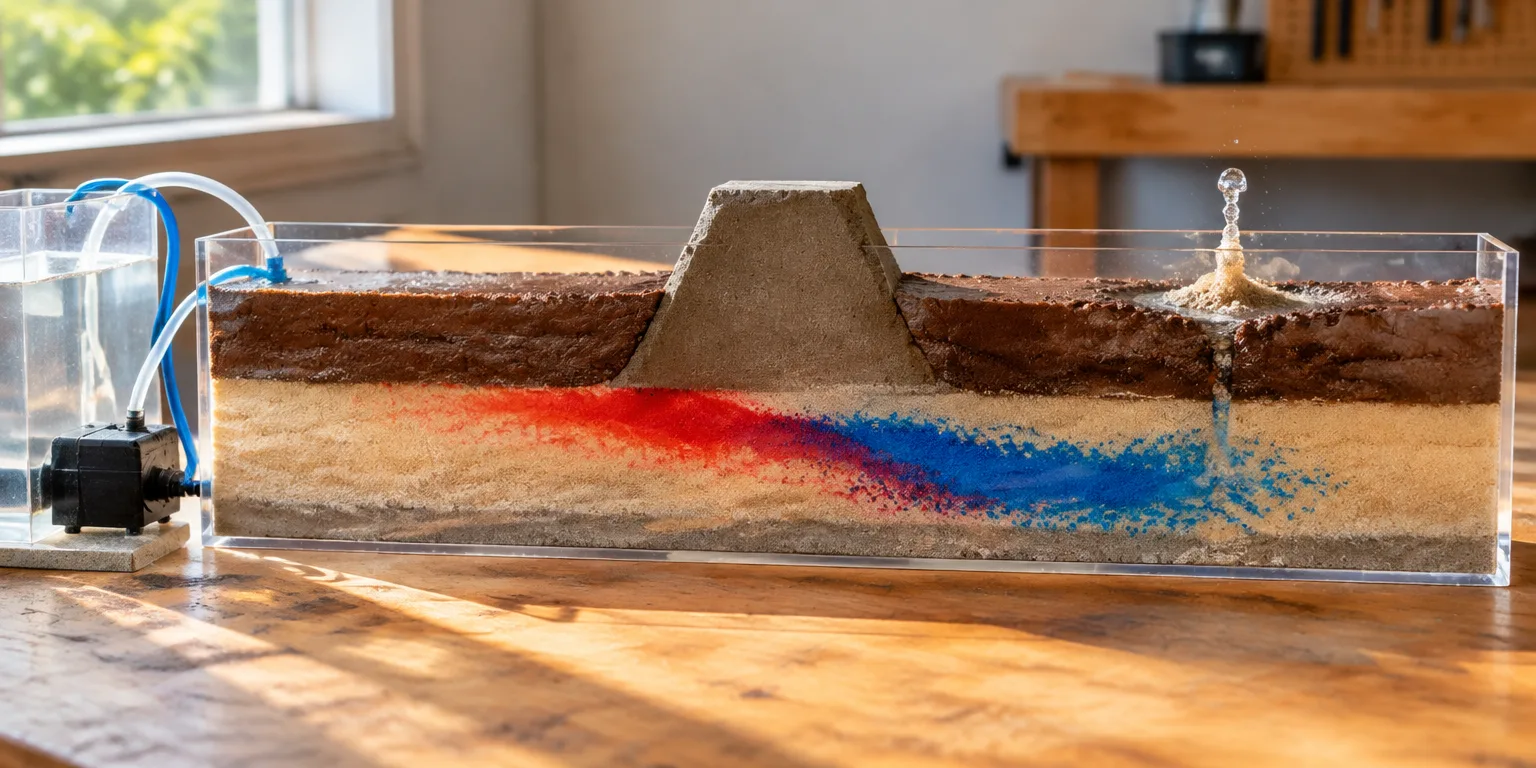
From above, the levee looks like it is winning. The wall holds, and the homes on the dry side stay dry. Below ground, it is losing. In a tabletop model made with soil, solid dye tablets, and a pump, color creeps through the foundation toward the protected side even while the wall itself stands firm. Levees are not just piles of dirt. They have to withstand what happens out of sight.
What happens is pressure. Think of soil as a pile of marbles. Squeeze the marbles together and they lock, and the pile resists sliding. Force water between them and they drift apart, and the whole mass gets weaker. Surge water piled high on one side of a levee pushes into the ground and keeps some of that pressure on the dry side, quietly loosening the soil that is supposed to hold the wall up.
Layers in the ground can concentrate that danger. Along one stretch of canal in New Orleans, a levee sat on a thin sheet of marshy clay over a deep layer of sand that water could move through easily. Water moved easily through the sand but not through the clay, so pressure bunched up right where the water tried to exit behind the levee. Engineers call that a steep exit gradient, and it means the upward push beneath a block of soil is much stronger than the push on top of it.
That difference pushes upward. If the upward push exceeds the weight of the soil, the ground lifts. At that canal, pressure blew a hole through the marsh layer, and the escaping water then scoured out what Grady, who built the tabletop model to explain the failure, described as "a mountain of sand from the foundation," grain by grain. Photos later showed a neighborhood covered in what looked like beach sand. With its support eroded, the wall lost support and collapsed, the levee opened, and the full force of the lake came through. The wall did not fail from the top down. It was undermined from below.
Questions people ask
What does that underground failure look like before a levee breaks?
The classic warning is a sand boil, a small fountain of water and sand bubbling up on the dry side. It means seepage is carrying soil particles out from under the levee. A few small boils can be normal during a flood, but growing or cloudy boils signal that piping erosion is underway.
How do engineers stop water from undermining a levee?
They lengthen the underground path water must travel or give pressure a safe outlet. Common fixes are deeper steel or concrete cutoff walls, wider earthen berms on the dry side, and relief wells that let pressurized water out without carrying soil with it. All three lower the exit gradient where water leaves the ground.
Why is a clay layer over sand especially risky?
Sand lets water pass easily, while clay blocks it, so pressure builds beneath the clay instead of dissipating gradually. That creates a sharp pressure change across a short distance. When the upward force exceeds the weight of the thin clay cap, the cap cracks or lifts, releasing the pressure all at once.